 Add to Chrome
 Add to Firefox
 Add to Edge
3PoinTr: 3D Point Tracks for Robot Manipulation Pretraining from Casual Videos
Mar 09, 2026
Data-efficient training of robust robot policies is the key to unlocking automation in a wide array of novel tasks. Current systems require large volumes of demonstrations to achieve robustness, which is impractical in many applications. Learning policies directly from human videos is a promising alternative that removes teleoperation costs, but it shifts the challenge toward overcoming the embodiment gap (differences in kinematics and strategies between robots and humans), often requiring restrictive and carefully choreographed human motions. We propose 3PoinTr, a method for pretraining robot policies from casual and unconstrained human videos, enabling learning from motions natural for humans. 3PoinTr uses a transformer architecture to predict 3D point tracks as an intermediate embodiment-agnostic representation. 3D point tracks encode goal specifications, scene geometry, and spatiotemporal relationships. We use a Perceiver IO architecture to extract a compact representation for sample-efficient behavior cloning, even when point tracks violate downstream embodiment-specific constraints. We conduct thorough evaluation on simulated and real-world tasks, and find that 3PoinTr achieves robust spatial generalization on diverse categories of manipulation tasks with only 20 action-labeled robot demonstrations. 3PoinTr outperforms the baselines, including behavior cloning methods, as well as prior methods for pretraining from human videos. We also provide evaluations of 3PoinTr's 3D point track predictions compared to an existing point track prediction baseline. We find that 3PoinTr produces more accurate and higher quality point tracks due to a lightweight yet expressive architecture built on a single transformer, in addition to a training formulation that preserves supervision of partially occluded points. Project page: https://adamhung60.github.io/3PoinTr/.

MapExRL: Human-Inspired Indoor Exploration with Predicted Environment Context and Reinforcement Learning
Mar 03, 2025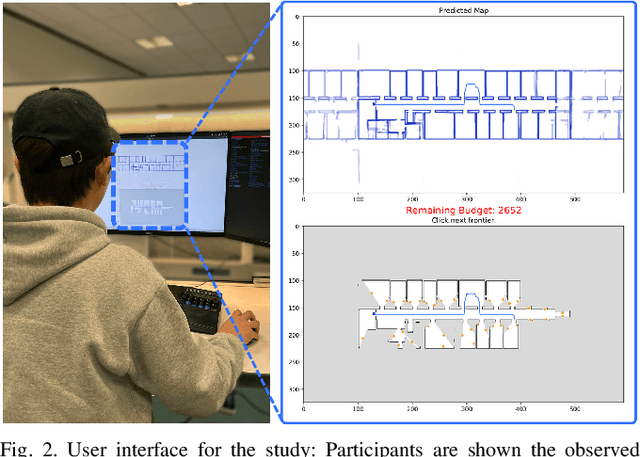
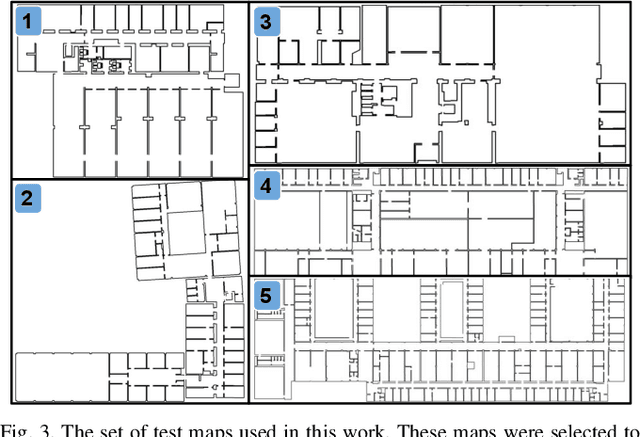
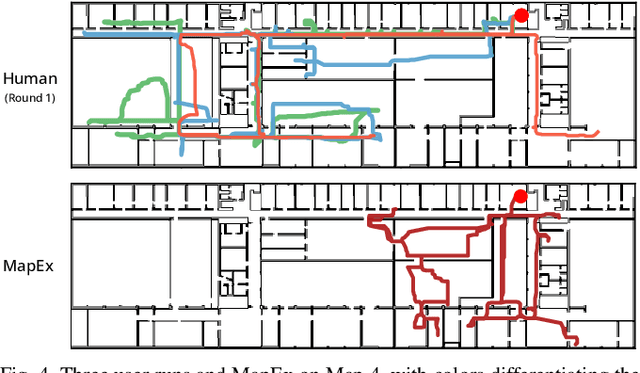
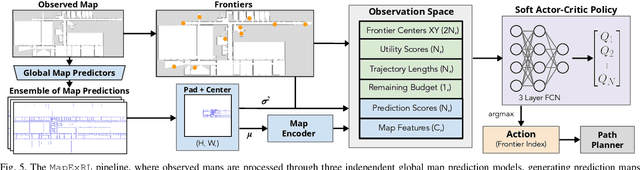
Path planning for robotic exploration is challenging, requiring reasoning over unknown spaces and anticipating future observations. Efficient exploration requires selecting budget-constrained paths that maximize information gain. Despite advances in autonomous exploration, existing algorithms still fall short of human performance, particularly in structured environments where predictive cues exist but are underutilized. Guided by insights from our user study, we introduce MapExRL, which improves robot exploration efficiency in structured indoor environments by enabling longer-horizon planning through reinforcement learning (RL) and global map predictions. Unlike many RL-based exploration methods that use motion primitives as the action space, our approach leverages frontiers for more efficient model learning and longer horizon reasoning. Our framework generates global map predictions from the observed map, which our policy utilizes, along with the prediction uncertainty, estimated sensor coverage, frontier distance, and remaining distance budget, to assess the strategic long-term value of frontiers. By leveraging multiple frontier scoring methods and additional context, our policy makes more informed decisions at each stage of the exploration. We evaluate our framework on a real-world indoor map dataset, achieving up to an 18.8% improvement over the strongest state-of-the-art baseline, with even greater gains compared to conventional frontier-based algorithms.
RoPotter: Toward Robotic Pottery and Deformable Object Manipulation with Structural Priors
Aug 05, 2024Humans are capable of continuously manipulating a wide variety of deformable objects into complex shapes. This is made possible by our intuitive understanding of material properties and mechanics of the object, for reasoning about object states even when visual perception is occluded. These capabilities allow us to perform diverse tasks ranging from cooking with dough to expressing ourselves with pottery-making. However, developing robotic systems to robustly perform similar tasks remains challenging, as current methods struggle to effectively model volumetric deformable objects and reason about the complex behavior they typically exhibit. To study the robotic systems and algorithms capable of deforming volumetric objects, we introduce a novel robotics task of continuously deforming clay on a pottery wheel. We propose a pipeline for perception and pottery skill-learning, called RoPotter, wherein we demonstrate that structural priors specific to the task of pottery-making can be exploited to simplify the pottery skill-learning process. Namely, we can project the cross-section of the clay to a plane to represent the state of the clay, reducing dimensionality. We also demonstrate a mesh-based method of occluded clay state recovery, toward robotic agents capable of continuously deforming clay. Our experiments show that by using the reduced representation with structural priors based on the deformation behaviors of the clay, RoPotter can perform the long-horizon pottery task with 44.4% lower final shape error compared to the state-of-the-art baselines.