 Add to Chrome
 Add to Firefox
 Add to Edge
ContractionPPO: Certified Reinforcement Learning via Differentiable Contraction Layers
Mar 20, 2026
Legged locomotion in unstructured environments demands not only high-performance control policies but also formal guarantees to ensure robustness under perturbations. Control methods often require carefully designed reference trajectories, which are challenging to construct in high-dimensional, contact-rich systems such as quadruped robots. In contrast, Reinforcement Learning (RL) directly learns policies that implicitly generate motion, and uniquely benefits from access to privileged information, such as full state and dynamics during training, that is not available at deployment. We present ContractionPPO, a framework for certified robust planning and control of legged robots by augmenting Proximal Policy Optimization (PPO) RL with a state-dependent contraction metric layer. This approach enables the policy to maximize performance while simultaneously producing a contraction metric that certifies incremental exponential stability of the simulated closed-loop system. The metric is parameterized as a Lipschitz neural network and trained jointly with the policy, either in parallel or as an auxiliary head of the PPO backbone. While the contraction metric is not deployed during real-world execution, we derive upper bounds on the worst-case contraction rate and show that these bounds ensure the learned contraction metric generalizes from simulation to real-world deployment. Our hardware experiments on quadruped locomotion demonstrate that ContractionPPO enables robust, certifiably stable control even under strong external perturbations.

MapExRL: Human-Inspired Indoor Exploration with Predicted Environment Context and Reinforcement Learning
Mar 03, 2025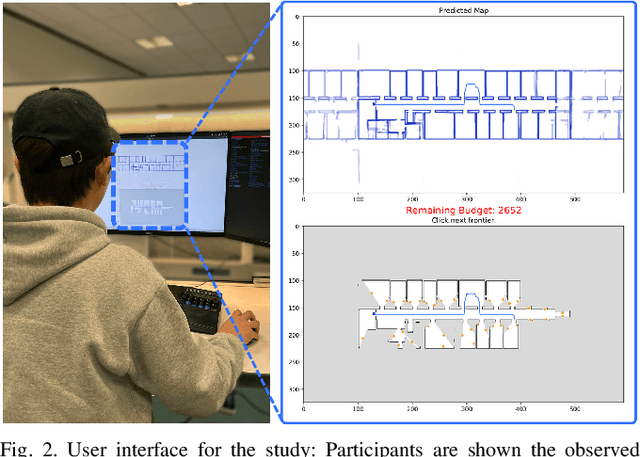
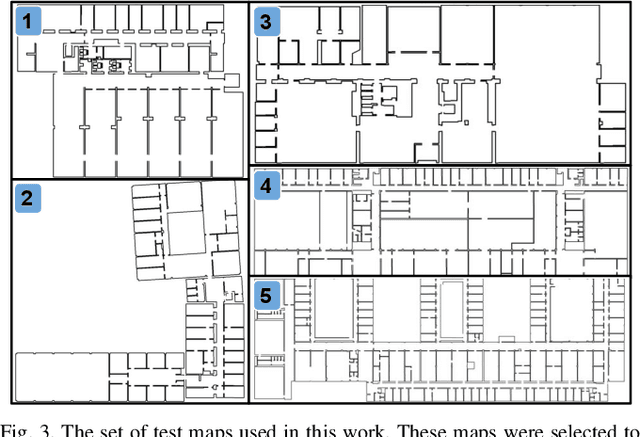
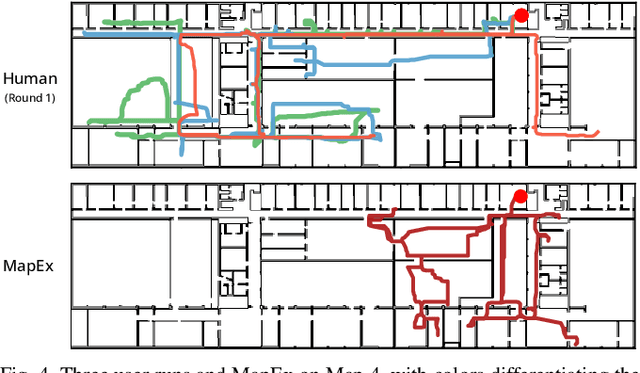
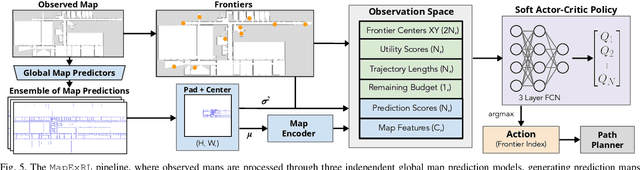
Path planning for robotic exploration is challenging, requiring reasoning over unknown spaces and anticipating future observations. Efficient exploration requires selecting budget-constrained paths that maximize information gain. Despite advances in autonomous exploration, existing algorithms still fall short of human performance, particularly in structured environments where predictive cues exist but are underutilized. Guided by insights from our user study, we introduce MapExRL, which improves robot exploration efficiency in structured indoor environments by enabling longer-horizon planning through reinforcement learning (RL) and global map predictions. Unlike many RL-based exploration methods that use motion primitives as the action space, our approach leverages frontiers for more efficient model learning and longer horizon reasoning. Our framework generates global map predictions from the observed map, which our policy utilizes, along with the prediction uncertainty, estimated sensor coverage, frontier distance, and remaining distance budget, to assess the strategic long-term value of frontiers. By leveraging multiple frontier scoring methods and additional context, our policy makes more informed decisions at each stage of the exploration. We evaluate our framework on a real-world indoor map dataset, achieving up to an 18.8% improvement over the strongest state-of-the-art baseline, with even greater gains compared to conventional frontier-based algorithms.