 Add to Chrome
 Add to Firefox
 Add to Edge
Discovering Functionally Selective Brain Regions with a Deep Topographic Multimodal Model
Jun 08, 2026
Nearby neurons in cortex share similar response profiles, producing systematic spatial organization across sensory and cognitive systems. Recent topographic models reproduce aspects of this structure but remain unimodal and spatially constrain each layer separately, yielding fragmented maps that capture neither the contiguity of cortical processing streams nor their integration across modalities. We introduce Topo-Omni, a topographic multimodal model in which visual, auditory, and language/cognitive processing share a single contiguous in-silico sheet. Built by fine-tuning a pretrained foundation model with a spatial smoothness objective, this architecture develops clusters across modalities that are consistent with human neuroimaging, from sensory to cognitive systems. Driving or suppressing a cluster selectively biases or impairs perception, paralleling human intervention studies. Finally, we use our model to screen for novel clusters in-silico and discover new natural landscape and animal networks which we validate in human data. A single spatial principle thus organizes representations across modalities and processing stages, yielding testable hypotheses about cortical organization.

MIRAGE: Adaptive Multimodal Gating for Whole-Brain fMRI Encoding
May 28, 2026Recent progress in task-optimized neural networks has established encoding models as a powerful tool for predicting brain responses to naturalistic stimuli, yet most existing approaches rely on unimodal representations. The emergence of omni-modal foundation models and rich multimodal neural datasets enables encoding models that jointly integrate visual, auditory, and linguistic information across subjects. We introduce MIRAGE, a brain encoding framework for predicting whole-brain fMRI responses to naturalistic audiovisual stimuli. MIRAGE achieves state-of-the-art performance via a native multimodal backbone and adaptive feature gating across layers. These representations are then combined with a transformer-based brain encoder and a subject-specific linear head over the cortical parcels. Controlled comparisons show that natively multimodal features consistently outperform post-hoc aggregation of independent unimodal features, across architectural levels and backbones. Beyond predictive accuracy, the learned attention weights are directly inspectable to interpret the modality-specific gating profile over the backbone, and each modality traces a distinct anatomical pattern across cortex. Together, these results propose adaptive layer-wise aggregation of natively multimodal features as a generalizable, interpretable, and accurate approach for whole-brain encoding.
Large Language Models Align with the Human Brain during Creative Thinking
Apr 03, 2026Creative thinking is a fundamental aspect of human cognition, and divergent thinking-the capacity to generate novel and varied ideas-is widely regarded as its core generative engine. Large language models (LLMs) have recently demonstrated impressive performance on divergent thinking tests and prior work has shown that models with higher task performance tend to be more aligned to human brain activity. However, existing brain-LLM alignment studies have focused on passive, non-creative tasks. Here, we explore brain alignment during creative thinking using fMRI data from 170 participants performing the Alternate Uses Task (AUT). We extract representations from LLMs varying in size (270M-72B) and measure alignment to brain responses via Representational Similarity Analysis (RSA), targeting the creativity-related default mode and frontoparietal networks. We find that brain-LLM alignment scales with model size (default mode network only) and idea originality (both networks), with effects strongest early in the creative process. We further show that post-training objectives shape alignment in functionally selective ways: a creativity-optimized \texttt{Llama-3.1-8B-Instruct} preserves alignment with high-creativity neural responses while reducing alignment with low-creativity ones; a human behavior fine-tuned model elevates alignment with both; and a reasoning-trained variant shows the opposite pattern, suggesting chain-of-thought training steers representations away from creative neural geometry toward analytical processing. These results demonstrate that post-training objectives selectively reshape LLM representations relative to the neural geometry of human creative thought.
Contour Integration Underlies Human-Like Vision
Apr 07, 2025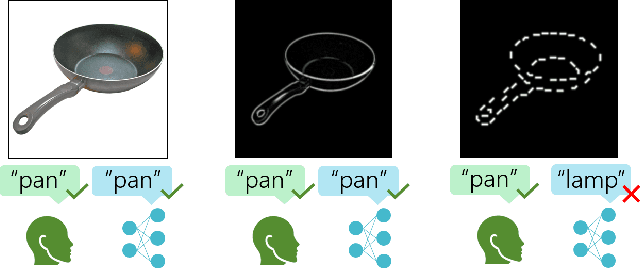
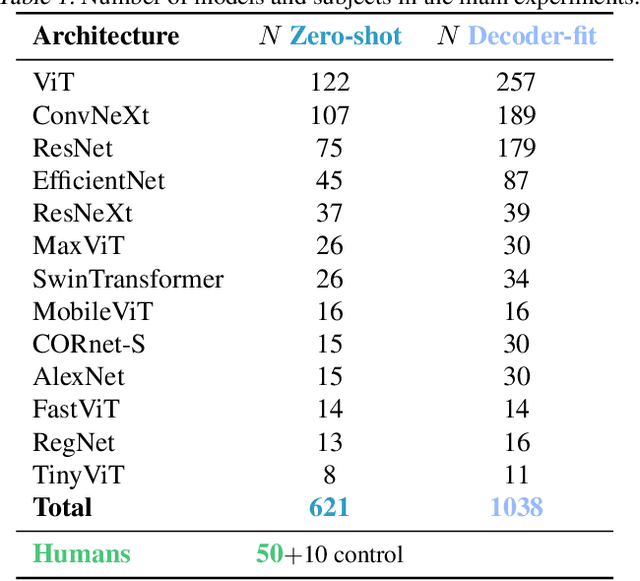
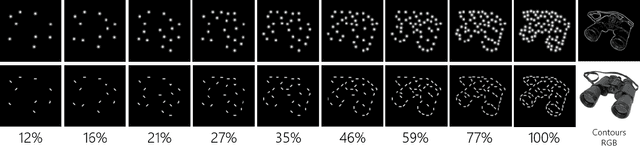
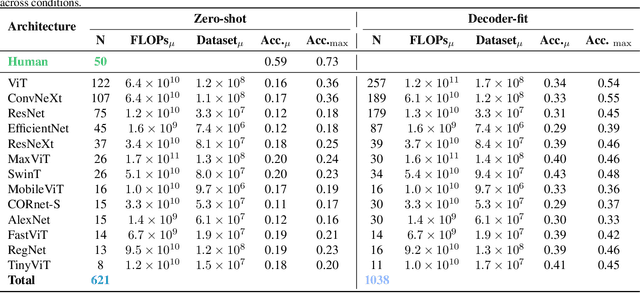
Despite the tremendous success of deep learning in computer vision, models still fall behind humans in generalizing to new input distributions. Existing benchmarks do not investigate the specific failure points of models by analyzing performance under many controlled conditions. Our study systematically dissects where and why models struggle with contour integration -- a hallmark of human vision -- by designing an experiment that tests object recognition under various levels of object fragmentation. Humans (n=50) perform at high accuracy, even with few object contours present. This is in contrast to models which exhibit substantially lower sensitivity to increasing object contours, with most of the over 1,000 models we tested barely performing above chance. Only at very large scales ($\sim5B$ training dataset size) do models begin to approach human performance. Importantly, humans exhibit an integration bias -- a preference towards recognizing objects made up of directional fragments over directionless fragments. We find that not only do models that share this property perform better at our task, but that this bias also increases with model training dataset size, and training models to exhibit contour integration leads to high shape bias. Taken together, our results suggest that contour integration is a hallmark of object vision that underlies object recognition performance, and may be a mechanism learned from data at scale.
Scaling Laws for Task-Optimized Models of the Primate Visual Ventral Stream
Nov 08, 2024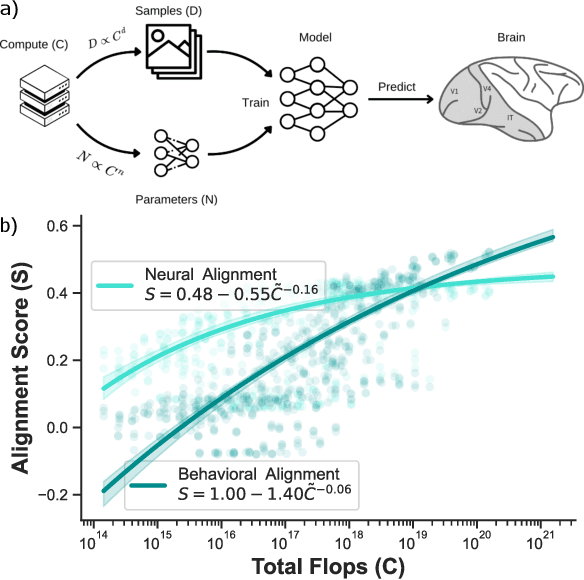
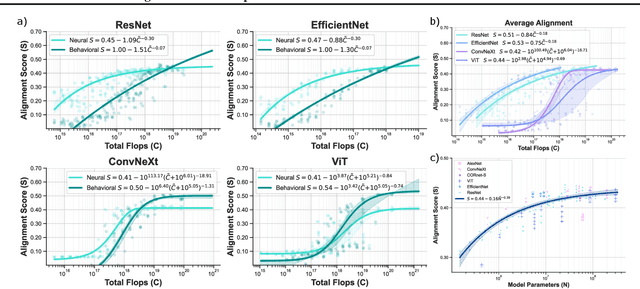
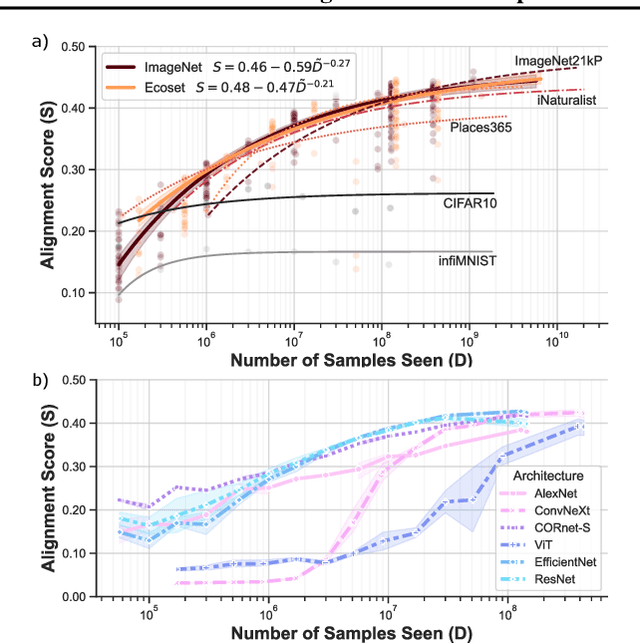
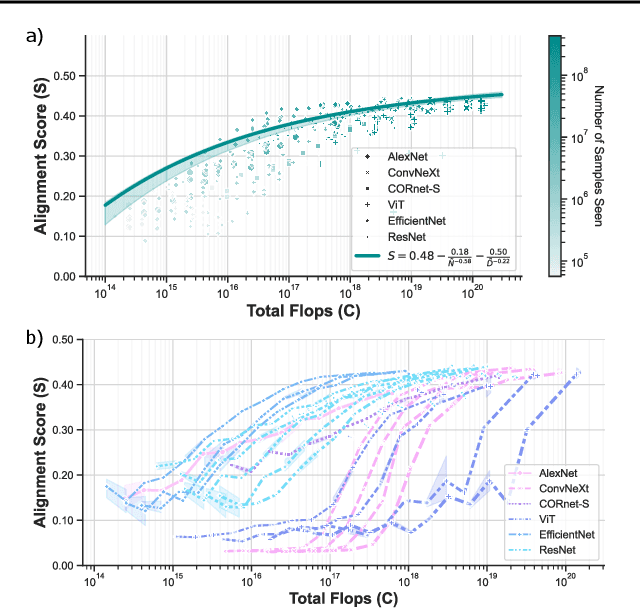
When trained on large-scale object classification datasets, certain artificial neural network models begin to approximate core object recognition (COR) behaviors and neural response patterns in the primate visual ventral stream (VVS). While recent machine learning advances suggest that scaling model size, dataset size, and compute resources improve task performance, the impact of scaling on brain alignment remains unclear. In this study, we explore scaling laws for modeling the primate VVS by systematically evaluating over 600 models trained under controlled conditions on benchmarks spanning V1, V2, V4, IT and COR behaviors. We observe that while behavioral alignment continues to scale with larger models, neural alignment saturates. This observation remains true across model architectures and training datasets, even though models with stronger inductive bias and datasets with higher-quality images are more compute-efficient. Increased scaling is especially beneficial for higher-level visual areas, where small models trained on few samples exhibit only poor alignment. Finally, we develop a scaling recipe, indicating that a greater proportion of compute should be allocated to data samples over model size. Our results suggest that while scaling alone might suffice for alignment with human core object recognition behavior, it will not yield improved models of the brain's visual ventral stream with current architectures and datasets, highlighting the need for novel strategies in building brain-like models.
EndoL2H: Deep Super-Resolution for Capsule Endoscopy
Feb 13, 2020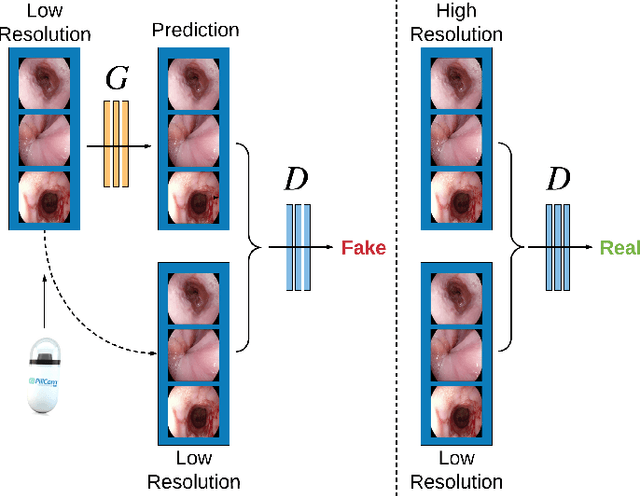
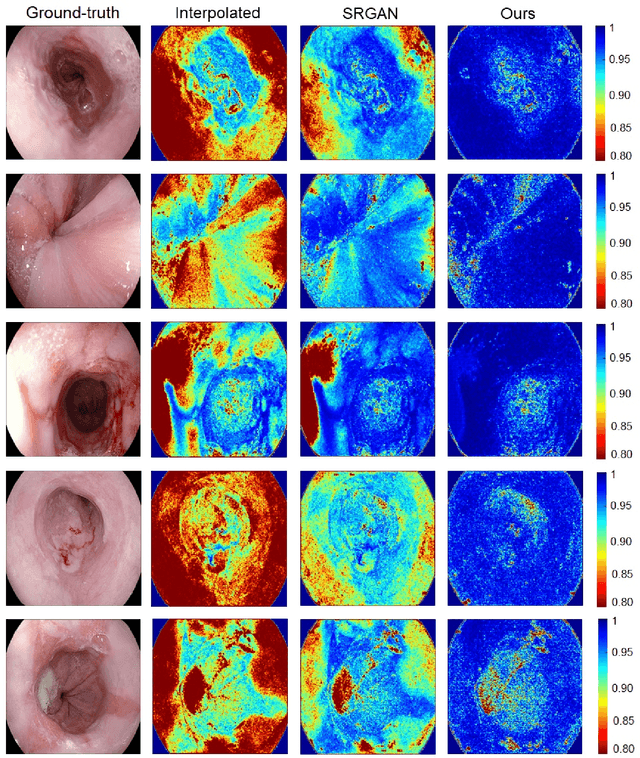
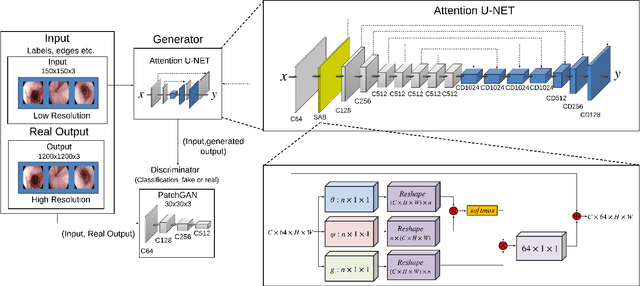
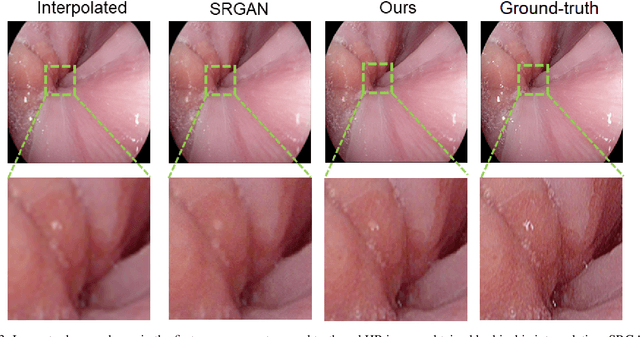
Wireless capsule endoscopy is the preferred modality for diagnosis and assessment of small bowel disease. However, the poor resolution is a limitation for both subjective and automated diagnostics. Enhanced-resolution endoscopy has shown to improve adenoma detection rate for conventional endoscopy and is likely to do the same for capsule endoscopy. In this work, we propose and quantitatively validate a novel framework to learn a mapping from low-to-high resolution endoscopic images. We use conditional adversarial networks and spatial attention to improve the resolution by up to a factor of 8x. Our quantitative study demonstrates the superiority of our proposed approach over Super-Resolution Generative Adversarial Network (SRGAN) and bicubic interpolation. For qualitative analysis, visual Turing tests were performed by 16 gastroenterologists to confirm the clinical utility of the proposed approach. Our approach is generally applicable to any endoscopic capsule system and has the potential to improve diagnosis and better harness computational approaches for polyp detection and characterization. Our code and trained models are available at https://github.com/akgokce/EndoL2H.