 Add to Chrome
 Add to Firefox
 Add to Edge
Large Language Models Align with the Human Brain during Creative Thinking
Apr 03, 2026
Creative thinking is a fundamental aspect of human cognition, and divergent thinking-the capacity to generate novel and varied ideas-is widely regarded as its core generative engine. Large language models (LLMs) have recently demonstrated impressive performance on divergent thinking tests and prior work has shown that models with higher task performance tend to be more aligned to human brain activity. However, existing brain-LLM alignment studies have focused on passive, non-creative tasks. Here, we explore brain alignment during creative thinking using fMRI data from 170 participants performing the Alternate Uses Task (AUT). We extract representations from LLMs varying in size (270M-72B) and measure alignment to brain responses via Representational Similarity Analysis (RSA), targeting the creativity-related default mode and frontoparietal networks. We find that brain-LLM alignment scales with model size (default mode network only) and idea originality (both networks), with effects strongest early in the creative process. We further show that post-training objectives shape alignment in functionally selective ways: a creativity-optimized \texttt{Llama-3.1-8B-Instruct} preserves alignment with high-creativity neural responses while reducing alignment with low-creativity ones; a human behavior fine-tuned model elevates alignment with both; and a reasoning-trained variant shows the opposite pattern, suggesting chain-of-thought training steers representations away from creative neural geometry toward analytical processing. These results demonstrate that post-training objectives selectively reshape LLM representations relative to the neural geometry of human creative thought.

Creative Preference Optimization
May 20, 2025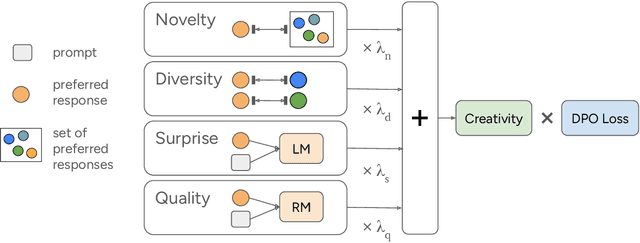
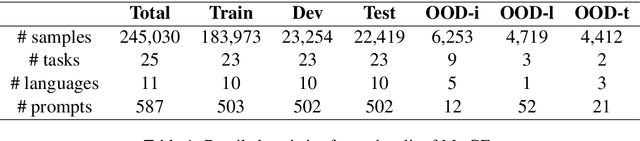
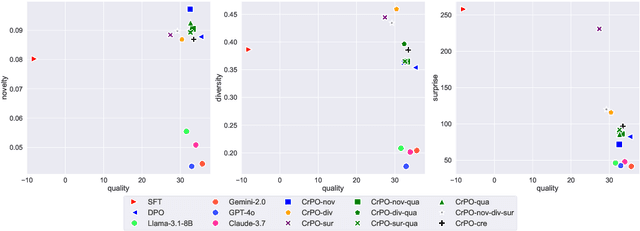
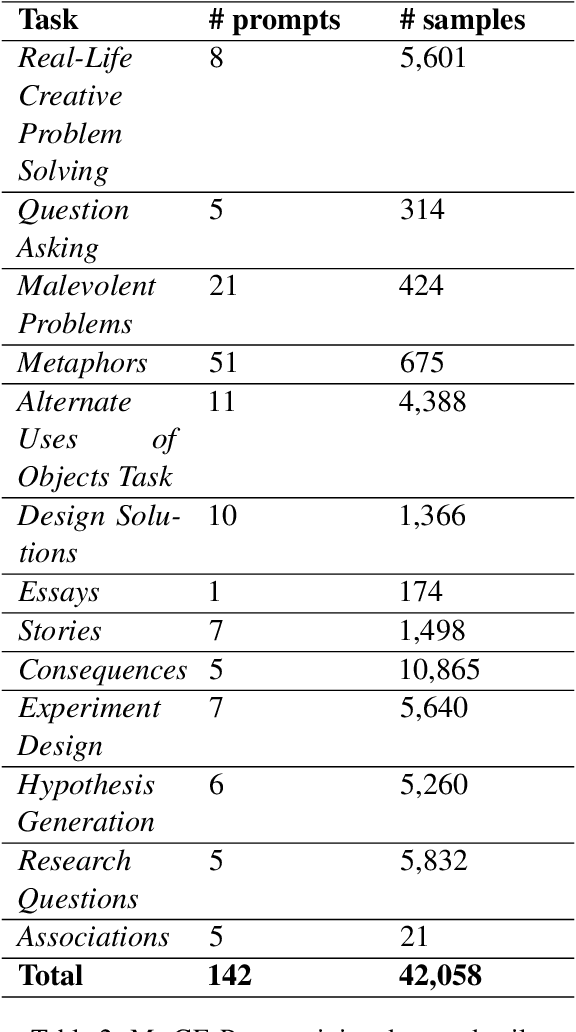
While Large Language Models (LLMs) have demonstrated impressive performance across natural language generation tasks, their ability to generate truly creative content-characterized by novelty, diversity, surprise, and quality-remains limited. Existing methods for enhancing LLM creativity often focus narrowly on diversity or specific tasks, failing to address creativity's multifaceted nature in a generalizable way. In this work, we propose Creative Preference Optimization (CrPO), a novel alignment method that injects signals from multiple creativity dimensions into the preference optimization objective in a modular fashion. We train and evaluate creativity-augmented versions of several models using CrPO and MuCE, a new large-scale human preference dataset spanning over 200,000 human-generated responses and ratings from more than 30 psychological creativity assessments. Our models outperform strong baselines, including GPT-4o, on both automated and human evaluations, producing more novel, diverse, and surprising generations while maintaining high output quality. Additional evaluations on NoveltyBench further confirm the generalizability of our approach. Together, our results demonstrate that directly optimizing for creativity within preference frameworks is a promising direction for advancing the creative capabilities of LLMs without compromising output quality.