 Add to Chrome
 Add to Firefox
 Add to Edge
Self Supervised Image Classification
Papers and Code
Supervised Contrastive Frame Aggregation for Video Representation Learning
Dec 14, 2025
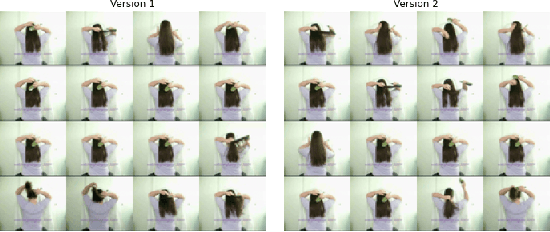
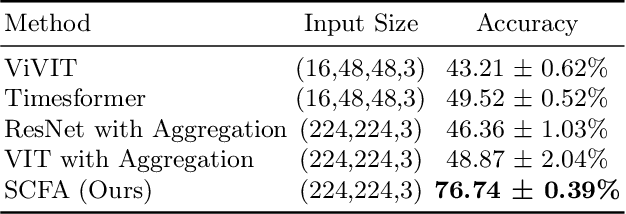
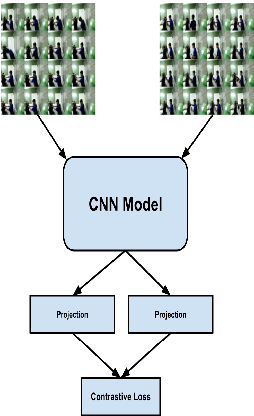
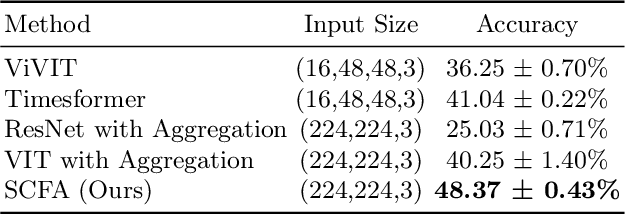
We propose a supervised contrastive learning framework for video representation learning that leverages temporally global context. We introduce a video to image aggregation strategy that spatially arranges multiple frames from each video into a single input image. This design enables the use of pre trained convolutional neural network backbones such as ResNet50 and avoids the computational overhead of complex video transformer models. We then design a contrastive learning objective that directly compares pairwise projections generated by the model. Positive pairs are defined as projections from videos sharing the same label while all other projections are treated as negatives. Multiple natural views of the same video are created using different temporal frame samplings from the same underlying video. Rather than relying on data augmentation these frame level variations produce diverse positive samples with global context and reduce overfitting. Experiments on the Penn Action and HMDB51 datasets demonstrate that the proposed method outperforms existing approaches in classification accuracy while requiring fewer computational resources. The proposed Supervised Contrastive Frame Aggregation method learns effective video representations in both supervised and self supervised settings and supports video based tasks such as classification and captioning. The method achieves seventy six percent classification accuracy on Penn Action compared to forty three percent achieved by ViVIT and forty eight percent accuracy on HMDB51 compared to thirty seven percent achieved by ViVIT.

StainNet: A Special Staining Self-Supervised Vision Transformer for Computational Pathology
Dec 11, 2025Foundation models trained with self-supervised learning (SSL) on large-scale histological images have significantly accelerated the development of computational pathology. These models can serve as backbones for region-of-interest (ROI) image analysis or patch-level feature extractors in whole-slide images (WSIs) based on multiple instance learning (MIL). Existing pathology foundation models (PFMs) are typically pre-trained on Hematoxylin-Eosin (H&E) stained pathology images. However, images with special stains, such as immunohistochemistry, are also frequently used in clinical practice. PFMs pre-trained mainly on H\&E-stained images may be limited in clinical applications involving special stains. To address this issue, we propose StainNet, a specialized foundation model for special stains based on the vision transformer (ViT) architecture. StainNet adopts a self-distillation SSL approach and is trained on over 1.4 million patch images cropping from 20,231 publicly available special staining WSIs in the HISTAI database. To evaluate StainNet, we conduct experiments on an in-house slide-level liver malignancy classification task and two public ROI-level datasets to demonstrate its strong ability. We also perform few-ratio learning and retrieval evaluations, and compare StainNet with recently larger PFMs to further highlight its strengths. We have released the StainNet model weights at: https://huggingface.co/JWonderLand/StainNet.
Local K-Similarity Constraint for Federated Learning with Label Noise
Nov 09, 2025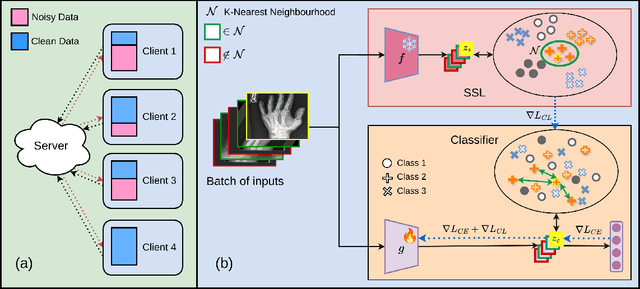
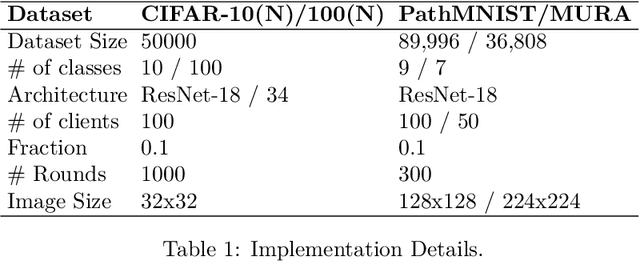
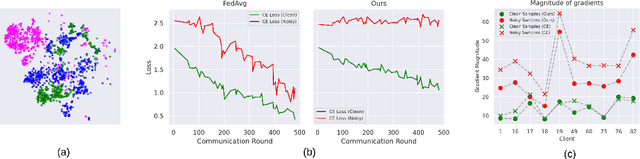
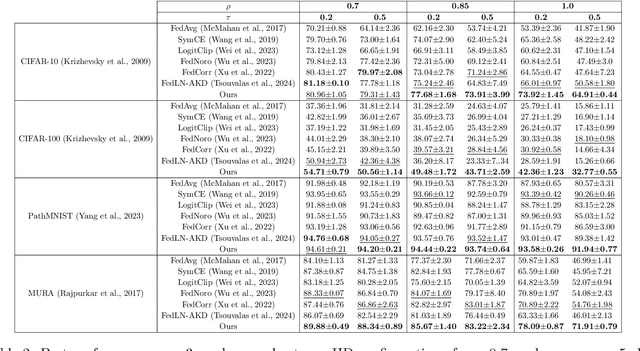
Federated learning on clients with noisy labels is a challenging problem, as such clients can infiltrate the global model, impacting the overall generalizability of the system. Existing methods proposed to handle noisy clients assume that a sufficient number of clients with clean labels are available, which can be leveraged to learn a robust global model while dampening the impact of noisy clients. This assumption fails when a high number of heterogeneous clients contain noisy labels, making the existing approaches ineffective. In such scenarios, it is important to locally regularize the clients before communication with the global model, to ensure the global model isn't corrupted by noisy clients. While pre-trained self-supervised models can be effective for local regularization, existing centralized approaches relying on pretrained initialization are impractical in a federated setting due to the potentially large size of these models, which increases communication costs. In that line, we propose a regularization objective for client models that decouples the pre-trained and classification models by enforcing similarity between close data points within the client. We leverage the representation space of a self-supervised pretrained model to evaluate the closeness among examples. This regularization, when applied with the standard objective function for the downstream task in standard noisy federated settings, significantly improves performance, outperforming existing state-of-the-art federated methods in multiple computer vision and medical image classification benchmarks. Unlike other techniques that rely on self-supervised pretrained initialization, our method does not require the pretrained model and classifier backbone to share the same architecture, making it architecture-agnostic.
Multimodal Wireless Foundation Models
Nov 19, 2025Wireless foundation models (WFMs) have recently demonstrated promising capabilities, jointly performing multiple wireless functions and adapting effectively to new environments. However, while current WFMs process only one modality, depending on the task and operating conditions, the most informative modality changes and no single modality is best for all tasks. WFMs should therefore be designed to accept multiple modalities to enable a broader and more diverse range of tasks and scenarios. In this work, we propose and build the first multimodal wireless foundation model capable of processing both raw IQ streams and image-like wireless modalities (e.g., spectrograms and CSI) and performing multiple tasks across both. We introduce masked wireless modeling for the multimodal setting, a self-supervised objective and pretraining recipe that learns a joint representation from IQ streams and image-like wireless modalities. We evaluate the model on five tasks across both modality families: image-based (human activity sensing, RF signal classification, 5G NR positioning) and IQ-based (RF device fingerprinting, interference detection/classification). The multimodal WFM is competitive with single-modality WFMs, and in several cases surpasses their performance. Our results demonstrates the strong potential of developing multimodal WFMs that support diverse wireless tasks across different modalities. We believe this provides a concrete step toward both AI-native 6G and the vision of joint sensing, communication, and localization.
Deep Learning Analysis of Prenatal Ultrasound for Identification of Ventriculomegaly
Nov 11, 2025The proposed study aimed to develop a deep learning model capable of detecting ventriculomegaly on prenatal ultrasound images. Ventriculomegaly is a prenatal condition characterized by dilated cerebral ventricles of the fetal brain and is important to diagnose early, as it can be associated with an increased risk for fetal aneuploidies and/or underlying genetic syndromes. An Ultrasound Self-Supervised Foundation Model with Masked Autoencoding (USF-MAE), recently developed by our group, was fine-tuned for a binary classification task to distinguish fetal brain ultrasound images as either normal or showing ventriculomegaly. The USF-MAE incorporates a Vision Transformer encoder pretrained on more than 370,000 ultrasound images from the OpenUS-46 corpus. For this study, the pretrained encoder was adapted and fine-tuned on a curated dataset of fetal brain ultrasound images to optimize its performance for ventriculomegaly detection. Model evaluation was conducted using 5-fold cross-validation and an independent test cohort, and performance was quantified using accuracy, precision, recall, specificity, F1-score, and area under the receiver operating characteristic curve (AUC). The proposed USF-MAE model reached an F1-score of 91.76% on the 5-fold cross-validation and 91.78% on the independent test set, with much higher scores than those obtained by the baseline models by 19.37% and 16.15% compared to VGG-19, 2.31% and 2.56% compared to ResNet-50, and 5.03% and 11.93% compared to ViT-B/16, respectively. The model also showed a high mean test precision of 94.47% and an accuracy of 97.24%. The Eigen-CAM (Eigen Class Activation Map) heatmaps showed that the model was focusing on the ventricle area for the diagnosis of ventriculomegaly, which has explainability and clinical plausibility.
Visual Bridge: Universal Visual Perception Representations Generating
Nov 11, 2025Recent advances in diffusion models have achieved remarkable success in isolated computer vision tasks such as text-to-image generation, depth estimation, and optical flow. However, these models are often restricted by a ``single-task-single-model'' paradigm, severely limiting their generalizability and scalability in multi-task scenarios. Motivated by the cross-domain generalization ability of large language models, we propose a universal visual perception framework based on flow matching that can generate diverse visual representations across multiple tasks. Our approach formulates the process as a universal flow-matching problem from image patch tokens to task-specific representations rather than an independent generation or regression problem. By leveraging a strong self-supervised foundation model as the anchor and introducing a multi-scale, circular task embedding mechanism, our method learns a universal velocity field to bridge the gap between heterogeneous tasks, supporting efficient and flexible representation transfer. Extensive experiments on classification, detection, segmentation, depth estimation, and image-text retrieval demonstrate that our model achieves competitive performance in both zero-shot and fine-tuned settings, outperforming prior generalist and several specialist models. Ablation studies further validate the robustness, scalability, and generalization of our framework. Our work marks a significant step towards general-purpose visual perception, providing a solid foundation for future research in universal vision modeling.
Learning to See Through a Baby's Eyes: Early Visual Diets Enable Robust Visual Intelligence in Humans and Machines
Nov 18, 2025Newborns perceive the world with low-acuity, color-degraded, and temporally continuous vision, which gradually sharpens as infants develop. To explore the ecological advantages of such staged "visual diets", we train self-supervised learning (SSL) models on object-centric videos under constraints that simulate infant vision: grayscale-to-color (C), blur-to-sharp (A), and preserved temporal continuity (T)-collectively termed CATDiet. For evaluation, we establish a comprehensive benchmark across ten datasets, covering clean and corrupted image recognition, texture-shape cue conflict tests, silhouette recognition, depth-order classification, and the visual cliff paradigm. All CATDiet variants demonstrate enhanced robustness in object recognition, despite being trained solely on object-centric videos. Remarkably, models also exhibit biologically aligned developmental patterns, including neural plasticity changes mirroring synaptic density in macaque V1 and behaviors resembling infants' visual cliff responses. Building on these insights, CombDiet initializes SSL with CATDiet before standard training while preserving temporal continuity. Trained on object-centric or head-mounted infant videos, CombDiet outperforms standard SSL on both in-domain and out-of-domain object recognition and depth perception. Together, these results suggest that the developmental progression of early infant visual experience offers a powerful reverse-engineering framework for understanding the emergence of robust visual intelligence in machines. All code, data, and models will be publicly released.
Quantum Machine Learning via Contrastive Training
Nov 17, 2025Quantum machine learning (QML) has attracted growing interest with the rapid parallel advances in large-scale classical machine learning and quantum technologies. Similar to classical machine learning, QML models also face challenges arising from the scarcity of labeled data, particularly as their scale and complexity increase. Here, we introduce self-supervised pretraining of quantum representations that reduces reliance on labeled data by learning invariances from unlabeled examples. We implement this paradigm on a programmable trapped-ion quantum computer, encoding images as quantum states. In situ contrastive pretraining on hardware yields a representation that, when fine-tuned, classifies image families with higher mean test accuracy and lower run-to-run variability than models trained from random initialization. Performance improvement is especially significant in regimes with limited labeled training data. We show that the learned invariances generalize beyond the pretraining image samples. Unlike prior work, our pipeline derives similarity from measured quantum overlaps and executes all training and classification stages on hardware. These results establish a label-efficient route to quantum representation learning, with direct relevance to quantum-native datasets and a clear path to larger classical inputs.
TSE-Net: Semi-supervised Monocular Height Estimation from Single Remote Sensing Images
Nov 17, 2025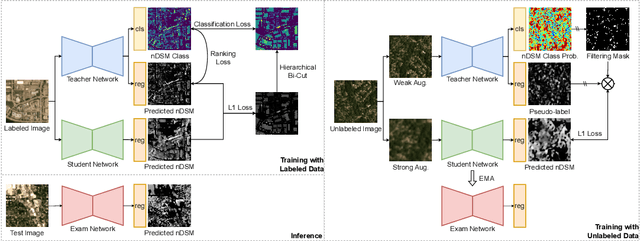
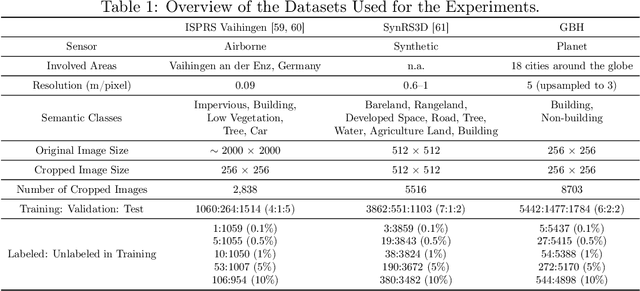
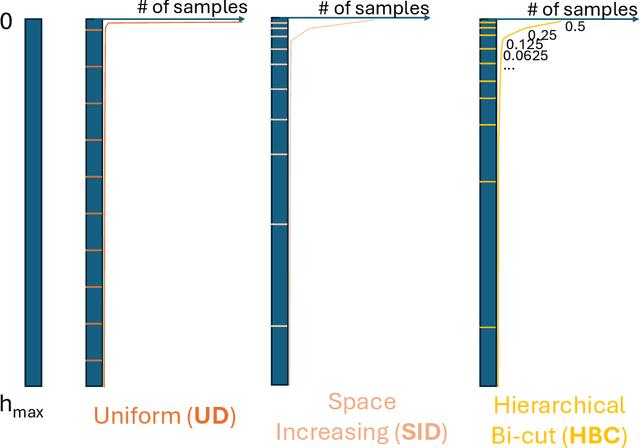
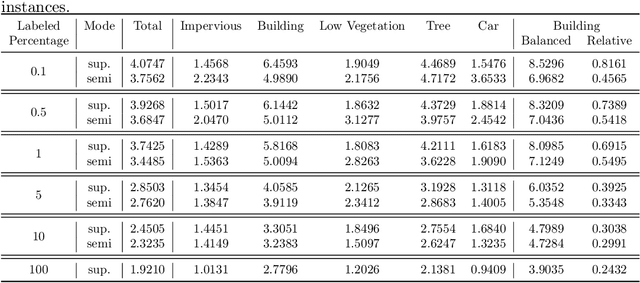
Monocular height estimation plays a critical role in 3D perception for remote sensing, offering a cost-effective alternative to multi-view or LiDAR-based methods. While deep learning has significantly advanced the capabilities of monocular height estimation, these methods remain fundamentally limited by the availability of labeled data, which are expensive and labor-intensive to obtain at scale. The scarcity of high-quality annotations hinders the generalization and performance of existing models. To overcome this limitation, we propose leveraging large volumes of unlabeled data through a semi-supervised learning framework, enabling the model to extract informative cues from unlabeled samples and improve its predictive performance. In this work, we introduce TSE-Net, a self-training pipeline for semi-supervised monocular height estimation. The pipeline integrates teacher, student, and exam networks. The student network is trained on unlabeled data using pseudo-labels generated by the teacher network, while the exam network functions as a temporal ensemble of the student network to stabilize performance. The teacher network is formulated as a joint regression and classification model: the regression branch predicts height values that serve as pseudo-labels, and the classification branch predicts height value classes along with class probabilities, which are used to filter pseudo-labels. Height value classes are defined using a hierarchical bi-cut strategy to address the inherent long-tailed distribution of heights, and the predicted class probabilities are calibrated with a Plackett-Luce model to reflect the expected accuracy of pseudo-labels. We evaluate the proposed pipeline on three datasets spanning different resolutions and imaging modalities. Codes are available at https://github.com/zhu-xlab/tse-net.
BootOOD: Self-Supervised Out-of-Distribution Detection via Synthetic Sample Exposure under Neural Collapse
Nov 17, 2025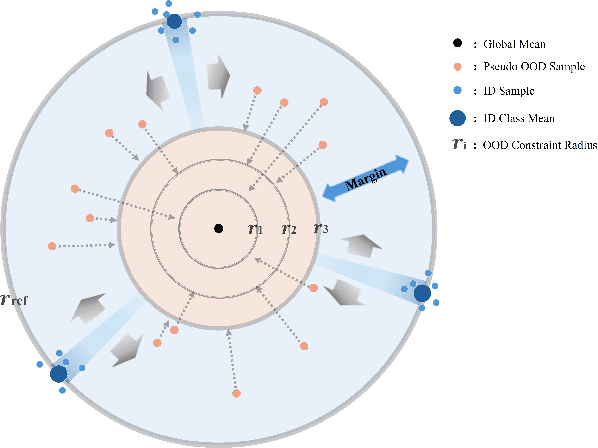
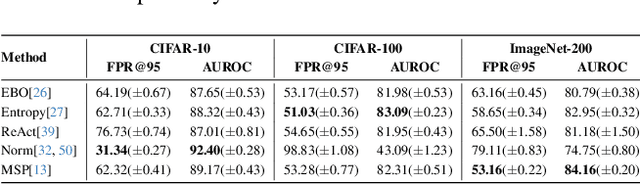
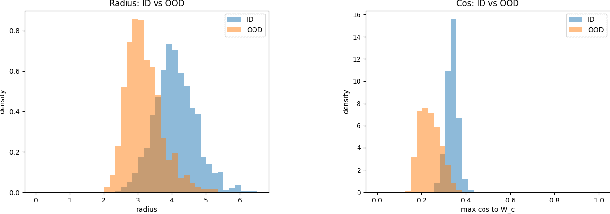
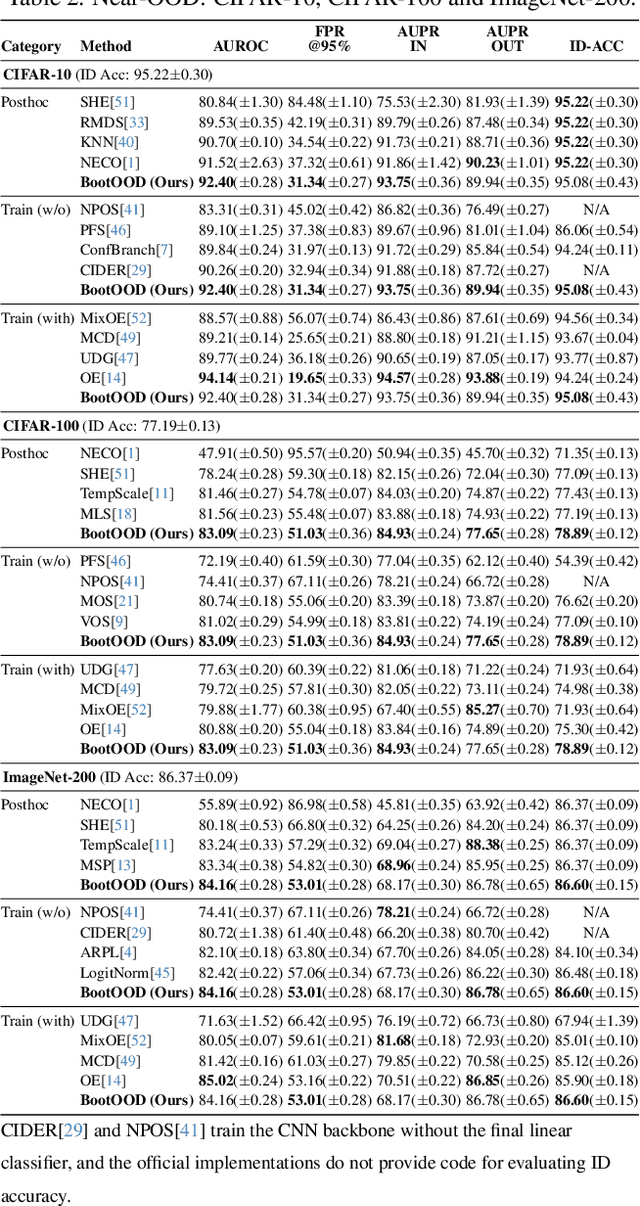
Out-of-distribution (OOD) detection is critical for deploying image classifiers in safety-sensitive environments, yet existing detectors often struggle when OOD samples are semantically similar to the in-distribution (ID) classes. We present BootOOD, a fully self-supervised OOD detection framework that bootstraps exclusively from ID data and is explicitly designed to handle semantically challenging OOD samples. BootOOD synthesizes pseudo-OOD features through simple transformations of ID representations and leverages Neural Collapse (NC), where ID features cluster tightly around class means with consistent feature norms. Unlike prior approaches that aim to constrain OOD features into subspaces orthogonal to the collapsed ID means, BootOOD introduces a lightweight auxiliary head that performs radius-based classification on feature norms. This design decouples OOD detection from the primary classifier and imposes a relaxed requirement: OOD samples are learned to have smaller feature norms than ID features, which is easier to satisfy when ID and OOD are semantically close. Experiments on CIFAR-10, CIFAR-100, and ImageNet-200 show that BootOOD outperforms prior post-hoc methods, surpasses training-based methods without outlier exposure, and is competitive with state-of-the-art outlier-exposure approaches while maintaining or improving ID accuracy.