 Add to Chrome
 Add to Firefox
 Add to Edge
iStructTab: Structured Feature Sequencing for Multimodal Learning of Image and Tabular Data
Aug 05, 2026
Multimodal learning of images and tabular data is often impaired by ineffective representations, resulting in redundancy, dispersion, and generalization problems. To tackle this challenge, we introduce Graph-Enhanced Descriptor Sequencing (GEDS), a structured feature sequencing algorithm grounded in principles from the Column Permutation Problem (CPP). GEDS refines statistical descriptors of the features through similarity graph-based computations, systematically determining an effective feature sequencing. We incorporate GEDS within an order-aware efficient transformer framework, utilizing order-aware memory tokens that explicitly adhere to the derived feature sequencing via a dedicated loss function. Experimental results across multimodal benchmarks demonstrate that iStructTab effectively minimizes feature dispersion, improving predictive performance and robustness, and highlighting the significance of structured feature sequencing in multimodal learning.
* This paper has been accepted for presentation at the 28th International Conference on Pattern Recognition (ICPR 2026) in Lyon, France Code: https://github.com/zadid6pretam/iStructTab PyPI: pip install istructtab

ProMoE-FL: Prototype-conditioned Mixture of Experts for Multimodal Federated Learning with Missing Modalities
Jul 07, 2026In this paper, we address the problem of multimodal federated learning with missing modality. Existing methods utilize an additional public dataset or perform naive feature synthesis that is based solely on the available modality. To address these limitations, we propose ProMoE-FL, a Prototype-conditioned Mixture-of-Experts framework for robust missing-modality feature synthesis in multimodal federated learning. ProMoE-FL builds a global client-aware prototype bank that captures clinically meaningful modality priors across institutions. Our Mixture of Experts is conditioned on these prototypes and modality indices to enable direction-aware expert routing for dynamically synthesizing missing features. We perform extensive quantitative and qualitative evaluations on four public chest X-ray datasets (MIMIC-CXR, NIH Open-I, PadChest, and CheXpert) and demonstrate that ProMoE-FL consistently outperforms state-of-the-art methods in both homogeneous as well as the more challenging heterogeneous settings.
A Benchmark for Hallucination Detection in VLMs for Gastrointestinal Endoscopy
Jun 23, 2026Vision-language models (VLMs) are prone to hallucination, which remains a major barrier to their safe deployment in clinical practice. To date, most hallucination detection methods have been evaluated on radiology benchmarks such as MIMIC-CXR and VQA-RAD, while gastrointestinal (GI) endoscopy remains largely underexplored. In this paper, we benchmark nine hallucination detection methods on the Gut-VLM dataset, a GI diagnostic Visual Question Answering (VQA) dataset with 4,392 test VQA pairs, across five VLMs (MedGemma-4B, MedGemma-27B, LLaVA-Med-7B, LLaVA-v1.6-7B, and Lingshu-32B). The methods span three categories: black-box methods (RadFlag, SelfCheckGPT-NLI), gray-box methods (AvgProb, AvgEnt, MaxProb, MaxEnt, Semantic Entropy, and VASE), and a white-box method (ReXTrust). Our results show that ReXTrust, a white-box method, achieves the highest AUC across all five models, outperforming the strongest alternative method on each VLM by a statistically significant margin (paired permutation test, p < 0.001 in all cases), reaching a peak AUC of 93.0 on MedGemma-4B. White-box hidden-state access provides a consistent advantage of 19.5 AUC points on average (range: 9.5--33.5), with ReXTrust maintaining strong performance even on LLaVA-v1.6-7B (AUC 79.9), where black-box methods and clustering-based gray-box methods collapse to near-chance performance. Among non-white-box methods, token-level gray-box statistics (MaxEnt, MaxProb) are the strongest alternatives, outperforming both clustering-based gray-box methods (Semantic Entropy, VASE) and black-box approaches on average. We further identify confident confabulation, a failure mode in which models hallucinate with high inter-sample consistency or high token-level probability, as a systemic failure for both consistency and uncertainty-based methods.
When Confidence Lacks Concepts: Interpretable OOD Detection via Representation Perturbations
Jun 15, 2026Deep neural networks have achieved remarkable performance across medical imaging tasks, yet their tendency to overgeneralize under distributional shifts poses a major obstacle to safe clinical deployment. Out-of-Distribution (OOD) detection methods aim to mitigate this risk, but most existing approaches rely on opaque internal signals with poorly understood semantic meaning, limiting trust in safety-critical settings. In this work, we propose an interpretable OOD detection framework that probes the stability of model predictions under class-conditioned semantic perturbations. Leveraging sparse autoencoders (SAEs), we learn class-specific concept vectors from in-distribution data that disentangle dense intermediate representations into sparse, semantically meaningful components. At inference, we perturb deeper-layer representations using the concept vectors associated with the model's predicted class and measure the class logits stability. We hypothesize that in-distribution samples exhibit low sensitivity to such perturbations, as their representations align with class-specific semantic directions, whereas OOD samples show amplified deviations due to representational misalignment. By framing OOD detection as a concept conditioned stability analysis, our approach provides both a discriminative OOD signal and an interpretable lens into the internal mechanisms driving model uncertainty, making it particularly suitable for high stakes medical applications.
BSTabDiff: Block-Subunit Diffusion Priors for High-Dimensional Tabular Data Generation
Jun 08, 2026High-Dimensional Low-Sample Size (HDLSS) tabular domains (e.g., omics) are characterized by $n \ll m$, where $n$ = number of samples, and $m$ = number of features. Such domains often exhibit strong local correlation groups, sparse cross-group dependencies, heavy-tailed non-Gaussian marginals, heteroscedastic noise, and structured missingness, making direct density learning in $\mathbb{R}^m$ ill-conditioned since $n \ll m$. We propose BSTabDiff, a block-subunit generative framework that partitions the $m$ observed features into $M$ latent blocks ($M \ll m$) and generates each block via a shared low-dimensional subunit variable, concentrating global dependence learning in the compact block-latent space $\mathbb{R}^M$ while decoding to the full feature space with copula-driven dependence, flexible per-feature marginals, and explicit missingness mechanisms. BSTabDiff supports modern deep priors on block latents, including diffusion and normalizing flows, enabling stable synthesis and controllable benchmark generation in the HDLSS regime. Empirically, BSTabDiff produces more realistic and stable high-dimensional synthetic data when compared with unstructured tabular generators on HDLSS data.
Two is better than one: A Collapse-free Multi-Reward RLIF Training Framework
May 21, 2026Reinforcement learning with verifiable rewards (RLVR) has substantially improved the reasoning ability of LLMs, but often depends on external supervision from human annotations or gold-standard solutions. Reinforcement learning from internal feedback (RLIF) has recently emerged as a scalable unsupervised alternative, using signals extracted from the model itself. However, existing RLIF methods typically rely on a single internal reward, which can lead to reward hacking, entropy collapse, and degraded reasoning structure. We propose a multi-reward RLIF framework that decomposes the training signal into two complementary components: an answer-level reward based on cluster voting and a completion-level reward based on token-wise self-certainty. To combine these signals robustly, we apply GDPO-based normalization to reduce reward-scale imbalance. We further introduce KL-Cov regularization, which targets low-entropy token distributions responsible for disproportionate entropy reduction, preserving exploration and preventing late-stage collapse. Across mathematical reasoning and code-generation benchmarks, our method improves stability and robustness over prior unsupervised RL approaches, while achieving performance close to supervised RLVR methods. These results show that complementary internal rewards, combined with targeted regularization, can support stable long-horizon reasoning without relying on external ground-truth supervision. Code will be released soon.
Local K-Similarity Constraint for Federated Learning with Label Noise
Nov 09, 2025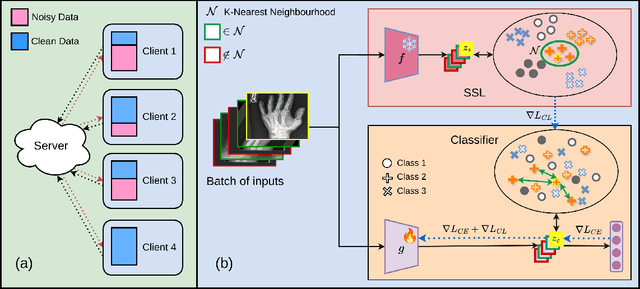
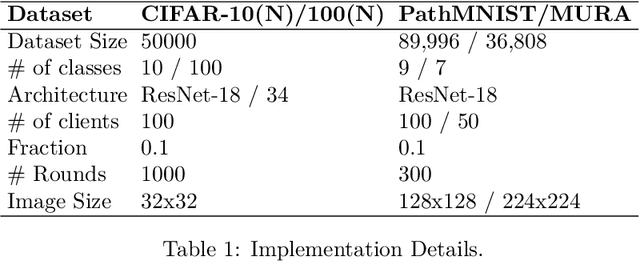
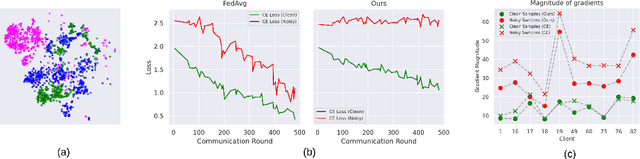
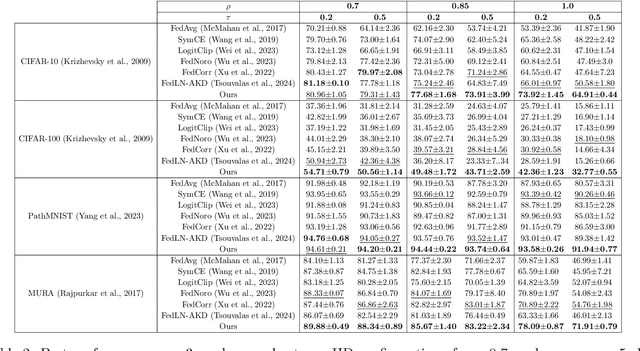
Federated learning on clients with noisy labels is a challenging problem, as such clients can infiltrate the global model, impacting the overall generalizability of the system. Existing methods proposed to handle noisy clients assume that a sufficient number of clients with clean labels are available, which can be leveraged to learn a robust global model while dampening the impact of noisy clients. This assumption fails when a high number of heterogeneous clients contain noisy labels, making the existing approaches ineffective. In such scenarios, it is important to locally regularize the clients before communication with the global model, to ensure the global model isn't corrupted by noisy clients. While pre-trained self-supervised models can be effective for local regularization, existing centralized approaches relying on pretrained initialization are impractical in a federated setting due to the potentially large size of these models, which increases communication costs. In that line, we propose a regularization objective for client models that decouples the pre-trained and classification models by enforcing similarity between close data points within the client. We leverage the representation space of a self-supervised pretrained model to evaluate the closeness among examples. This regularization, when applied with the standard objective function for the downstream task in standard noisy federated settings, significantly improves performance, outperforming existing state-of-the-art federated methods in multiple computer vision and medical image classification benchmarks. Unlike other techniques that rely on self-supervised pretrained initialization, our method does not require the pretrained model and classifier backbone to share the same architecture, making it architecture-agnostic.
Effect of Data Augmentation on Conformal Prediction for Diabetic Retinopathy
Aug 19, 2025The clinical deployment of deep learning models for high-stakes tasks such as diabetic retinopathy (DR) grading requires demonstrable reliability. While models achieve high accuracy, their clinical utility is limited by a lack of robust uncertainty quantification. Conformal prediction (CP) offers a distribution-free framework to generate prediction sets with statistical guarantees of coverage. However, the interaction between standard training practices like data augmentation and the validity of these guarantees is not well understood. In this study, we systematically investigate how different data augmentation strategies affect the performance of conformal predictors for DR grading. Using the DDR dataset, we evaluate two backbone architectures -- ResNet-50 and a Co-Scale Conv-Attentional Transformer (CoaT) -- trained under five augmentation regimes: no augmentation, standard geometric transforms, CLAHE, Mixup, and CutMix. We analyze the downstream effects on conformal metrics, including empirical coverage, average prediction set size, and correct efficiency. Our results demonstrate that sample-mixing strategies like Mixup and CutMix not only improve predictive accuracy but also yield more reliable and efficient uncertainty estimates. Conversely, methods like CLAHE can negatively impact model certainty. These findings highlight the need to co-design augmentation strategies with downstream uncertainty quantification in mind to build genuinely trustworthy AI systems for medical imaging.
Addressing Bias in VLMs for Glaucoma Detection Without Protected Attribute Supervision
Aug 12, 2025Vision-Language Models (VLMs) have achieved remarkable success on multimodal tasks such as image-text retrieval and zero-shot classification, yet they can exhibit demographic biases even when explicit protected attributes are absent during training. In this work, we focus on automated glaucoma screening from retinal fundus images, a critical application given that glaucoma is a leading cause of irreversible blindness and disproportionately affects underserved populations. Building on a reweighting-based contrastive learning framework, we introduce an attribute-agnostic debiasing method that (i) infers proxy subgroups via unsupervised clustering of image-image embeddings, (ii) computes gradient-similarity weights between the CLIP-style multimodal loss and a SimCLR-style image-pair contrastive loss, and (iii) applies these weights in a joint, top-$k$ weighted objective to upweight underperforming clusters. This label-free approach adaptively targets the hardest examples, thereby reducing subgroup disparities. We evaluate our method on the Harvard FairVLMed glaucoma subset, reporting Equalized Odds Distance (EOD), Equalized Subgroup AUC (ES AUC), and Groupwise AUC to demonstrate equitable performance across inferred demographic subgroups.
NERO: Explainable Out-of-Distribution Detection with Neuron-level Relevance
Jun 18, 2025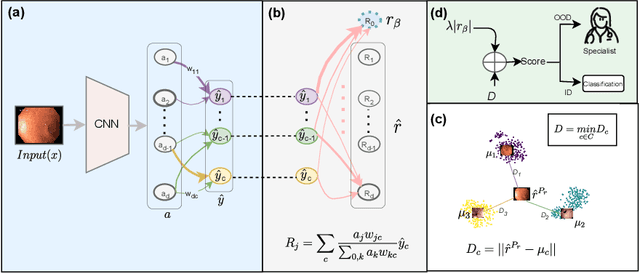
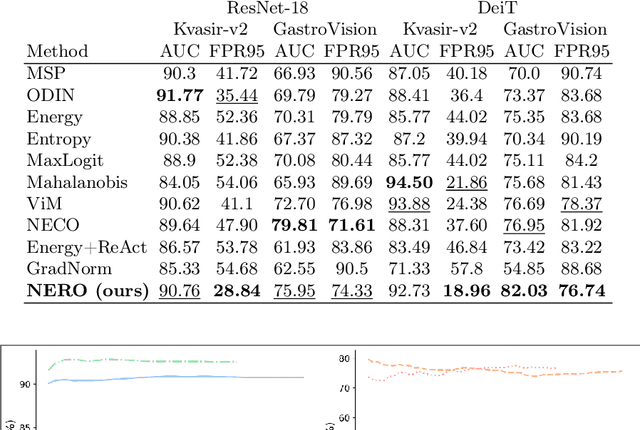
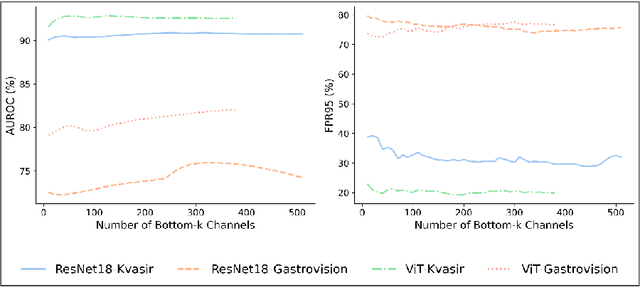
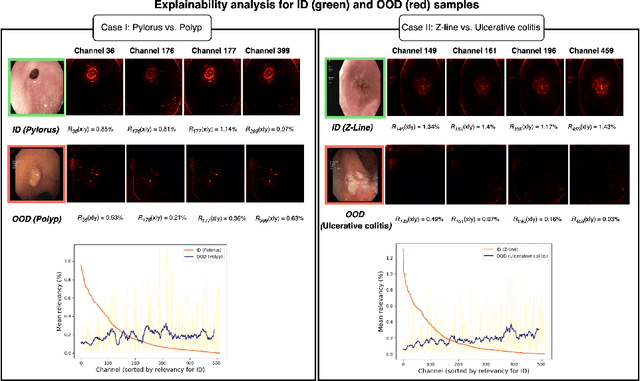
Ensuring reliability is paramount in deep learning, particularly within the domain of medical imaging, where diagnostic decisions often hinge on model outputs. The capacity to separate out-of-distribution (OOD) samples has proven to be a valuable indicator of a model's reliability in research. In medical imaging, this is especially critical, as identifying OOD inputs can help flag potential anomalies that might otherwise go undetected. While many OOD detection methods rely on feature or logit space representations, recent works suggest these approaches may not fully capture OOD diversity. To address this, we propose a novel OOD scoring mechanism, called NERO, that leverages neuron-level relevance at the feature layer. Specifically, we cluster neuron-level relevance for each in-distribution (ID) class to form representative centroids and introduce a relevance distance metric to quantify a new sample's deviation from these centroids, enhancing OOD separability. Additionally, we refine performance by incorporating scaled relevance in the bias term and combining feature norms. Our framework also enables explainable OOD detection. We validate its effectiveness across multiple deep learning architectures on the gastrointestinal imaging benchmarks Kvasir and GastroVision, achieving improvements over state-of-the-art OOD detection methods.