 Add to Chrome
 Add to Firefox
 Add to Edge
Benchmarking Self-Supervised Models for Cardiac Ultrasound View Classification
Feb 17, 2026
Reliable interpretation of cardiac ultrasound images is essential for accurate clinical diagnosis and assessment. Self-supervised learning has shown promise in medical imaging by leveraging large unlabelled datasets to learn meaningful representations. In this study, we evaluate and compare two self-supervised learning frameworks, USF-MAE, developed by our team, and MoCo v3, on the recently introduced CACTUS dataset (37,736 images) for automated simulated cardiac view (A4C, PL, PSAV, PSMV, Random, and SC) classification. Both models used 5-fold cross-validation, enabling robust assessment of generalization performance across multiple random splits. The CACTUS dataset provides expert-annotated cardiac ultrasound images with diverse views. We adopt an identical training protocol for both models to ensure a fair comparison. Both models are configured with a learning rate of 0.0001 and a weight decay of 0.01. For each fold, we record performance metrics including ROC-AUC, accuracy, F1-score, and recall. Our results indicate that USF-MAE consistently outperforms MoCo v3 across metrics. The average testing AUC for USF-MAE is 99.99% (+/-0.01% 95% CI), compared to 99.97% (+/-0.01%) for MoCo v3. USF-MAE achieves a mean testing accuracy of 99.33% (+/-0.18%), higher than the 98.99% (+/-0.28%) reported for MoCo v3. Similar trends are observed for the F1-score and recall, with improvements statistically significant across folds (paired t-test, p=0.0048 < 0.01). This proof-of-concept analysis suggests that USF-MAE learns more discriminative features for cardiac view classification than MoCo v3 when applied to this dataset. The enhanced performance across multiple metrics highlights the potential of USF-MAE for improving automated cardiac ultrasound classification.

Improved cystic hygroma detection from prenatal imaging using ultrasound-specific self-supervised representation learning
Dec 28, 2025Cystic hygroma is a high-risk prenatal ultrasound finding that portends high rates of chromosomal abnormalities, structural malformations, and adverse pregnancy outcomes. Automated detection can increase reproducibility and support scalable early screening programs, but supervised deep learning methods are limited by small labelled datasets. This study assesses whether ultrasound-specific self-supervised pretraining can facilitate accurate, robust deep learning detection of cystic hygroma in first-trimester ultrasound images. We fine-tuned the Ultrasound Self-Supervised Foundation Model with Masked Autoencoding (USF-MAE), pretrained on over 370,000 unlabelled ultrasound images, for binary classification of normal controls and cystic hygroma cases used in this study. Performance was evaluated on the same curated ultrasound dataset, preprocessing pipeline, and 4-fold cross-validation protocol as for the DenseNet-169 baseline, using accuracy, sensitivity, specificity, and the area under the receiver operating characteristic curve (ROC-AUC). Model interpretability was analyzed qualitatively using Score-CAM visualizations. USF-MAE outperformed the DenseNet-169 baseline on all evaluation metrics. The proposed model yielded a mean accuracy of 0.96, sensitivity of 0.94, specificity of 0.98, and ROC-AUC of 0.98 compared to 0.93, 0.92, 0.94, and 0.94 for the DenseNet-169 baseline, respectively. Qualitative Score-CAM visualizations of model predictions demonstrated clinical relevance by highlighting expected regions in the fetal neck for both positive and negative cases. Paired statistical analysis using a Wilcoxon signed-rank test confirmed that performance improvements achieved by USF-MAE were statistically significant (p = 0.0057).
Self-Supervised Ultrasound Representation Learning for Renal Anomaly Prediction in Prenatal Imaging
Dec 15, 2025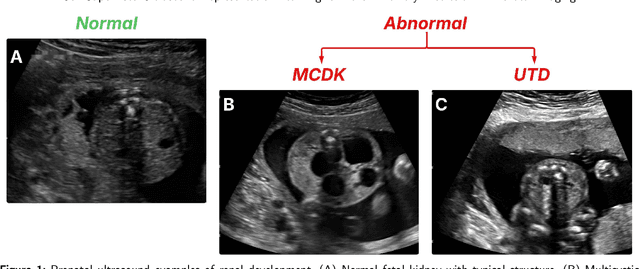
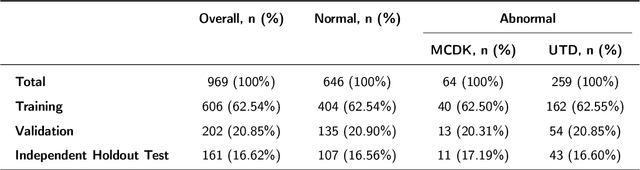

Prenatal ultrasound is the cornerstone for detecting congenital anomalies of the kidneys and urinary tract, but diagnosis is limited by operator dependence and suboptimal imaging conditions. We sought to assess the performance of a self-supervised ultrasound foundation model for automated fetal renal anomaly classification using a curated dataset of 969 two-dimensional ultrasound images. A pretrained Ultrasound Self-Supervised Foundation Model with Masked Autoencoding (USF-MAE) was fine-tuned for binary and multi-class classification of normal kidneys, urinary tract dilation, and multicystic dysplastic kidney. Models were compared with a DenseNet-169 convolutional baseline using cross-validation and an independent test set. USF-MAE consistently improved upon the baseline across all evaluation metrics in both binary and multi-class settings. USF-MAE achieved an improvement of about 1.87% (AUC) and 7.8% (F1-score) on the validation set, 2.32% (AUC) and 4.33% (F1-score) on the independent holdout test set. The largest gains were observed in the multi-class setting, where the improvement in AUC was 16.28% and 46.15% in F1-score. To facilitate model interpretability, Score-CAM visualizations were adapted for a transformer architecture and show that model predictions were informed by known, clinically relevant renal structures, including the renal pelvis in urinary tract dilation and cystic regions in multicystic dysplastic kidney. These results show that ultrasound-specific self-supervised learning can generate a useful representation as a foundation for downstream diagnostic tasks. The proposed framework offers a robust, interpretable approach to support the prenatal detection of renal anomalies and demonstrates the promise of foundation models in obstetric imaging.
Deep Learning Analysis of Prenatal Ultrasound for Identification of Ventriculomegaly
Nov 11, 2025The proposed study aimed to develop a deep learning model capable of detecting ventriculomegaly on prenatal ultrasound images. Ventriculomegaly is a prenatal condition characterized by dilated cerebral ventricles of the fetal brain and is important to diagnose early, as it can be associated with an increased risk for fetal aneuploidies and/or underlying genetic syndromes. An Ultrasound Self-Supervised Foundation Model with Masked Autoencoding (USF-MAE), recently developed by our group, was fine-tuned for a binary classification task to distinguish fetal brain ultrasound images as either normal or showing ventriculomegaly. The USF-MAE incorporates a Vision Transformer encoder pretrained on more than 370,000 ultrasound images from the OpenUS-46 corpus. For this study, the pretrained encoder was adapted and fine-tuned on a curated dataset of fetal brain ultrasound images to optimize its performance for ventriculomegaly detection. Model evaluation was conducted using 5-fold cross-validation and an independent test cohort, and performance was quantified using accuracy, precision, recall, specificity, F1-score, and area under the receiver operating characteristic curve (AUC). The proposed USF-MAE model reached an F1-score of 91.76% on the 5-fold cross-validation and 91.78% on the independent test set, with much higher scores than those obtained by the baseline models by 19.37% and 16.15% compared to VGG-19, 2.31% and 2.56% compared to ResNet-50, and 5.03% and 11.93% compared to ViT-B/16, respectively. The model also showed a high mean test precision of 94.47% and an accuracy of 97.24%. The Eigen-CAM (Eigen Class Activation Map) heatmaps showed that the model was focusing on the ventricle area for the diagnosis of ventriculomegaly, which has explainability and clinical plausibility.