 Add to Chrome
 Add to Firefox
 Add to Edge
Weakly Supervised Semantic Segmentation
Papers and Code
Instance-Guided Class Activation Mapping for Weakly Supervised Semantic Segmentation
Sep 15, 2025
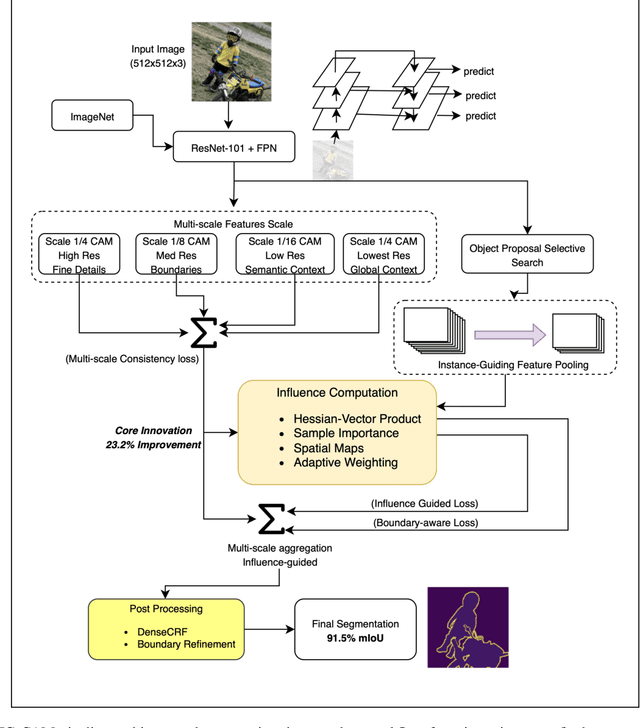
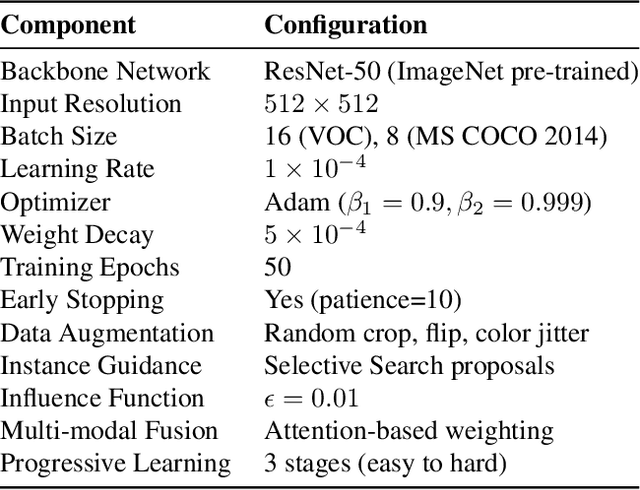
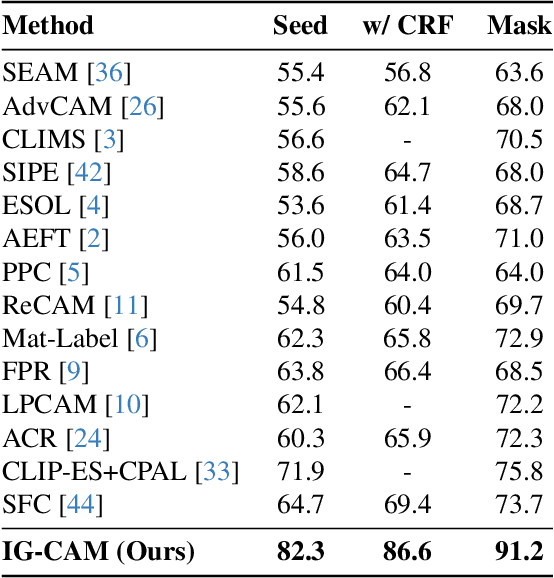
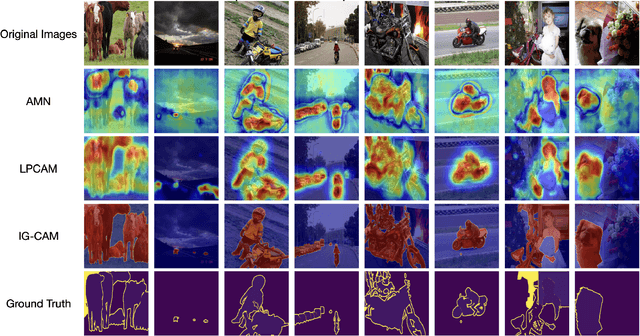
Weakly Supervised Semantic Segmentation (WSSS) addresses the challenge of training segmentation models using only image-level annotations, eliminating the need for expensive pixel-level labeling. While existing methods struggle with precise object boundary localization and often focus only on the most discriminative regions, we propose IG-CAM (Instance-Guided Class Activation Mapping), a novel approach that leverages instance-level cues and influence functions to generate high-quality, boundary-aware localization maps. Our method introduces three key innovations: (1) Instance-Guided Refinement that uses ground truth segmentation masks to guide CAM generation, ensuring complete object coverage rather than just discriminative parts; (2) Influence Function Integration that captures the relationship between training samples and model predictions, leading to more robust feature representations; and (3) Multi-Scale Boundary Enhancement that employs progressive refinement strategies to achieve sharp, precise object boundaries. IG-CAM achieves state-of-the-art performance on the PASCAL VOC 2012 dataset with an mIoU of 82.3% before post-processing, which further improves to 86.6% after applying Conditional Random Field (CRF) refinement, significantly outperforming previous WSSS methods. Our approach demonstrates superior localization accuracy, with complete object coverage and precise boundary delineation, while maintaining computational efficiency. Extensive ablation studies validate the contribution of each component, and qualitative comparisons across 600 diverse images showcase the method's robustness and generalization capability. The results establish IG-CAM as a new benchmark for weakly supervised semantic segmentation, offering a practical solution for scenarios where pixel-level annotations are unavailable or prohibitively expensive.

LandSegmenter: Towards a Flexible Foundation Model for Land Use and Land Cover Mapping
Nov 11, 2025Land Use and Land Cover (LULC) mapping is a fundamental task in Earth Observation (EO). However, current LULC models are typically developed for a specific modality and a fixed class taxonomy, limiting their generability and broader applicability. Recent advances in foundation models (FMs) offer promising opportunities for building universal models. Yet, task-agnostic FMs often require fine-tuning for downstream applications, whereas task-specific FMs rely on massive amounts of labeled data for training, which is costly and impractical in the remote sensing (RS) domain. To address these challenges, we propose LandSegmenter, an LULC FM framework that resolves three-stage challenges at the input, model, and output levels. From the input side, to alleviate the heavy demand on labeled data for FM training, we introduce LAnd Segment (LAS), a large-scale, multi-modal, multi-source dataset built primarily with globally sampled weak labels from existing LULC products. LAS provides a scalable, cost-effective alternative to manual annotation, enabling large-scale FM training across diverse LULC domains. For model architecture, LandSegmenter integrates an RS-specific adapter for cross-modal feature extraction and a text encoder for semantic awareness enhancement. At the output stage, we introduce a class-wise confidence-guided fusion strategy to mitigate semantic omissions and further improve LandSegmenter's zero-shot performance. We evaluate LandSegmenter on six precisely annotated LULC datasets spanning diverse modalities and class taxonomies. Extensive transfer learning and zero-shot experiments demonstrate that LandSegmenter achieves competitive or superior performance, particularly in zero-shot settings when transferred to unseen datasets. These results highlight the efficacy of our proposed framework and the utility of weak supervision for building task-specific FMs.
Contrastive Prompt Clustering for Weakly Supervised Semantic Segmentation
Aug 23, 2025


Weakly Supervised Semantic Segmentation (WSSS) with image-level labels has gained attention for its cost-effectiveness. Most existing methods emphasize inter-class separation, often neglecting the shared semantics among related categories and lacking fine-grained discrimination. To address this, we propose Contrastive Prompt Clustering (CPC), a novel WSSS framework. CPC exploits Large Language Models (LLMs) to derive category clusters that encode intrinsic inter-class relationships, and further introduces a class-aware patch-level contrastive loss to enforce intra-class consistency and inter-class separation. This hierarchical design leverages clusters as coarse-grained semantic priors while preserving fine-grained boundaries, thereby reducing confusion among visually similar categories. Experiments on PASCAL VOC 2012 and MS COCO 2014 demonstrate that CPC surpasses existing state-of-the-art methods in WSSS.
The point is the mask: scaling coral reef segmentation with weak supervision
Aug 26, 2025Monitoring coral reefs at large spatial scales remains an open challenge, essential for assessing ecosystem health and informing conservation efforts. While drone-based aerial imagery offers broad spatial coverage, its limited resolution makes it difficult to reliably distinguish fine-scale classes, such as coral morphotypes. At the same time, obtaining pixel-level annotations over large spatial extents is costly and labor-intensive, limiting the scalability of deep learning-based segmentation methods for aerial imagery. We present a multi-scale weakly supervised semantic segmentation framework that addresses this challenge by transferring fine-scale ecological information from underwater imagery to aerial data. Our method enables large-scale coral reef mapping from drone imagery with minimal manual annotation, combining classification-based supervision, spatial interpolation and self-distillation techniques. We demonstrate the efficacy of the approach, enabling large-area segmentation of coral morphotypes and demonstrating flexibility for integrating new classes. This study presents a scalable, cost-effective methodology for high-resolution reef monitoring, combining low-cost data collection, weakly supervised deep learning and multi-scale remote sensing.
Mitigating Spurious Correlations in Weakly Supervised Semantic Segmentation via Cross-architecture Consistency Regularization
Jul 29, 2025Scarcity of pixel-level labels is a significant challenge in practical scenarios. In specific domains like industrial smoke, acquiring such detailed annotations is particularly difficult and often requires expert knowledge. To alleviate this, weakly supervised semantic segmentation (WSSS) has emerged as a promising approach. However, due to the supervision gap and inherent bias in models trained with only image level labels, existing WSSS methods suffer from limitations such as incomplete foreground coverage, inaccurate object boundaries, and spurious correlations, especially in our domain, where emissions are always spatially coupled with chimneys. Previous solutions typically rely on additional priors or external knowledge to mitigate these issues, but they often lack scalability and fail to address the model's inherent bias toward co-occurring context. To address this, we propose a novel WSSS framework that directly targets the co-occurrence problem without relying on external supervision. Unlike prior methods that adopt a single network, we employ a teacher-student framework that combines CNNs and ViTs. We introduce a knowledge transfer loss that enforces cross-architecture consistency by aligning internal representations. Additionally, we incorporate post-processing techniques to address partial coverage and further improve pseudo mask quality.
Integrating SAM Supervision for 3D Weakly Supervised Point Cloud Segmentation
Aug 27, 2025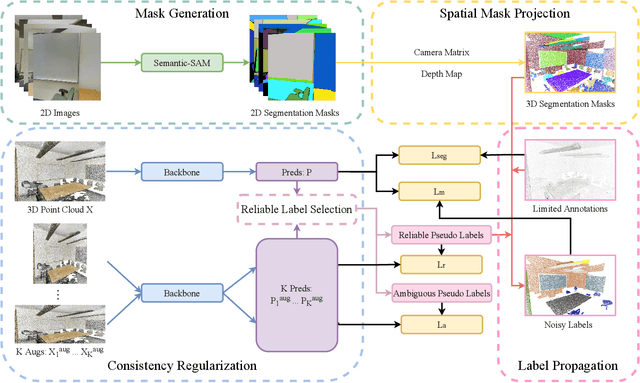
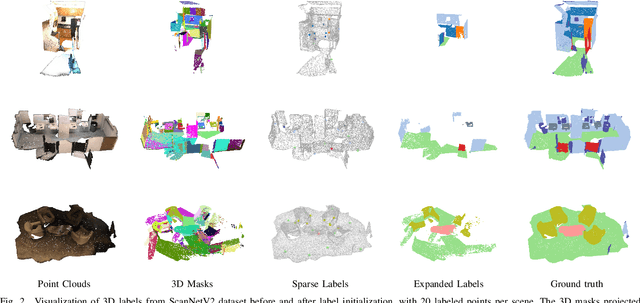
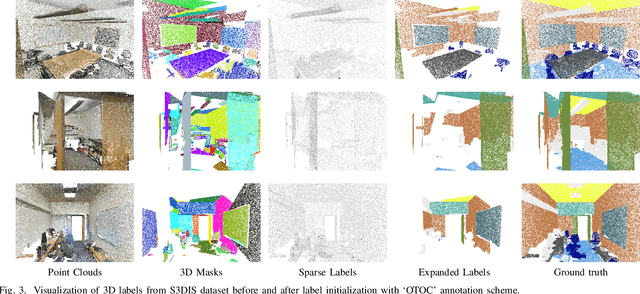
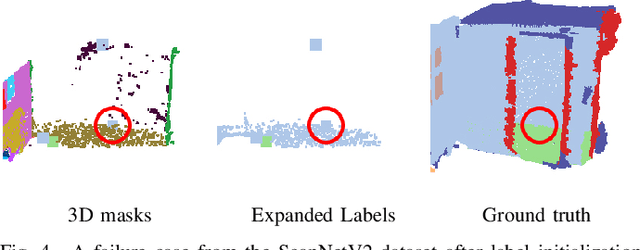
Current methods for 3D semantic segmentation propose training models with limited annotations to address the difficulty of annotating large, irregular, and unordered 3D point cloud data. They usually focus on the 3D domain only, without leveraging the complementary nature of 2D and 3D data. Besides, some methods extend original labels or generate pseudo labels to guide the training, but they often fail to fully use these labels or address the noise within them. Meanwhile, the emergence of comprehensive and adaptable foundation models has offered effective solutions for segmenting 2D data. Leveraging this advancement, we present a novel approach that maximizes the utility of sparsely available 3D annotations by incorporating segmentation masks generated by 2D foundation models. We further propagate the 2D segmentation masks into the 3D space by establishing geometric correspondences between 3D scenes and 2D views. We extend the highly sparse annotations to encompass the areas delineated by 3D masks, thereby substantially augmenting the pool of available labels. Furthermore, we apply confidence- and uncertainty-based consistency regularization on augmentations of the 3D point cloud and select the reliable pseudo labels, which are further spread on the 3D masks to generate more labels. This innovative strategy bridges the gap between limited 3D annotations and the powerful capabilities of 2D foundation models, ultimately improving the performance of 3D weakly supervised segmentation.
Know Your Attention Maps: Class-specific Token Masking for Weakly Supervised Semantic Segmentation
Jul 09, 2025Weakly Supervised Semantic Segmentation (WSSS) is a challenging problem that has been extensively studied in recent years. Traditional approaches often rely on external modules like Class Activation Maps to highlight regions of interest and generate pseudo segmentation masks. In this work, we propose an end-to-end method that directly utilizes the attention maps learned by a Vision Transformer (ViT) for WSSS. We propose training a sparse ViT with multiple [CLS] tokens (one for each class), using a random masking strategy to promote [CLS] token - class assignment. At inference time, we aggregate the different self-attention maps of each [CLS] token corresponding to the predicted labels to generate pseudo segmentation masks. Our proposed approach enhances the interpretability of self-attention maps and ensures accurate class assignments. Extensive experiments on two standard benchmarks and three specialized datasets demonstrate that our method generates accurate pseudo-masks, outperforming related works. Those pseudo-masks can be used to train a segmentation model which achieves results comparable to fully-supervised models, significantly reducing the need for fine-grained labeled data.
UniMRSeg: Unified Modality-Relax Segmentation via Hierarchical Self-Supervised Compensation
Sep 19, 2025Multi-modal image segmentation faces real-world deployment challenges from incomplete/corrupted modalities degrading performance. While existing methods address training-inference modality gaps via specialized per-combination models, they introduce high deployment costs by requiring exhaustive model subsets and model-modality matching. In this work, we propose a unified modality-relax segmentation network (UniMRSeg) through hierarchical self-supervised compensation (HSSC). Our approach hierarchically bridges representation gaps between complete and incomplete modalities across input, feature and output levels. % First, we adopt modality reconstruction with the hybrid shuffled-masking augmentation, encouraging the model to learn the intrinsic modality characteristics and generate meaningful representations for missing modalities through cross-modal fusion. % Next, modality-invariant contrastive learning implicitly compensates the feature space distance among incomplete-complete modality pairs. Furthermore, the proposed lightweight reverse attention adapter explicitly compensates for the weak perceptual semantics in the frozen encoder. Last, UniMRSeg is fine-tuned under the hybrid consistency constraint to ensure stable prediction under all modality combinations without large performance fluctuations. Without bells and whistles, UniMRSeg significantly outperforms the state-of-the-art methods under diverse missing modality scenarios on MRI-based brain tumor segmentation, RGB-D semantic segmentation, RGB-D/T salient object segmentation. The code will be released at https://github.com/Xiaoqi-Zhao-DLUT/UniMRSeg.
Diffusion-Guided Knowledge Distillation for Weakly-Supervised Low-Light Semantic Segmentation
Jul 10, 2025Weakly-supervised semantic segmentation aims to assign category labels to each pixel using weak annotations, significantly reducing manual annotation costs. Although existing methods have achieved remarkable progress in well-lit scenarios, their performance significantly degrades in low-light environments due to two fundamental limitations: severe image quality degradation (e.g., low contrast, noise, and color distortion) and the inherent constraints of weak supervision. These factors collectively lead to unreliable class activation maps and semantically ambiguous pseudo-labels, ultimately compromising the model's ability to learn discriminative feature representations. To address these problems, we propose Diffusion-Guided Knowledge Distillation for Weakly-Supervised Low-light Semantic Segmentation (DGKD-WLSS), a novel framework that synergistically combines Diffusion-Guided Knowledge Distillation (DGKD) with Depth-Guided Feature Fusion (DGF2). DGKD aligns normal-light and low-light features via diffusion-based denoising and knowledge distillation, while DGF2 integrates depth maps as illumination-invariant geometric priors to enhance structural feature learning. Extensive experiments demonstrate the effectiveness of DGKD-WLSS, which achieves state-of-the-art performance in weakly supervised semantic segmentation tasks under low-light conditions. The source codes have been released at:https://github.com/ChunyanWang1/DGKD-WLSS.
TEn-CATS: Text-Enriched Audio-Visual Video Parsing with Multi-Scale Category-Aware Temporal Graph
Sep 04, 2025Audio-Visual Video Parsing (AVVP) task aims to identify event categories and their occurrence times in a given video with weakly supervised labels. Existing methods typically fall into two categories: (i) designing enhanced architectures based on attention mechanism for better temporal modeling, and (ii) generating richer pseudo-labels to compensate for the absence of frame-level annotations. However, the first type methods treat noisy segment-level pseudo labels as reliable supervision and the second type methods let indiscriminate attention spread them across all frames, the initial errors are repeatedly amplified during training. To address this issue, we propose a method that combines the Bi-Directional Text Fusion (BiT) module and Category-Aware Temporal Graph (CATS) module. Specifically, we integrate the strengths and complementarity of the two previous research directions. We first perform semantic injection and dynamic calibration on audio and visual modality features through the BiT module, to locate and purify cleaner and richer semantic cues. Then, we leverage the CATS module for semantic propagation and connection to enable precise semantic information dissemination across time. Experimental results demonstrate that our proposed method achieves state-of-the-art (SOTA) performance in multiple key indicators on two benchmark datasets, LLP and UnAV-100.