 Add to Chrome
 Add to Firefox
 Add to Edge
facial recognition
Facial recognition is an AI-based technique for identifying or confirming an individual's identity using their face. It maps facial features from an image or video and then compares the information with a collection of known faces to find a match.
Papers and Code
Skeleton-based sign language recognition using a dual-stream spatio-temporal dynamic graph convolutional network
Sep 10, 2025
Isolated Sign Language Recognition (ISLR) is challenged by gestures that are morphologically similar yet semantically distinct, a problem rooted in the complex interplay between hand shape and motion trajectory. Existing methods, often relying on a single reference frame, struggle to resolve this geometric ambiguity. This paper introduces Dual-SignLanguageNet (DSLNet), a dual-reference, dual-stream architecture that decouples and models gesture morphology and trajectory in separate, complementary coordinate systems. Our approach utilizes a wrist-centric frame for view-invariant shape analysis and a facial-centric frame for context-aware trajectory modeling. These streams are processed by specialized networks-a topology-aware graph convolution for shape and a Finsler geometry-based encoder for trajectory-and are integrated via a geometry-driven optimal transport fusion mechanism. DSLNet sets a new state-of-the-art, achieving 93.70%, 89.97% and 99.79% accuracy on the challenging WLASL-100, WLASL-300 and LSA64 datasets, respectively, with significantly fewer parameters than competing models.

2D-3D Attention and Entropy for Pose Robust 2D Facial Recognition
May 14, 2025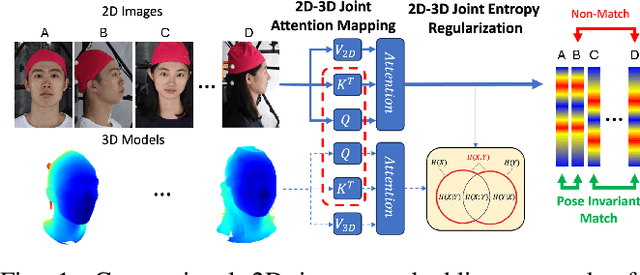
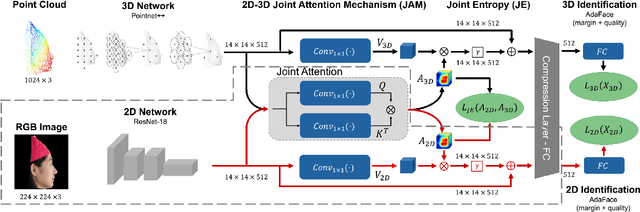
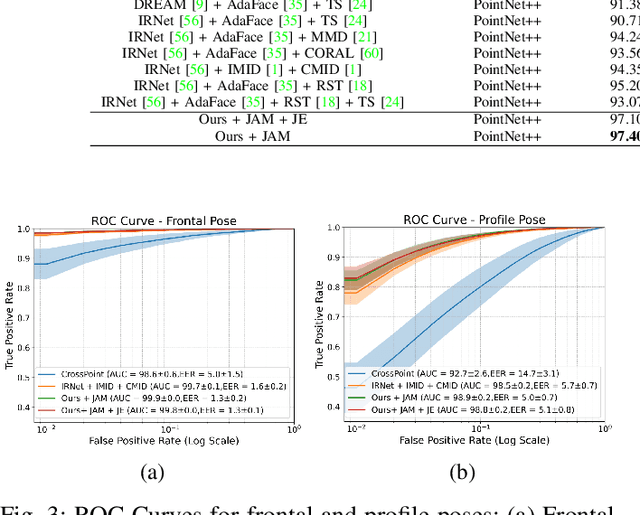
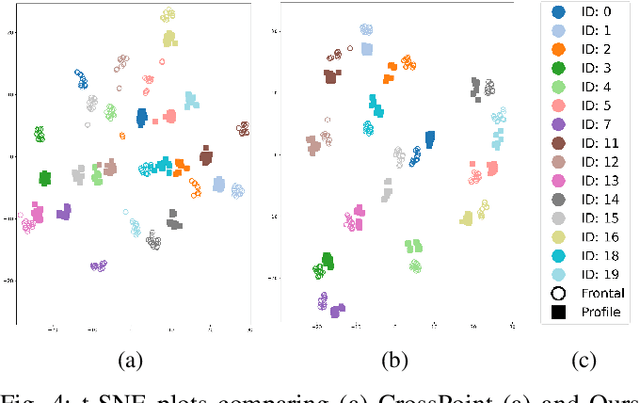
Despite recent advances in facial recognition, there remains a fundamental issue concerning degradations in performance due to substantial perspective (pose) differences between enrollment and query (probe) imagery. Therefore, we propose a novel domain adaptive framework to facilitate improved performances across large discrepancies in pose by enabling image-based (2D) representations to infer properties of inherently pose invariant point cloud (3D) representations. Specifically, our proposed framework achieves better pose invariance by using (1) a shared (joint) attention mapping to emphasize common patterns that are most correlated between 2D facial images and 3D facial data and (2) a joint entropy regularizing loss to promote better consistency$\unicode{x2014}$enhancing correlations among the intersecting 2D and 3D representations$\unicode{x2014}$by leveraging both attention maps. This framework is evaluated on FaceScape and ARL-VTF datasets, where it outperforms competitive methods by achieving profile (90$\unicode{x00b0}$$\unicode{x002b}$) TAR @ 1$\unicode{x0025}$ FAR improvements of at least 7.1$\unicode{x0025}$ and 1.57$\unicode{x0025}$, respectively.
VisualSpeaker: Visually-Guided 3D Avatar Lip Synthesis
Jul 08, 2025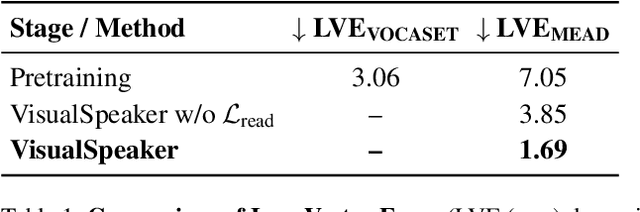
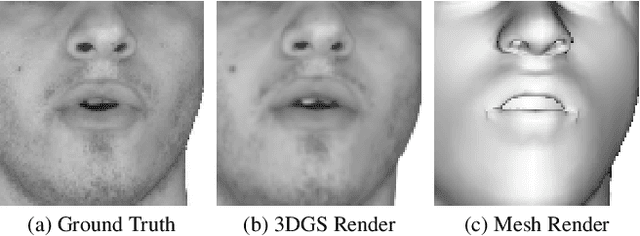
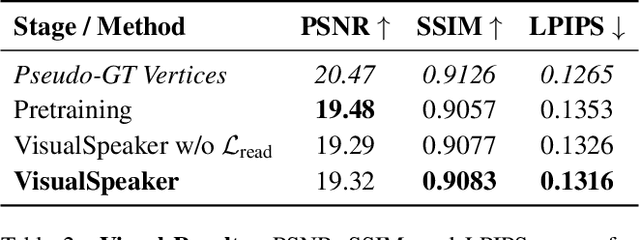
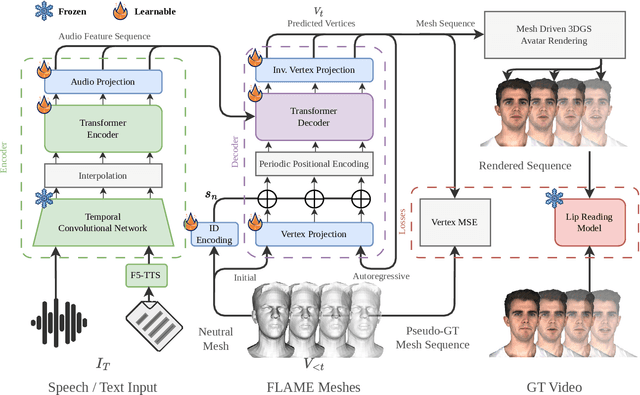
Realistic, high-fidelity 3D facial animations are crucial for expressive avatar systems in human-computer interaction and accessibility. Although prior methods show promising quality, their reliance on the mesh domain limits their ability to fully leverage the rapid visual innovations seen in 2D computer vision and graphics. We propose VisualSpeaker, a novel method that bridges this gap using photorealistic differentiable rendering, supervised by visual speech recognition, for improved 3D facial animation. Our contribution is a perceptual lip-reading loss, derived by passing photorealistic 3D Gaussian Splatting avatar renders through a pre-trained Visual Automatic Speech Recognition model during training. Evaluation on the MEAD dataset demonstrates that VisualSpeaker improves both the standard Lip Vertex Error metric by 56.1% and the perceptual quality of the generated animations, while retaining the controllability of mesh-driven animation. This perceptual focus naturally supports accurate mouthings, essential cues that disambiguate similar manual signs in sign language avatars.
Accuracy and Fairness of Facial Recognition Technology in Low-Quality Police Images: An Experiment With Synthetic Faces
May 20, 2025Facial recognition technology (FRT) is increasingly used in criminal investigations, yet most evaluations of its accuracy rely on high-quality images, unlike those often encountered by law enforcement. This study examines how five common forms of image degradation--contrast, brightness, motion blur, pose shift, and resolution--affect FRT accuracy and fairness across demographic groups. Using synthetic faces generated by StyleGAN3 and labeled with FairFace, we simulate degraded images and evaluate performance using Deepface with ArcFace loss in 1:n identification tasks. We perform an experiment and find that false positive rates peak near baseline image quality, while false negatives increase as degradation intensifies--especially with blur and low resolution. Error rates are consistently higher for women and Black individuals, with Black females most affected. These disparities raise concerns about fairness and reliability when FRT is used in real-world investigative contexts. Nevertheless, even under the most challenging conditions and for the most affected subgroups, FRT accuracy remains substantially higher than that of many traditional forensic methods. This suggests that, if appropriately validated and regulated, FRT should be considered a valuable investigative tool. However, algorithmic accuracy alone is not sufficient: we must also evaluate how FRT is used in practice, including user-driven data manipulation. Such cases underscore the need for transparency and oversight in FRT deployment to ensure both fairness and forensic validity.
FG 2025 TrustFAA: the First Workshop on Towards Trustworthy Facial Affect Analysis: Advancing Insights of Fairness, Explainability, and Safety (TrustFAA)
Jun 05, 2025With the increasing prevalence and deployment of Emotion AI-powered facial affect analysis (FAA) tools, concerns about the trustworthiness of these systems have become more prominent. This first workshop on "Towards Trustworthy Facial Affect Analysis: Advancing Insights of Fairness, Explainability, and Safety (TrustFAA)" aims to bring together researchers who are investigating different challenges in relation to trustworthiness-such as interpretability, uncertainty, biases, and privacy-across various facial affect analysis tasks, including macro/ micro-expression recognition, facial action unit detection, other corresponding applications such as pain and depression detection, as well as human-robot interaction and collaboration. In alignment with FG2025's emphasis on ethics, as demonstrated by the inclusion of an Ethical Impact Statement requirement for this year's submissions, this workshop supports FG2025's efforts by encouraging research, discussion and dialogue on trustworthy FAA.
TKFNet: Learning Texture Key Factor Driven Feature for Facial Expression Recognition
May 15, 2025Facial expression recognition (FER) in the wild remains a challenging task due to the subtle and localized nature of expression-related features, as well as the complex variations in facial appearance. In this paper, we introduce a novel framework that explicitly focuses on Texture Key Driver Factors (TKDF), localized texture regions that exhibit strong discriminative power across emotional categories. By carefully observing facial image patterns, we identify that certain texture cues, such as micro-changes in skin around the brows, eyes, and mouth, serve as primary indicators of emotional dynamics. To effectively capture and leverage these cues, we propose a FER architecture comprising a Texture-Aware Feature Extractor (TAFE) and Dual Contextual Information Filtering (DCIF). TAFE employs a ResNet-based backbone enhanced with multi-branch attention to extract fine-grained texture representations, while DCIF refines these features by filtering context through adaptive pooling and attention mechanisms. Experimental results on RAF-DB and KDEF datasets demonstrate that our method achieves state-of-the-art performance, verifying the effectiveness and robustness of incorporating TKDFs into FER pipelines.
A Deep Learning Approach for Facial Attribute Manipulation and Reconstruction in Surveillance and Reconnaissance
Jun 06, 2025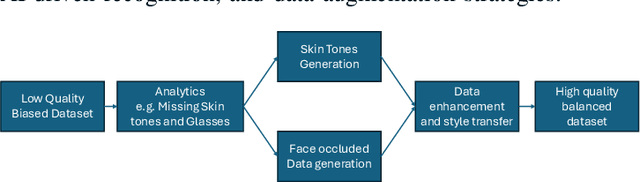
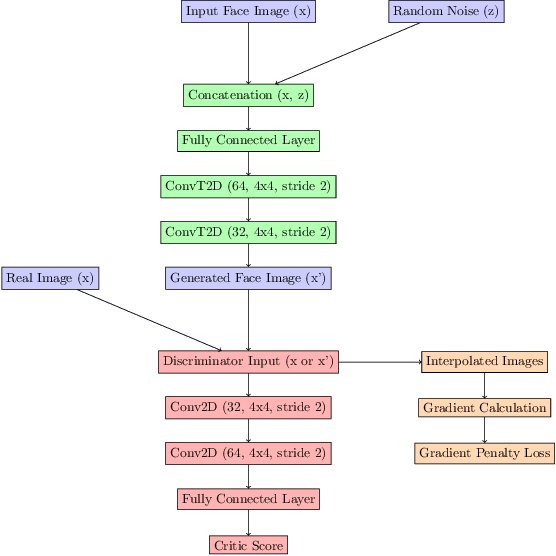
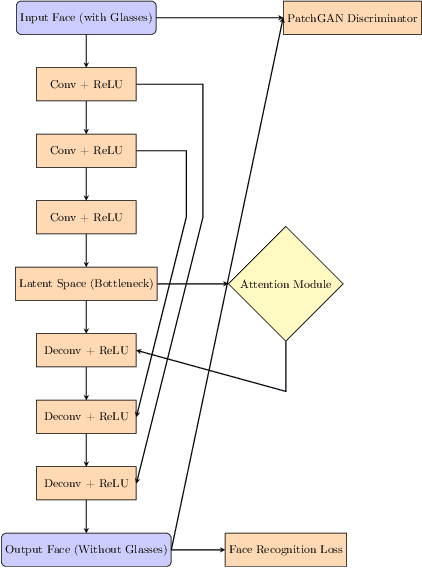
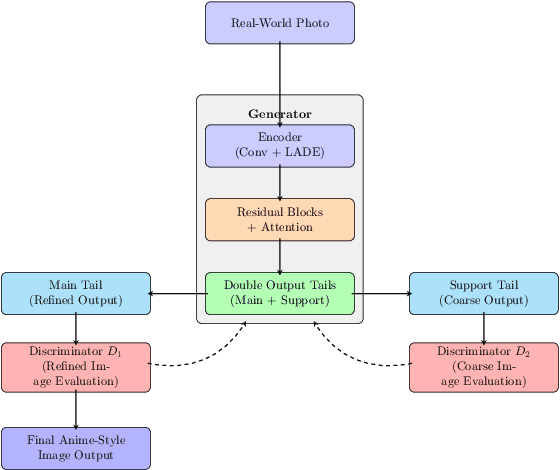
Surveillance systems play a critical role in security and reconnaissance, but their performance is often compromised by low-quality images and videos, leading to reduced accuracy in face recognition. Additionally, existing AI-based facial analysis models suffer from biases related to skin tone variations and partially occluded faces, further limiting their effectiveness in diverse real-world scenarios. These challenges are the results of data limitations and imbalances, where available training datasets lack sufficient diversity, resulting in unfair and unreliable facial recognition performance. To address these issues, we propose a data-driven platform that enhances surveillance capabilities by generating synthetic training data tailored to compensate for dataset biases. Our approach leverages deep learning-based facial attribute manipulation and reconstruction using autoencoders and Generative Adversarial Networks (GANs) to create diverse and high-quality facial datasets. Additionally, our system integrates an image enhancement module, improving the clarity of low-resolution or occluded faces in surveillance footage. We evaluate our approach using the CelebA dataset, demonstrating that the proposed platform enhances both training data diversity and model fairness. This work contributes to reducing bias in AI-based facial analysis and improving surveillance accuracy in challenging environments, leading to fairer and more reliable security applications.
A Feature-level Bias Evaluation Framework for Facial Expression Recognition Models
May 26, 2025Recent studies on fairness have shown that Facial Expression Recognition (FER) models exhibit biases toward certain visually perceived demographic groups. However, the limited availability of human-annotated demographic labels in public FER datasets has constrained the scope of such bias analysis. To overcome this limitation, some prior works have resorted to pseudo-demographic labels, which may distort bias evaluation results. Alternatively, in this paper, we propose a feature-level bias evaluation framework for evaluating demographic biases in FER models under the setting where demographic labels are unavailable in the test set. Extensive experiments demonstrate that our method more effectively evaluates demographic biases compared to existing approaches that rely on pseudo-demographic labels. Furthermore, we observe that many existing studies do not include statistical testing in their bias evaluations, raising concerns that some reported biases may not be statistically significant but rather due to randomness. To address this issue, we introduce a plug-and-play statistical module to ensure the statistical significance of biased evaluation results. A comprehensive bias analysis based on the proposed module is then conducted across three sensitive attributes (age, gender, and race), seven facial expressions, and multiple network architectures on a large-scale dataset, revealing the prominent demographic biases in FER and providing insights on selecting a fairer network architecture.
SocialDF: Benchmark Dataset and Detection Model for Mitigating Harmful Deepfake Content on Social Media Platforms
Jun 05, 2025
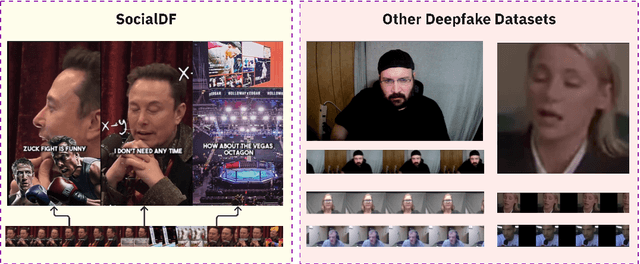
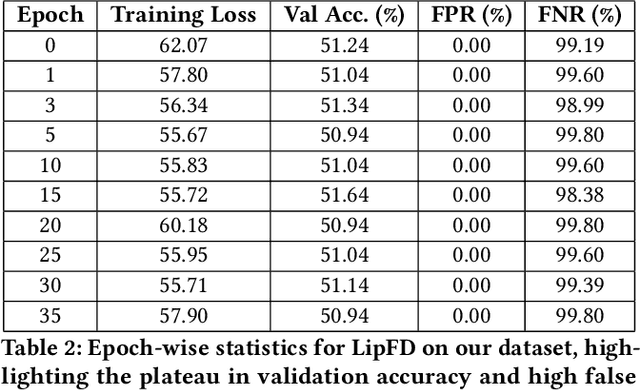
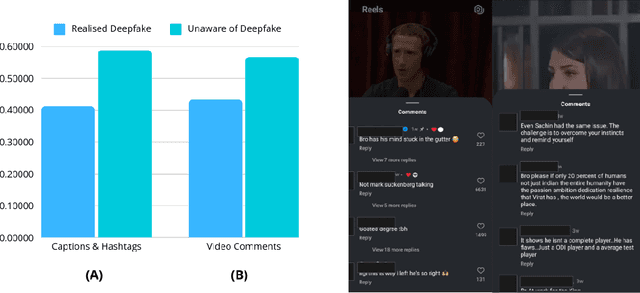
The rapid advancement of deep generative models has significantly improved the realism of synthetic media, presenting both opportunities and security challenges. While deepfake technology has valuable applications in entertainment and accessibility, it has emerged as a potent vector for misinformation campaigns, particularly on social media. Existing detection frameworks struggle to distinguish between benign and adversarially generated deepfakes engineered to manipulate public perception. To address this challenge, we introduce SocialDF, a curated dataset reflecting real-world deepfake challenges on social media platforms. This dataset encompasses high-fidelity deepfakes sourced from various online ecosystems, ensuring broad coverage of manipulative techniques. We propose a novel LLM-based multi-factor detection approach that combines facial recognition, automated speech transcription, and a multi-agent LLM pipeline to cross-verify audio-visual cues. Our methodology emphasizes robust, multi-modal verification techniques that incorporate linguistic, behavioral, and contextual analysis to effectively discern synthetic media from authentic content.
Emotion Recognition from Skeleton Data: A Comprehensive Survey
Jul 24, 2025Emotion recognition through body movements has emerged as a compelling and privacy-preserving alternative to traditional methods that rely on facial expressions or physiological signals. Recent advancements in 3D skeleton acquisition technologies and pose estimation algorithms have significantly enhanced the feasibility of emotion recognition based on full-body motion. This survey provides a comprehensive and systematic review of skeleton-based emotion recognition techniques. First, we introduce psychological models of emotion and examine the relationship between bodily movements and emotional expression. Next, we summarize publicly available datasets, highlighting the differences in data acquisition methods and emotion labeling strategies. We then categorize existing methods into posture-based and gait-based approaches, analyzing them from both data-driven and technical perspectives. In particular, we propose a unified taxonomy that encompasses four primary technical paradigms: Traditional approaches, Feat2Net, FeatFusionNet, and End2EndNet. Representative works within each category are reviewed and compared, with benchmarking results across commonly used datasets. Finally, we explore the extended applications of emotion recognition in mental health assessment, such as detecting depression and autism, and discuss the open challenges and future research directions in this rapidly evolving field.