 Add to Chrome
 Add to Firefox
 Add to Edge
Time Series Analysis
Time series analysis comprises statistical methods for analyzing a sequence of data points collected over an interval of time to identify interesting patterns and trends.
Papers and Code
A Regime-Aware Fusion Framework for Time Series Classification
Dec 17, 2025
Kernel-based methods such as Rocket are among the most effective default approaches for univariate time series classification (TSC), yet they do not perform equally well across all datasets. We revisit the long-standing intuition that different representations capture complementary structure and show that selectively fusing them can yield consistent improvements over Rocket on specific, systematically identifiable kinds of datasets. We introduce Fusion-3 (F3), a lightweight framework that adaptively fuses Rocket, Sax, and Sfa representations. To understand when fusion helps, we cluster UCR datasets into six groups using meta-features capturing series length, spectral structure, roughness, and class imbalance, and treat these clusters as interpretable data-structure regimes. Our analysis shows that fusion typically outperforms strong baselines in regimes with structured variability or rich frequency content, while offering diminishing returns in highly irregular or outlier-heavy settings. To support these findings, we combine three complementary analyses: non-parametric paired statistics across datasets, ablation studies isolating the roles of individual representations, and attribution via SHAP to identify which dataset properties predict fusion gains. Sample-level case studies further reveal the underlying mechanism: fusion primarily improves performance by rescuing specific errors, with adaptive increases in frequency-domain weighting precisely where corrections occur. Using 5-fold cross-validation on the 113 UCR datasets, F3 yields small but consistent average improvements over Rocket, supported by frequentist and Bayesian evidence and accompanied by clearly identifiable failure cases. Our results show that selectively applied fusion provides dependable and interpretable extension to strong kernel-based methods, correcting their weaknesses precisely where the data support it.

SigTime: Learning and Visually Explaining Time Series Signatures
Dec 12, 2025Understanding and distinguishing temporal patterns in time series data is essential for scientific discovery and decision-making. For example, in biomedical research, uncovering meaningful patterns in physiological signals can improve diagnosis, risk assessment, and patient outcomes. However, existing methods for time series pattern discovery face major challenges, including high computational complexity, limited interpretability, and difficulty in capturing meaningful temporal structures. To address these gaps, we introduce a novel learning framework that jointly trains two Transformer models using complementary time series representations: shapelet-based representations to capture localized temporal structures and traditional feature engineering to encode statistical properties. The learned shapelets serve as interpretable signatures that differentiate time series across classification labels. Additionally, we develop a visual analytics system -- SigTIme -- with coordinated views to facilitate exploration of time series signatures from multiple perspectives, aiding in useful insights generation. We quantitatively evaluate our learning framework on eight publicly available datasets and one proprietary clinical dataset. Additionally, we demonstrate the effectiveness of our system through two usage scenarios along with the domain experts: one involving public ECG data and the other focused on preterm labor analysis.
A Quantum Tensor Network-Based Viewpoint for Modeling and Analysis of Time Series Data
Nov 17, 2025Accurate uncertainty quantification is a critical challenge in machine learning. While neural networks are highly versatile and capable of learning complex patterns, they often lack interpretability due to their ``black box'' nature. On the other hand, probabilistic ``white box'' models, though interpretable, often suffer from a significant performance gap when compared to neural networks. To address this, we propose a novel quantum physics-based ``white box'' method that offers both accurate uncertainty quantification and enhanced interpretability. By mapping the kernel mean embedding (KME) of a time series data vector to a reproducing kernel Hilbert space (RKHS), we construct a tensor network-inspired 1D spin chain Hamiltonian, with the KME as one of its eigen-functions or eigen-modes. We then solve the associated Schr{ö}dinger equation and apply perturbation theory to quantify uncertainty, thereby improving the interpretability of tasks performed with the quantum tensor network-based model. We demonstrate the effectiveness of this methodology, compared to state-of-the-art ``white box" models, in change point detection and time series clustering, providing insights into the uncertainties associated with decision-making throughout the process.
Investigating ECG Diagnosis with Ambiguous Labels using Partial Label Learning
Dec 11, 2025Label ambiguity is an inherent problem in real-world electrocardiogram (ECG) diagnosis, arising from overlapping conditions and diagnostic disagreement. However, current ECG models are trained under the assumption of clean and non-ambiguous annotations, which limits both the development and the meaningful evaluation of models under real-world conditions. Although Partial Label Learning (PLL) frameworks are designed to learn from ambiguous labels, their effectiveness in medical time-series domains, ECG in particular, remains largely unexplored. In this work, we present the first systematic study of PLL methods for ECG diagnosis. We adapt nine PLL algorithms to multi-label ECG diagnosis and evaluate them using a diverse set of clinically motivated ambiguity generation strategies, capturing both unstructured (e.g., random) and structured ambiguities (e.g., cardiologist-derived similarities, treatment relationships, and diagnostic taxonomies). Our experiments on the PTB-XL and Chapman datasets demonstrate that PLL methods vary substantially in their robustness to different types and degrees of ambiguity. Through extensive analysis, we identify key limitations of current PLL approaches in clinical settings and outline future directions for developing robust and clinically aligned ambiguity-aware learning frameworks for ECG diagnosis.
Near-real time fires detection using satellite imagery in Sudan conflict
Dec 08, 2025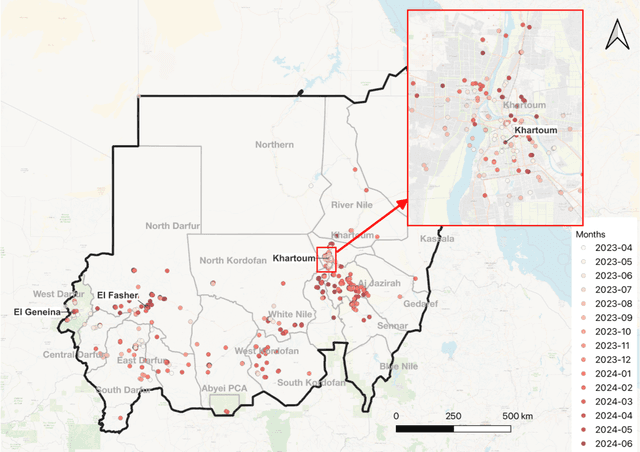
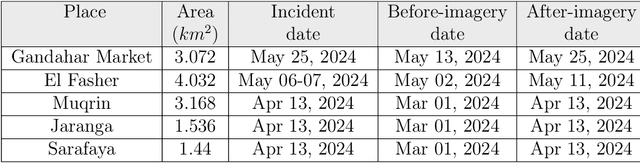
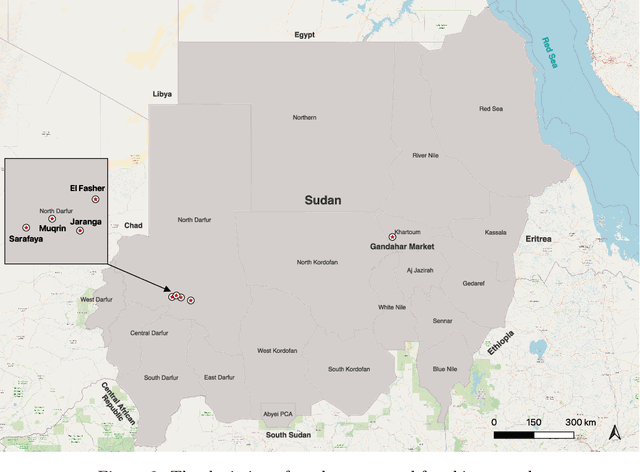
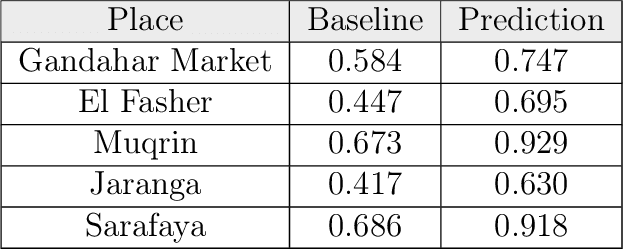
The challenges of ongoing war in Sudan highlight the need for rapid monitoring and analysis of such conflicts. Advances in deep learning and readily available satellite remote sensing imagery allow for near real-time monitoring. This paper uses 4-band imagery from Planet Labs with a deep learning model to show that fire damage in armed conflicts can be monitored with minimal delay. We demonstrate the effectiveness of our approach using five case studies in Sudan. We show that, compared to a baseline, the automated method captures the active fires and charred areas more accurately. Our results indicate that using 8-band imagery or time series of such imagery only result in marginal gains.
TimeSense:Making Large Language Models Proficient in Time-Series Analysis
Nov 09, 2025In the time-series domain, an increasing number of works combine text with temporal data to leverage the reasoning capabilities of large language models (LLMs) for various downstream time-series understanding tasks. This enables a single model to flexibly perform tasks that previously required specialized models for each domain. However, these methods typically rely on text labels for supervision during training, biasing the model toward textual cues while potentially neglecting the full temporal features. Such a bias can lead to outputs that contradict the underlying time-series context. To address this issue, we construct the EvalTS benchmark, comprising 10 tasks across three difficulty levels, from fundamental temporal pattern recognition to complex real-world reasoning, to evaluate models under more challenging and realistic scenarios. We also propose TimeSense, a multimodal framework that makes LLMs proficient in time-series analysis by balancing textual reasoning with a preserved temporal sense. TimeSense incorporates a Temporal Sense module that reconstructs the input time-series within the model's context, ensuring that textual reasoning is grounded in the time-series dynamics. Moreover, to enhance spatial understanding of time-series data, we explicitly incorporate coordinate-based positional embeddings, which provide each time point with spatial context and enable the model to capture structural dependencies more effectively. Experimental results demonstrate that TimeSense achieves state-of-the-art performance across multiple tasks, and it particularly outperforms existing methods on complex multi-dimensional time-series reasoning tasks.
Discovering Operational Patterns Using Image-Based Convolutional Clustering and Composite Evaluation: A Case Study in Foundry Melting Processes
Nov 17, 2025Industrial process monitoring increasingly relies on sensor-generated time-series data, yet the lack of labels, high variability, and operational noise make it difficult to extract meaningful patterns using conventional methods. Existing clustering techniques either rely on fixed distance metrics or deep models designed for static data, limiting their ability to handle dynamic, unstructured industrial sequences. Addressing this gap, this paper proposes a novel framework for unsupervised discovery of operational modes in univariate time-series data using image-based convolutional clustering with composite internal evaluation. The proposed framework improves upon existing approaches in three ways: (1) raw time-series sequences are transformed into grayscale matrix representations via overlapping sliding windows, allowing effective feature extraction using a deep convolutional autoencoder; (2) the framework integrates both soft and hard clustering outputs and refines the selection through a two-stage strategy; and (3) clustering performance is objectively evaluated by a newly developed composite score, S_eva, which combines normalized Silhouette, Calinski-Harabasz, and Davies-Bouldin indices. Applied to over 3900 furnace melting operations from a Nordic foundry, the method identifies seven explainable operational patterns, revealing significant differences in energy consumption, thermal dynamics, and production duration. Compared to classical and deep clustering baselines, the proposed approach achieves superior overall performance, greater robustness, and domain-aligned explainability. The framework addresses key challenges in unsupervised time-series analysis, such as sequence irregularity, overlapping modes, and metric inconsistency, and provides a generalizable solution for data-driven diagnostics and energy optimization in industrial systems.
HAROOD: A Benchmark for Out-of-distribution Generalization in Sensor-based Human Activity Recognition
Dec 12, 2025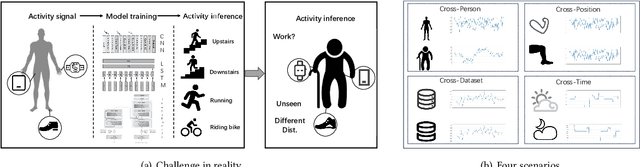

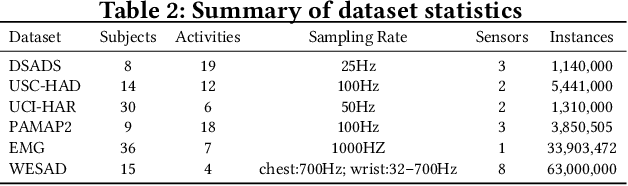
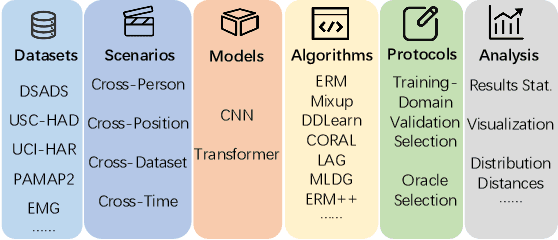
Sensor-based human activity recognition (HAR) mines activity patterns from the time-series sensory data. In realistic scenarios, variations across individuals, devices, environments, and time introduce significant distributional shifts for the same activities. Recent efforts attempt to solve this challenge by applying or adapting existing out-of-distribution (OOD) algorithms, but only in certain distribution shift scenarios (e.g., cross-device or cross-position), lacking comprehensive insights on the effectiveness of these algorithms. For instance, is OOD necessary to HAR? Which OOD algorithm performs the best? In this paper, we fill this gap by proposing HAROOD, a comprehensive benchmark for HAR in OOD settings. We define 4 OOD scenarios: cross-person, cross-position, cross-dataset, and cross-time, and build a testbed covering 6 datasets, 16 comparative methods (implemented with CNN-based and Transformer-based architectures), and two model selection protocols. Then, we conduct extensive experiments and present several findings for future research, e.g., no single method consistently outperforms others, highlighting substantial opportunity for advancement. Our codebase is highly modular and easy to extend for new datasets, algorithms, comparisons, and analysis, with the hope to facilitate the research in OOD-based HAR. Our implementation is released and can be found at https://github.com/AIFrontierLab/HAROOD.
A Causal-Guided Multimodal Large Language Model for Generalized Power System Time-Series Data Analytics
Nov 11, 2025Power system time series analytics is critical in understanding the system operation conditions and predicting the future trends. Despite the wide adoption of Artificial Intelligence (AI) tools, many AI-based time series analytical models suffer from task-specificity (i.e. one model for one task) and structural rigidity (i.e. the input-output format is fixed), leading to limited model performances and resource wastes. In this paper, we propose a Causal-Guided Multimodal Large Language Model (CM-LLM) that can solve heterogeneous power system time-series analysis tasks. First, we introduce a physics-statistics combined causal discovery mechanism to capture the causal relationship, which is represented by graph, among power system variables. Second, we propose a multimodal data preprocessing framework that can encode and fuse text, graph and time series to enhance the model performance. Last, we formulate a generic "mask-and-reconstruct" paradigm and design a dynamic input-output padding mechanism to enable CM-LLM adaptive to heterogeneous time-series analysis tasks with varying sample lengths. Simulation results based on open-source LLM Qwen and real-world dataset demonstrate that, after simple fine-tuning, the proposed CM-LLM can achieve satisfying accuracy and efficiency on three heterogeneous time-series analytics tasks: missing data imputation, forecasting and super resolution.
Semiconductor Industry Trend Prediction with Event Intervention Based on LSTM Model in Sentiment-Enhanced Time Series Data
Nov 19, 2025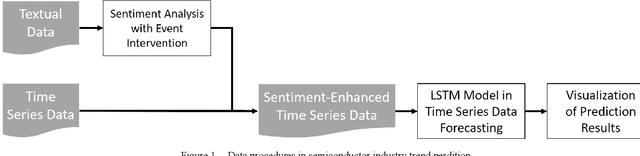
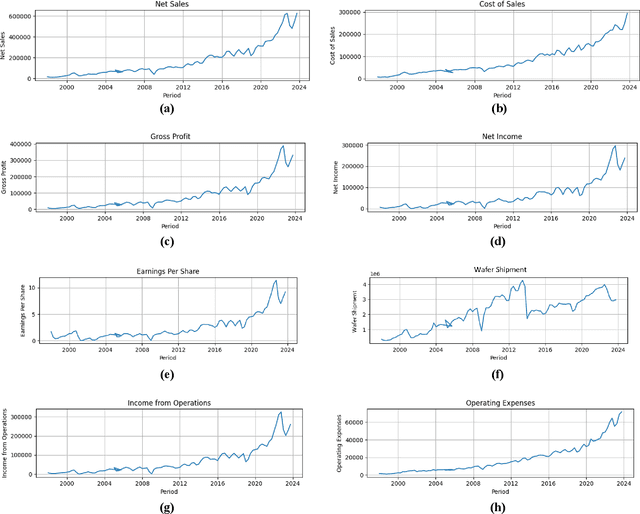
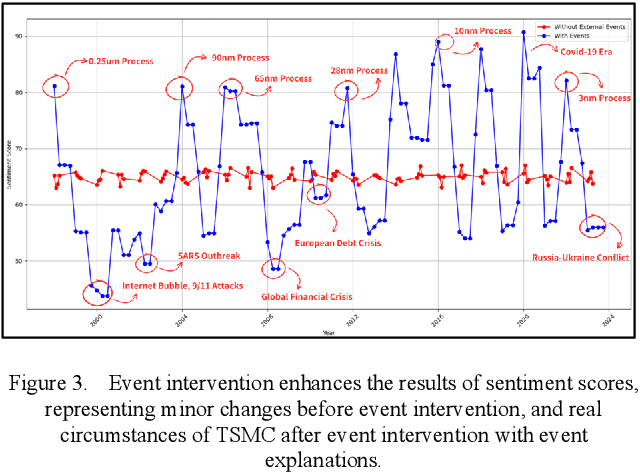
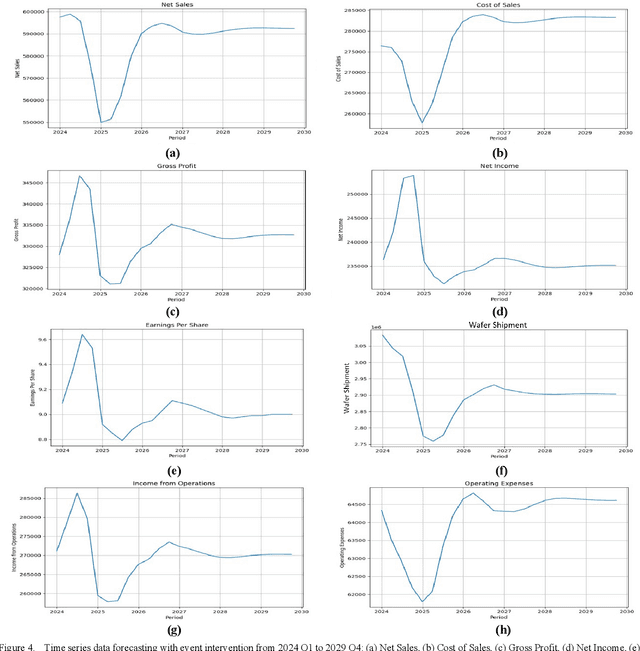
The innovation of the study is that the deep learning method and sentiment analysis are integrated in traditional business model analysis and forecasting, and the research subject is TSMC for industry trend prediction of semiconductor industry in Taiwan. For the rapid market changes and development of wafer technologies of semiconductor industry, traditional data analysis methods not perform well in the high variety and time series data. Textual data and time series data were collected from seasonal reports of TSMC including financial information. Textual data through sentiment analysis by considering the event intervention both from internal events of the company and the external global events. Using the sentiment-enhanced time series data, the LSTM model was adopted for predicting industry trend of TSMC. The prediction results reveal significant development of wafer technology of TSMC and the potential threatens in the global market, and matches the product released news of TSMC and the international news. The contribution of the work performed accurately in industry trend prediction of the semiconductor industry by considering both the internal and external event intervention, and the prediction results provide valuable information of semiconductor industry both in research and business aspects.