 Add to Chrome
 Add to Firefox
 Add to Edge
A Causal-Guided Multimodal Large Language Model for Generalized Power System Time-Series Data Analytics
Nov 11, 2025
Power system time series analytics is critical in understanding the system operation conditions and predicting the future trends. Despite the wide adoption of Artificial Intelligence (AI) tools, many AI-based time series analytical models suffer from task-specificity (i.e. one model for one task) and structural rigidity (i.e. the input-output format is fixed), leading to limited model performances and resource wastes. In this paper, we propose a Causal-Guided Multimodal Large Language Model (CM-LLM) that can solve heterogeneous power system time-series analysis tasks. First, we introduce a physics-statistics combined causal discovery mechanism to capture the causal relationship, which is represented by graph, among power system variables. Second, we propose a multimodal data preprocessing framework that can encode and fuse text, graph and time series to enhance the model performance. Last, we formulate a generic "mask-and-reconstruct" paradigm and design a dynamic input-output padding mechanism to enable CM-LLM adaptive to heterogeneous time-series analysis tasks with varying sample lengths. Simulation results based on open-source LLM Qwen and real-world dataset demonstrate that, after simple fine-tuning, the proposed CM-LLM can achieve satisfying accuracy and efficiency on three heterogeneous time-series analytics tasks: missing data imputation, forecasting and super resolution.

Deep-Learning-based Frequency-Domain Watermarking for Energy System Time Series Data Asset Protection
Nov 11, 2025Data has been regarded as a valuable asset with the fast development of artificial intelligence technologies. In this paper, we introduce deep-learning neural network-based frequency-domain watermarking for protecting energy system time series data assets and secure data authenticity when being shared or traded across communities. First, the concept and desired watermarking characteristics are introduced. Second, a deep-learning neural network-based watermarking model with specially designed loss functions and network structure is proposed to embed watermarks into the original dataset. Third, a frequency-domain data preprocessing method is proposed to eliminate the frequency bias of neural networks when learning time series datasets to enhance the model performances. Last, a comprehensive watermarking performance evaluation framework is designed for measuring its invisibility, restorability, robustness, secrecy, false-positive detection, generalization, and capacity. Case studies based on practical load and photovoltaic time series datasets demonstrate the effectiveness of the proposed method.
MAPS: Advancing Multi-Modal Reasoning in Expert-Level Physical Science
Jan 18, 2025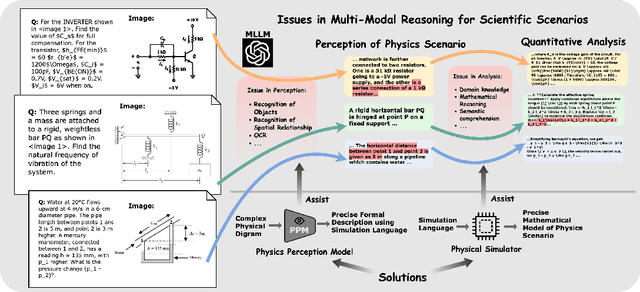

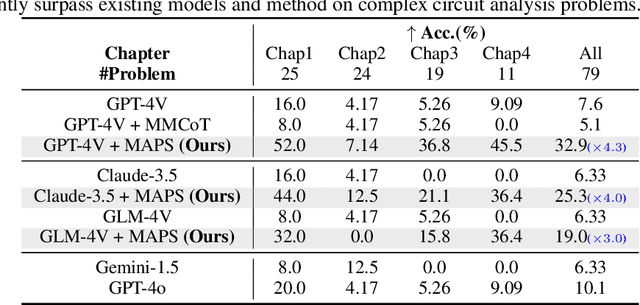

Pre-trained on extensive text and image corpora, current Multi-Modal Large Language Models (MLLM) have shown strong capabilities in general visual reasoning tasks. However, their performance is still lacking in physical domains that require understanding diagrams with complex physical structures and quantitative analysis based on multi-modal information. To address this, we develop a new framework, named Multi-Modal Scientific Reasoning with Physics Perception and Simulation (MAPS) based on an MLLM. MAPS decomposes expert-level multi-modal reasoning task into physical diagram understanding via a Physical Perception Model (PPM) and reasoning with physical knowledge via a simulator. The PPM module is obtained by fine-tuning a visual language model using carefully designed synthetic data with paired physical diagrams and corresponding simulation language descriptions. At the inference stage, MAPS integrates the simulation language description of the input diagram provided by PPM and results obtained through a Chain-of-Simulation process with MLLM to derive the underlying rationale and the final answer. Validated using our collected college-level circuit analysis problems, MAPS significantly improves reasoning accuracy of MLLM and outperforms all existing models. The results confirm MAPS offers a promising direction for enhancing multi-modal scientific reasoning ability of MLLMs. We will release our code, model and dataset used for our experiments upon publishing of this paper.
Improved Crowding Distance for NSGA-II
Nov 30, 2018


Non-dominated sorting genetic algorithm II (NSGA-II) does well in dealing with multi-objective problems. When evaluating validity of an algorithm for multi-objective problems, two kinds of indices are often considered simultaneously, i.e. the convergence to Pareto Front and the distribution characteristic. The crowding distance in the standard NSGA-II has the property that solutions within a cubic have the same crowding distance, which has no contribution to the convergence of the algorithm. Actually the closer to the Pareto Front a solution is, the higher priority it should have. In the paper, the crowding distance is redefined while keeping almost all the advantages of the original one. Moreover, the speed of converging to the Pareto Front is faster. Finally, the improvement is proved to be effective by applying it to solve nine Benchmark problems.