 Add to Chrome
 Add to Firefox
 Add to Edge
Semantic Uncertainty Quantification of Hallucinations in LLMs: A Quantum Tensor Network Based Method
Jan 27, 2026
Large language models (LLMs) exhibit strong generative capabilities but remain vulnerable to confabulations, fluent yet unreliable outputs that vary arbitrarily even under identical prompts. Leveraging a quantum tensor network based pipeline, we propose a quantum physics inspired uncertainty quantification framework that accounts for aleatoric uncertainty in token sequence probability for semantic equivalence based clustering of LLM generations. This offers a principled and interpretable scheme for hallucination detection. We further introduce an entropy maximization strategy that prioritizes high certainty, semantically coherent outputs and highlights entropy regions where LLM decisions are likely to be unreliable, offering practical guidelines for when human oversight is warranted. We evaluate the robustness of our scheme under different generation lengths and quantization levels, dimensions overlooked in prior studies, demonstrating that our approach remains reliable even in resource constrained deployments. A total of 116 experiments on TriviaQA, NQ, SVAMP, and SQuAD across multiple architectures including Mistral-7B, Mistral-7B-instruct, Falcon-rw-1b, LLaMA-3.2-1b, LLaMA-2-13b-chat, LLaMA-2-7b-chat, LLaMA-2-13b, and LLaMA-2-7b show consistent improvements in AUROC and AURAC over state of the art baselines.

A Quantum Tensor Network-Based Viewpoint for Modeling and Analysis of Time Series Data
Nov 17, 2025Accurate uncertainty quantification is a critical challenge in machine learning. While neural networks are highly versatile and capable of learning complex patterns, they often lack interpretability due to their ``black box'' nature. On the other hand, probabilistic ``white box'' models, though interpretable, often suffer from a significant performance gap when compared to neural networks. To address this, we propose a novel quantum physics-based ``white box'' method that offers both accurate uncertainty quantification and enhanced interpretability. By mapping the kernel mean embedding (KME) of a time series data vector to a reproducing kernel Hilbert space (RKHS), we construct a tensor network-inspired 1D spin chain Hamiltonian, with the KME as one of its eigen-functions or eigen-modes. We then solve the associated Schr{ö}dinger equation and apply perturbation theory to quantify uncertainty, thereby improving the interpretability of tasks performed with the quantum tensor network-based model. We demonstrate the effectiveness of this methodology, compared to state-of-the-art ``white box" models, in change point detection and time series clustering, providing insights into the uncertainties associated with decision-making throughout the process.
Clustering Edges in Directed Graphs
Feb 23, 2022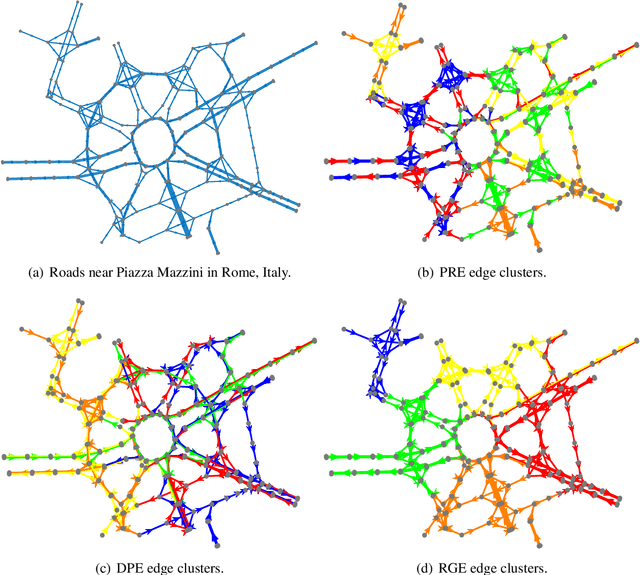
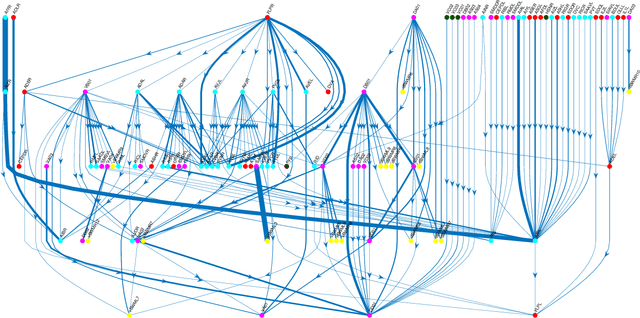
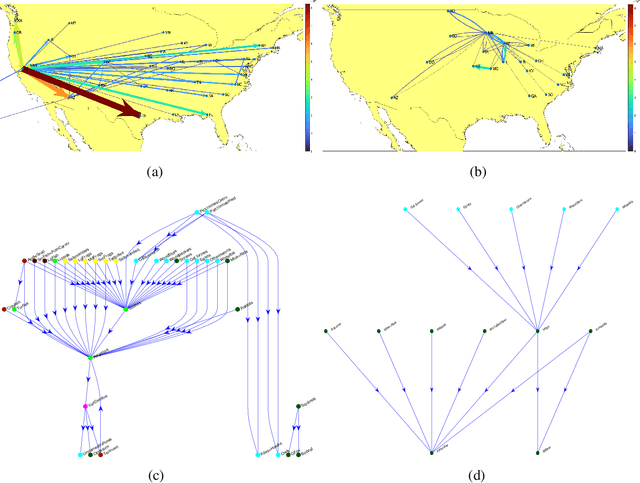
How do vertices exert influence in graph data? We develop a framework for edge clustering, a new method for exploratory data analysis that reveals how both vertices and edges collaboratively accomplish directed influence in graphs, especially for directed graphs. In contrast to the ubiquitous vertex clustering which groups vertices, edge clustering groups edges. Edges sharing a functional affinity are assigned to the same group and form an influence subgraph cluster. With a complexity comparable to that of vertex clustering, this framework presents three different methods for edge spectral clustering that reveal important influence subgraphs in graph data, with each method providing different insight into directed influence processes. We present several diverse examples demonstrating the potential for widespread application of edge clustering in scientific research.