 Add to Chrome
 Add to Firefox
 Add to Edge
Skin Lesion Identification
Papers and Code
Adaptive Hybrid Optimizer based Framework for Lumpy Skin Disease Identification
Jan 05, 2026
Lumpy Skin Disease (LSD) is a contagious viral infection that significantly deteriorates livestock health, thereby posing a serious threat to the global economy and food security. Owing to its rapid spread characteristics, early and precise identification is crucial to prevent outbreaks and ensure timely intervention. In this paper, we propose a hybrid deep learning-based approach called LUMPNet for the early detection of LSD. LUMPNet utilizes image data to detect and classify skin nodules -- the primary indicator of LSD. To this end, LUMPNet uses YOLOv11, EfficientNet-based CNN classifier with compound scaling, and a novel adaptive hybrid optimizer. More precisely, LUMPNet detects and localizes LSD skin nodules and lesions on cattle images. It exploits EfficientNet to classify the localized cattle images into LSD-affected or healthy categories. To stabilize and accelerate the training of YOLOv11 and EfficientNet hybrid model, a novel adaptive hybrid optimizer is proposed and utilized. We evaluate LUMPNet at various stages of LSD using a publicly available dataset. Results indicate that the proposed scheme achieves 99% LSD detection training accuracy, and outperforms existing schemes. The model also achieves validation accuracy of 98%. Moreover, for further evaluation, we conduct a case study using an optimized EfficientNet-B0 model trained with the AdamW optimizer, and compare its performance with LUMPNet. The results show that LUMPNet achieves superior performance.

LSSF-Net: Lightweight Segmentation with Self-Awareness, Spatial Attention, and Focal Modulation
Sep 03, 2024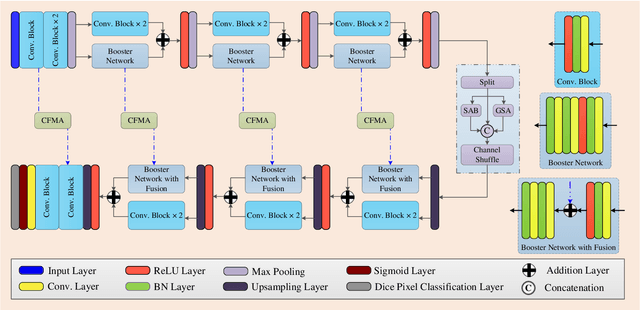
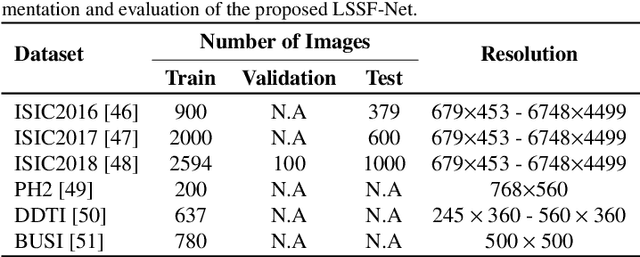

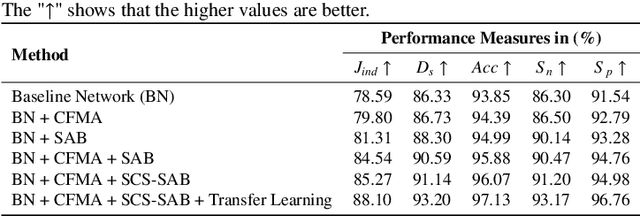
Accurate segmentation of skin lesions within dermoscopic images plays a crucial role in the timely identification of skin cancer for computer-aided diagnosis on mobile platforms. However, varying shapes of the lesions, lack of defined edges, and the presence of obstructions such as hair strands and marker colors make this challenge more complex. \textcolor{red}Additionally, skin lesions often exhibit subtle variations in texture and color that are difficult to differentiate from surrounding healthy skin, necessitating models that can capture both fine-grained details and broader contextual information. Currently, melanoma segmentation models are commonly based on fully connected networks and U-Nets. However, these models often struggle with capturing the complex and varied characteristics of skin lesions, such as the presence of indistinct boundaries and diverse lesion appearances, which can lead to suboptimal segmentation performance.To address these challenges, we propose a novel lightweight network specifically designed for skin lesion segmentation utilizing mobile devices, featuring a minimal number of learnable parameters (only 0.8 million). This network comprises an encoder-decoder architecture that incorporates conformer-based focal modulation attention, self-aware local and global spatial attention, and split channel-shuffle. The efficacy of our model has been evaluated on four well-established benchmark datasets for skin lesion segmentation: ISIC 2016, ISIC 2017, ISIC 2018, and PH2. Empirical findings substantiate its state-of-the-art performance, notably reflected in a high Jaccard index.
Non-parametric regularization for class imbalance federated medical image classification
Jul 17, 2024Limited training data and severe class imbalance pose significant challenges to developing clinically robust deep learning models. Federated learning (FL) addresses the former by enabling different medical clients to collaboratively train a deep model without sharing privacy-sensitive data. However, class imbalance worsens due to variation in inter-client class distribution. We propose federated learning with non-parametric regularization (FedNPR and FedNPR-Per, a personalized version of FedNPR) to regularize the feature extractor and enhance useful and discriminative signal in the feature space. Our extensive experiments show that FedNPR outperform the existing state-of-the art FL approaches in class imbalance skin lesion classification and intracranial hemorrhage identification. Additionally, the non-parametric regularization module consistently improves the performance of existing state-of-the-art FL approaches. We believe that NPR is a valuable tool in FL under clinical settings.
Data-Algorithm-Architecture Co-Optimization for Fair Neural Networks on Skin Lesion Dataset
Jul 18, 2024As Artificial Intelligence (AI) increasingly integrates into our daily lives, fairness has emerged as a critical concern, particularly in medical AI, where datasets often reflect inherent biases due to social factors like the underrepresentation of marginalized communities and socioeconomic barriers to data collection. Traditional approaches to mitigating these biases have focused on data augmentation and the development of fairness-aware training algorithms. However, this paper argues that the architecture of neural networks, a core component of Machine Learning (ML), plays a crucial role in ensuring fairness. We demonstrate that addressing fairness effectively requires a holistic approach that simultaneously considers data, algorithms, and architecture. Utilizing Automated ML (AutoML) technology, specifically Neural Architecture Search (NAS), we introduce a novel framework, BiaslessNAS, designed to achieve fair outcomes in analyzing skin lesion datasets. BiaslessNAS incorporates fairness considerations at every stage of the NAS process, leading to the identification of neural networks that are not only more accurate but also significantly fairer. Our experiments show that BiaslessNAS achieves a 2.55% increase in accuracy and a 65.50% improvement in fairness compared to traditional NAS methods, underscoring the importance of integrating fairness into neural network architecture for better outcomes in medical AI applications.
GDN: A Stacking Network Used for Skin Cancer Diagnosis
Dec 05, 2023Skin cancer, the primary type of cancer that can be identified by visual recognition, requires an automatic identification system that can accurately classify different types of lesions. This paper presents GoogLe-Dense Network (GDN), which is an image-classification model to identify two types of skin cancer, Basal Cell Carcinoma, and Melanoma. GDN uses stacking of different networks to enhance the model performance. Specifically, GDN consists of two sequential levels in its structure. The first level performs basic classification tasks accomplished by GoogLeNet and DenseNet, which are trained in parallel to enhance efficiency. To avoid low accuracy and long training time, the second level takes the output of the GoogLeNet and DenseNet as the input for a logistic regression model. We compare our method with four baseline networks including ResNet, VGGNet, DenseNet, and GoogLeNet on the dataset, in which GoogLeNet and DenseNet significantly outperform ResNet and VGGNet. In the second level, different stacking methods such as perceptron, logistic regression, SVM, decision trees and K-neighbor are studied in which Logistic Regression shows the best prediction result among all. The results prove that GDN, compared to a single network structure, has higher accuracy in optimizing skin cancer detection.
Application of Machine Learning in Melanoma Detection and the Identification of 'Ugly Duckling' and Suspicious Naevi: A Review
Sep 05, 2023
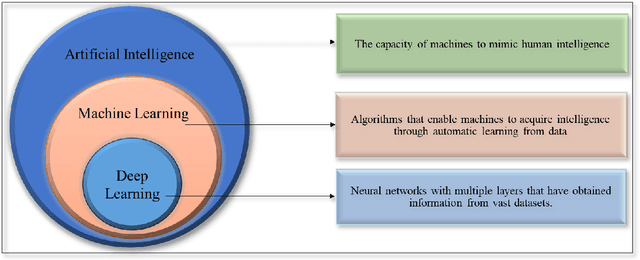

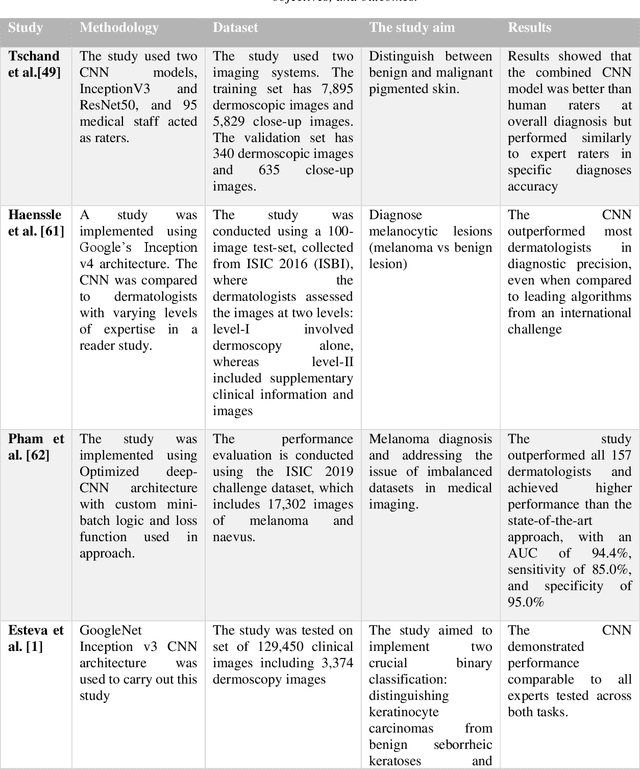
Skin lesions known as naevi exhibit diverse characteristics such as size, shape, and colouration. The concept of an "Ugly Duckling Naevus" comes into play when monitoring for melanoma, referring to a lesion with distinctive features that sets it apart from other lesions in the vicinity. As lesions within the same individual typically share similarities and follow a predictable pattern, an ugly duckling naevus stands out as unusual and may indicate the presence of a cancerous melanoma. Computer-aided diagnosis (CAD) has become a significant player in the research and development field, as it combines machine learning techniques with a variety of patient analysis methods. Its aim is to increase accuracy and simplify decision-making, all while responding to the shortage of specialized professionals. These automated systems are especially important in skin cancer diagnosis where specialist availability is limited. As a result, their use could lead to life-saving benefits and cost reductions within healthcare. Given the drastic change in survival when comparing early stage to late-stage melanoma, early detection is vital for effective treatment and patient outcomes. Machine learning (ML) and deep learning (DL) techniques have gained popularity in skin cancer classification, effectively addressing challenges, and providing results equivalent to that of specialists. This article extensively covers modern Machine Learning and Deep Learning algorithms for detecting melanoma and suspicious naevi. It begins with general information on skin cancer and different types of naevi, then introduces AI, ML, DL, and CAD. The article then discusses the successful applications of various ML techniques like convolutional neural networks (CNN) for melanoma detection compared to dermatologists' performance. Lastly, it examines ML methods for UD naevus detection and identifying suspicious naevi.
Data augmentation and explainability for bias discovery and mitigation in deep learning
Aug 18, 2023This dissertation explores the impact of bias in deep neural networks and presents methods for reducing its influence on model performance. The first part begins by categorizing and describing potential sources of bias and errors in data and models, with a particular focus on bias in machine learning pipelines. The next chapter outlines a taxonomy and methods of Explainable AI as a way to justify predictions and control and improve the model. Then, as an example of a laborious manual data inspection and bias discovery process, a skin lesion dataset is manually examined. A Global Explanation for the Bias Identification method is proposed as an alternative semi-automatic approach to manual data exploration for discovering potential biases in data. Relevant numerical methods and metrics are discussed for assessing the effects of the identified biases on the model. Whereas identifying errors and bias is critical, improving the model and reducing the number of flaws in the future is an absolute priority. Hence, the second part of the thesis focuses on mitigating the influence of bias on ML models. Three approaches are proposed and discussed: Style Transfer Data Augmentation, Targeted Data Augmentations, and Attribution Feedback. Style Transfer Data Augmentation aims to address shape and texture bias by merging a style of a malignant lesion with a conflicting shape of a benign one. Targeted Data Augmentations randomly insert possible biases into all images in the dataset during the training, as a way to make the process random and, thus, destroy spurious correlations. Lastly, Attribution Feedback is used to fine-tune the model to improve its accuracy by eliminating obvious mistakes and teaching it to ignore insignificant input parts via an attribution loss. The goal of these approaches is to reduce the influence of bias on machine learning models, rather than eliminate it entirely.
SkinDistilViT: Lightweight Vision Transformer for Skin Lesion Classification
Aug 16, 2023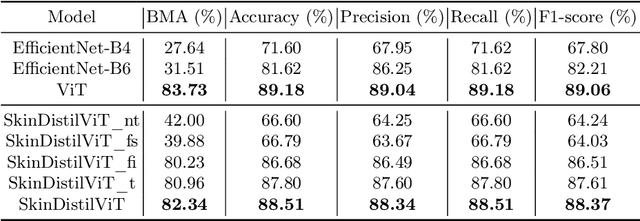
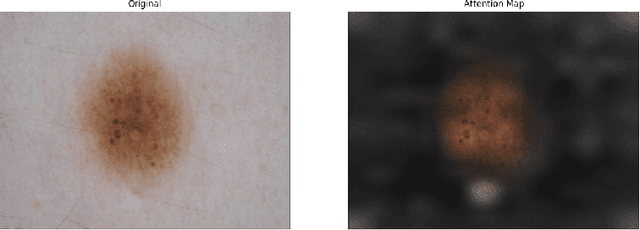
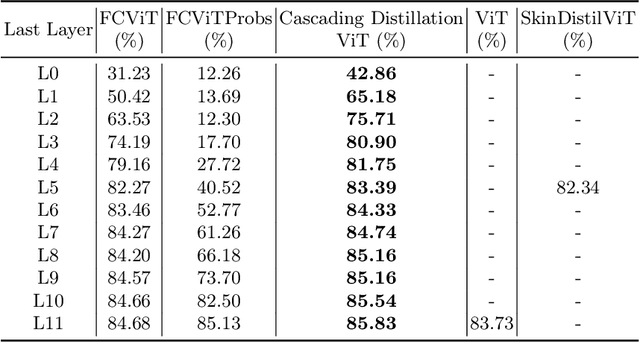
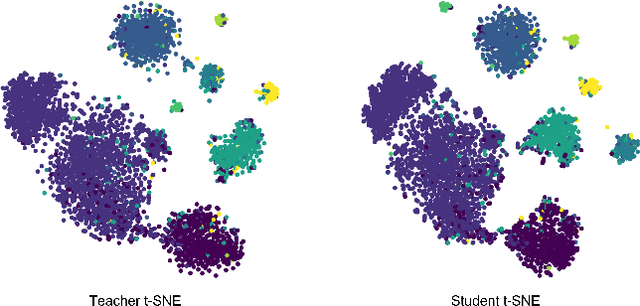
Skin cancer is a treatable disease if discovered early. We provide a production-specific solution to the skin cancer classification problem that matches human performance in melanoma identification by training a vision transformer on melanoma medical images annotated by experts. Since inference cost, both time and memory wise is important in practice, we employ knowledge distillation to obtain a model that retains 98.33% of the teacher's balanced multi-class accuracy, at a fraction of the cost. Memory-wise, our model is 49.60% smaller than the teacher. Time-wise, our solution is 69.25% faster on GPU and 97.96% faster on CPU. By adding classification heads at each level of the transformer and employing a cascading distillation process, we improve the balanced multi-class accuracy of the base model by 2.1%, while creating a range of models of various sizes but comparable performance. We provide the code at https://github.com/Longman-Stan/SkinDistilVit.
Generative Adversarial Networks based Skin Lesion Segmentation
May 29, 2023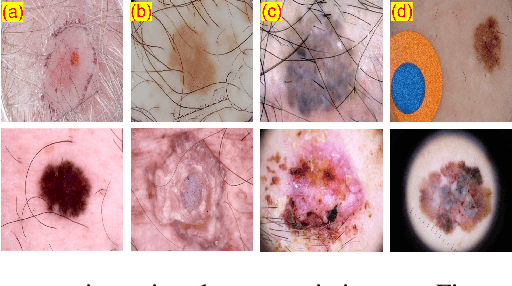
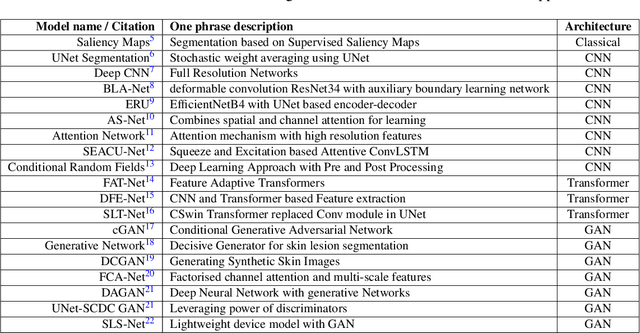
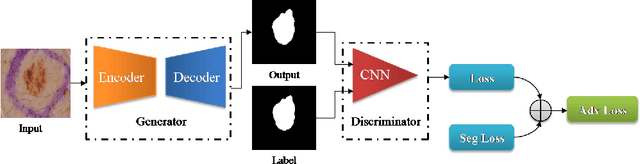

Skin cancer is a serious condition that requires accurate identification and treatment. One way to assist clinicians in this task is by using computer-aided diagnosis (CAD) tools that can automatically segment skin lesions from dermoscopic images. To this end, a new adversarial learning-based framework called EGAN has been developed. This framework uses an unsupervised generative network to generate accurate lesion masks. It consists of a generator module with a top-down squeeze excitation-based compound scaled path and an asymmetric lateral connection-based bottom-up path, and a discriminator module that distinguishes between original and synthetic masks. Additionally, a morphology-based smoothing loss is implemented to encourage the network to create smooth semantic boundaries of lesions. The framework is evaluated on the International Skin Imaging Collaboration (ISIC) Lesion Dataset 2018 and outperforms the current state-of-the-art skin lesion segmentation approaches with a Dice coefficient, Jaccard similarity, and Accuracy of 90.1%, 83.6%, and 94.5%, respectively. This represents a 2% increase in Dice Coefficient, 1% increase in Jaccard Index, and 1% increase in Accuracy.
Deep Learning based Novel Cascaded Approach for Skin Lesion Analysis
Jan 16, 2023
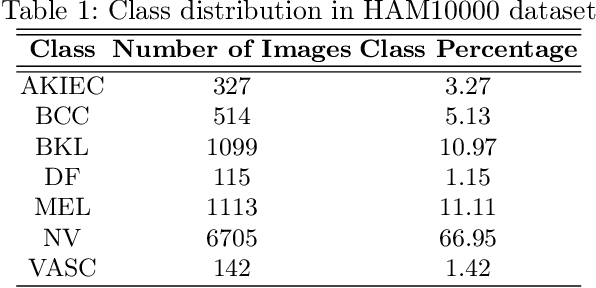

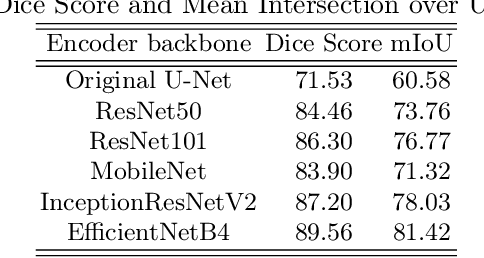
Automatic lesion analysis is critical in skin cancer diagnosis and ensures effective treatment. The computer aided diagnosis of such skin cancer in dermoscopic images can significantly reduce the clinicians workload and help improve diagnostic accuracy. Although researchers are working extensively to address this problem, early detection and accurate identification of skin lesions remain challenging. This research focuses on a two step framework for skin lesion segmentation followed by classification for lesion analysis. We explored the effectiveness of deep convolutional neural network based architectures by designing an encoder-decoder architecture for skin lesion segmentation and CNN based classification network. The proposed approaches are evaluated quantitatively in terms of the Accuracy, mean Intersection over Union and Dice Similarity Coefficient. Our cascaded end to end deep learning based approach is the first of its kind, where the classification accuracy of the lesion is significantly improved because of prior segmentation.