 Add to Chrome
 Add to Firefox
 Add to Edge
LaDe: Unified Multi-Layered Graphic Media Generation and Decomposition
Mar 18, 2026
Media design layer generation enables the creation of fully editable, layered design documents such as posters, flyers, and logos using only natural language prompts. Existing methods either restrict outputs to a fixed number of layers or require each layer to contain only spatially continuous regions, causing the layer count to scale linearly with design complexity. We propose LaDe (Layered Media Design), a latent diffusion framework that generates a flexible number of semantically meaningful layers. LaDe combines three components: an LLM-based prompt expander that transforms a short user intent into structured per-layer descriptions that guide the generation, a Latent Diffusion Transformer with a 4D RoPE positional encoding mechanism that jointly generates the full media design and its constituent RGBA layers, and an RGBA VAE that decodes each layer with full alpha-channel support. By conditioning on layer samples during training, our unified framework supports three tasks: text-to-image generation, text-to-layers media design generation, and media design decomposition. We compare LaDe to Qwen-Image-Layered on text-to-layers and image-to-layers tasks on the Crello test set. LaDe outperforms Qwen-Image-Layered in text-to-layers generation by improving text-to-layer alignment, as validated by two VLM-as-a-judge evaluators (GPT-4o mini and Qwen3-VL).

SkinDistilViT: Lightweight Vision Transformer for Skin Lesion Classification
Aug 16, 2023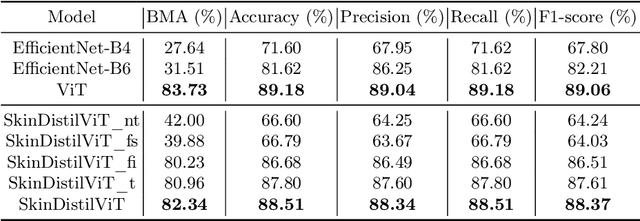
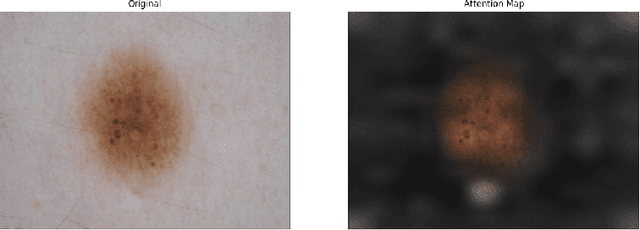
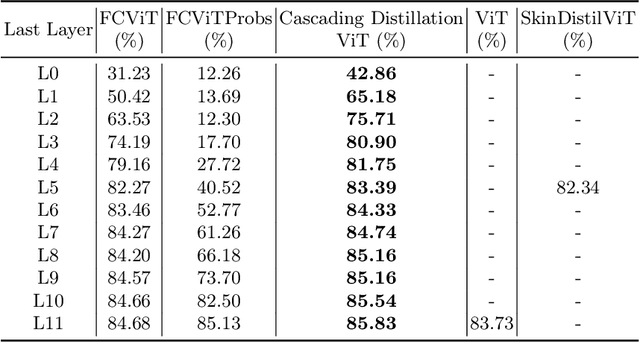
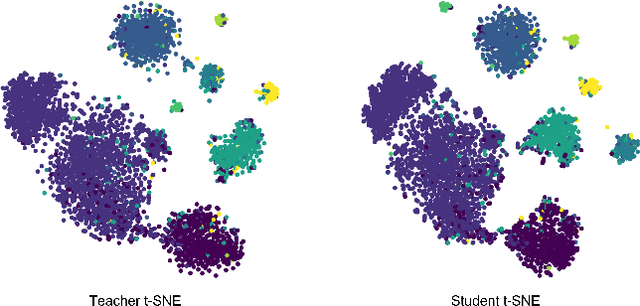
Skin cancer is a treatable disease if discovered early. We provide a production-specific solution to the skin cancer classification problem that matches human performance in melanoma identification by training a vision transformer on melanoma medical images annotated by experts. Since inference cost, both time and memory wise is important in practice, we employ knowledge distillation to obtain a model that retains 98.33% of the teacher's balanced multi-class accuracy, at a fraction of the cost. Memory-wise, our model is 49.60% smaller than the teacher. Time-wise, our solution is 69.25% faster on GPU and 97.96% faster on CPU. By adding classification heads at each level of the transformer and employing a cascading distillation process, we improve the balanced multi-class accuracy of the base model by 2.1%, while creating a range of models of various sizes but comparable performance. We provide the code at https://github.com/Longman-Stan/SkinDistilVit.