 Add to Chrome
 Add to Firefox
 Add to Edge
RankLLM: Weighted Ranking of LLMs by Quantifying Question Difficulty
Feb 12, 2026
Benchmarks establish a standardized evaluation framework to systematically assess the performance of large language models (LLMs), facilitating objective comparisons and driving advancements in the field. However, existing benchmarks fail to differentiate question difficulty, limiting their ability to effectively distinguish models' capabilities. To address this limitation, we propose RankLLM, a novel framework designed to quantify both question difficulty and model competency. RankLLM introduces difficulty as the primary criterion for differentiation, enabling a more fine-grained evaluation of LLM capabilities. RankLLM's core mechanism facilitates bidirectional score propagation between models and questions. The core intuition of RankLLM is that a model earns a competency score when it correctly answers a question, while a question's difficulty score increases when it challenges a model. Using this framework, we evaluate 30 models on 35,550 questions across multiple domains. RankLLM achieves 90% agreement with human judgments and consistently outperforms strong baselines such as IRT. It also exhibits strong stability, fast convergence, and high computational efficiency, making it a practical solution for large-scale, difficulty-aware LLM evaluation.

Speech Emotion Recognition with Phonation Excitation Information and Articulatory Kinematics
Nov 11, 2025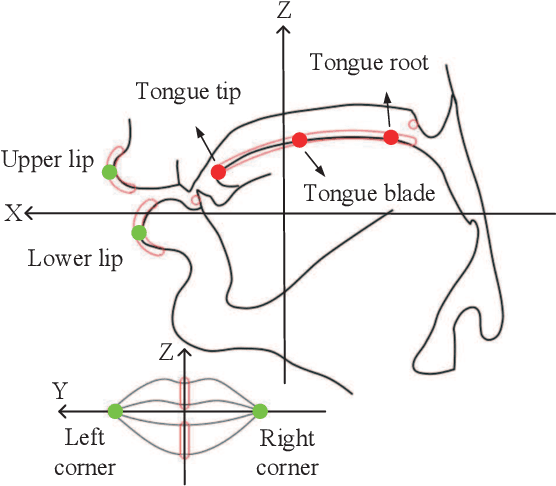
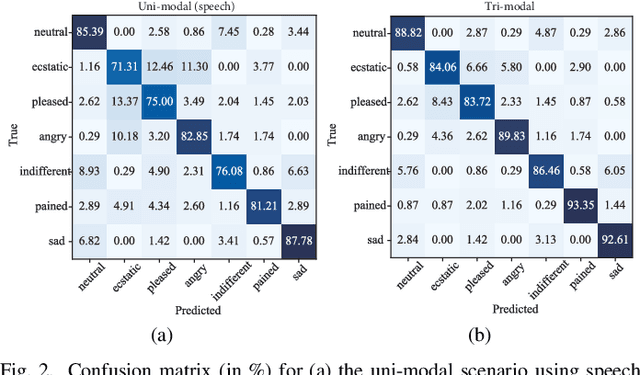
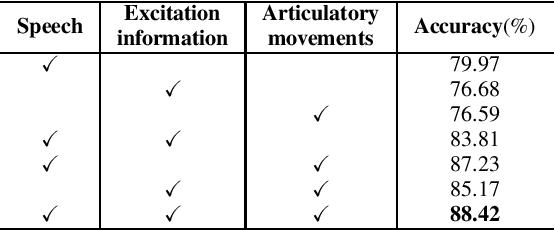
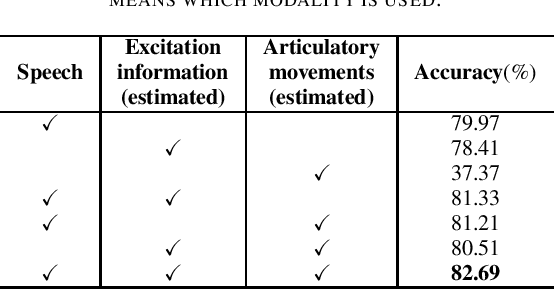
Speech emotion recognition (SER) has advanced significantly for the sake of deep-learning methods, while textual information further enhances its performance. However, few studies have focused on the physiological information during speech production, which also encompasses speaker traits, including emotional states. To bridge this gap, we conducted a series of experiments to investigate the potential of the phonation excitation information and articulatory kinematics for SER. Due to the scarcity of training data for this purpose, we introduce a portrayed emotional dataset, STEM-E2VA, which includes audio and physiological data such as electroglottography (EGG) and electromagnetic articulography (EMA). EGG and EMA provide information of phonation excitation and articulatory kinematics, respectively. Additionally, we performed emotion recognition using estimated physiological data derived through inversion methods from speech, instead of collected EGG and EMA, to explore the feasibility of applying such physiological information in real-world SER. Experimental results confirm the effectiveness of incorporating physiological information about speech production for SER and demonstrate its potential for practical use in real-world scenarios.
TransforMARS: Fault-Tolerant Self-Reconfiguration for Arbitrarily Shaped Modular Aerial Robot Systems
Sep 17, 2025Modular Aerial Robot Systems (MARS) consist of multiple drone modules that are physically bound together to form a single structure for flight. Exploiting structural redundancy, MARS can be reconfigured into different formations to mitigate unit or rotor failures and maintain stable flight. Prior work on MARS self-reconfiguration has solely focused on maximizing controllability margins to tolerate a single rotor or unit fault for rectangular-shaped MARS. We propose TransforMARS, a general fault-tolerant reconfiguration framework that transforms arbitrarily shaped MARS under multiple rotor and unit faults while ensuring continuous in-air stability. Specifically, we develop algorithms to first identify and construct minimum controllable assemblies containing faulty units. We then plan feasible disassembly-assembly sequences to transport MARS units or subassemblies to form target configuration. Our approach enables more flexible and practical feasible reconfiguration. We validate TransforMARS in challenging arbitrarily shaped MARS configurations, demonstrating substantial improvements over prior works in both the capacity of handling diverse configurations and the number of faults tolerated. The videos and source code of this work are available at the anonymous repository: https://anonymous.4open.science/r/TransforMARS-1030/
GDN: A Stacking Network Used for Skin Cancer Diagnosis
Dec 05, 2023Skin cancer, the primary type of cancer that can be identified by visual recognition, requires an automatic identification system that can accurately classify different types of lesions. This paper presents GoogLe-Dense Network (GDN), which is an image-classification model to identify two types of skin cancer, Basal Cell Carcinoma, and Melanoma. GDN uses stacking of different networks to enhance the model performance. Specifically, GDN consists of two sequential levels in its structure. The first level performs basic classification tasks accomplished by GoogLeNet and DenseNet, which are trained in parallel to enhance efficiency. To avoid low accuracy and long training time, the second level takes the output of the GoogLeNet and DenseNet as the input for a logistic regression model. We compare our method with four baseline networks including ResNet, VGGNet, DenseNet, and GoogLeNet on the dataset, in which GoogLeNet and DenseNet significantly outperform ResNet and VGGNet. In the second level, different stacking methods such as perceptron, logistic regression, SVM, decision trees and K-neighbor are studied in which Logistic Regression shows the best prediction result among all. The results prove that GDN, compared to a single network structure, has higher accuracy in optimizing skin cancer detection.
Implementing a new fully stepwise decomposition-based sampling technique for the hybrid water level forecasting model in real-world application
Sep 19, 2023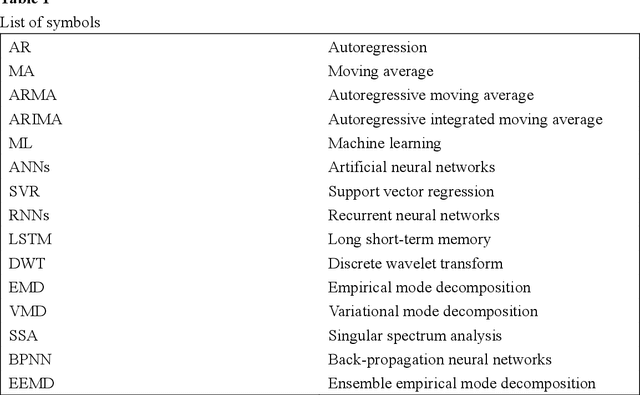
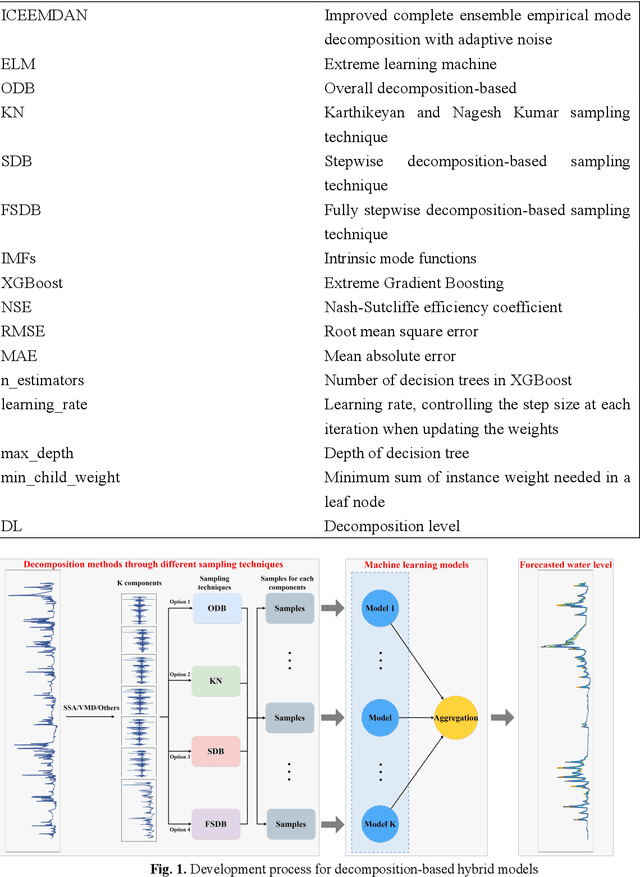
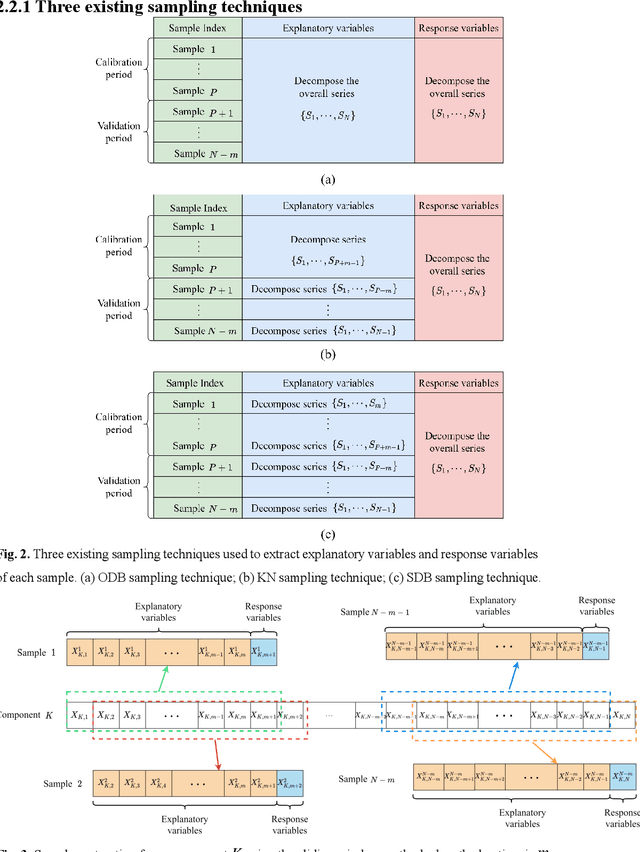
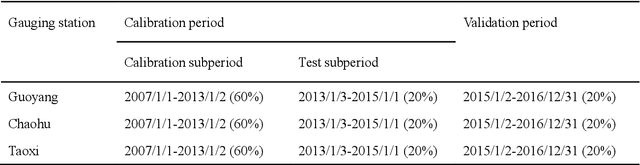
Various time variant non-stationary signals need to be pre-processed properly in hydrological time series forecasting in real world, for example, predictions of water level. Decomposition method is a good candidate and widely used in such a pre-processing problem. However, decomposition methods with an inappropriate sampling technique may introduce future data which is not available in practical applications, and result in incorrect decomposition-based forecasting models. In this work, a novel Fully Stepwise Decomposition-Based (FSDB) sampling technique is well designed for the decomposition-based forecasting model, strictly avoiding introducing future information. This sampling technique with decomposition methods, such as Variational Mode Decomposition (VMD) and Singular spectrum analysis (SSA), is applied to predict water level time series in three different stations of Guoyang and Chaohu basins in China. Results of VMD-based hybrid model using FSDB sampling technique show that Nash-Sutcliffe Efficiency (NSE) coefficient is increased by 6.4%, 28.8% and 7.0% in three stations respectively, compared with those obtained from the currently most advanced sampling technique. In the meantime, for series of SSA-based experiments, NSE is increased by 3.2%, 3.1% and 1.1% respectively. We conclude that the newly developed FSDB sampling technique can be used to enhance the performance of decomposition-based hybrid model in water level time series forecasting in real world.
Multi-agent Continual Coordination via Progressive Task Contextualization
May 07, 2023Cooperative Multi-agent Reinforcement Learning (MARL) has attracted significant attention and played the potential for many real-world applications. Previous arts mainly focus on facilitating the coordination ability from different aspects (e.g., non-stationarity, credit assignment) in single-task or multi-task scenarios, ignoring the stream of tasks that appear in a continual manner. This ignorance makes the continual coordination an unexplored territory, neither in problem formulation nor efficient algorithms designed. Towards tackling the mentioned issue, this paper proposes an approach Multi-Agent Continual Coordination via Progressive Task Contextualization, dubbed MACPro. The key point lies in obtaining a factorized policy, using shared feature extraction layers but separated independent task heads, each specializing in a specific class of tasks. The task heads can be progressively expanded based on the learned task contextualization. Moreover, to cater to the popular CTDE paradigm in MARL, each agent learns to predict and adopt the most relevant policy head based on local information in a decentralized manner. We show in multiple multi-agent benchmarks that existing continual learning methods fail, while MACPro is able to achieve close-to-optimal performance. More results also disclose the effectiveness of MACPro from multiple aspects like high generalization ability.