 Add to Chrome
 Add to Firefox
 Add to Edge
An Ensemble Learning Approach towards Waste Segmentation in Cluttered Environment
Feb 14, 2026
Environmental pollution is a critical global issue, with recycling emerging as one of the most viable solutions. This study focuses on waste segregation, a crucial step in recycling processes to obtain raw material. Recent advancements in computer vision have significantly contributed to waste classification and recognition. In waste segregation, segmentation masks are essential for robots to accurately localize and pick objects from conveyor belts. The complexity of real-world waste environments, characterized by deformed items without specific patterns and overlapping objects, further complicates waste segmentation tasks. This paper proposes an Ensemble Learning approach to improve segmentation accuracy by combining high performing segmentation models, U-Net and FPN, using a weighted average method. U-Net excels in capturing fine details and boundaries in segmentation tasks, while FPN effectively handles scale variation and context in complex environments, and their combined masks result in more precise predictions. The dataset used closely mimics real-life waste scenarios, and preprocessing techniques were applied to enhance feature learning for deep learning segmentation models. The ensemble model, referred to as EL-4, achieved an IoU value of 0.8306, an improvement over U-Net's 0.8065, and reduced Dice loss to 0.09019 from FPN's 0.1183. This study could contribute to the efficiency of waste sorting at Material Recovery Facility, facilitating better raw material acquisition for recycling with minimal human intervention and enhancing the overall throughput.

LSSF-Net: Lightweight Segmentation with Self-Awareness, Spatial Attention, and Focal Modulation
Sep 03, 2024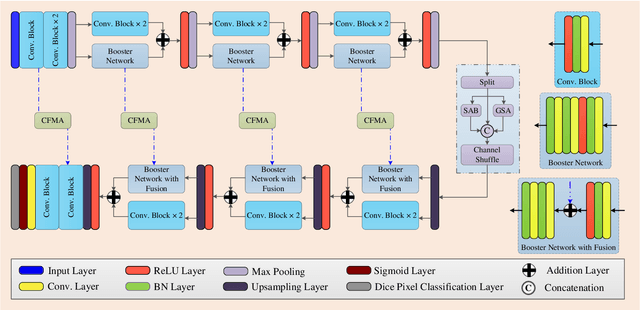
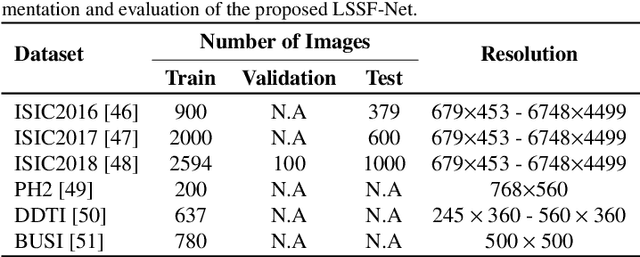

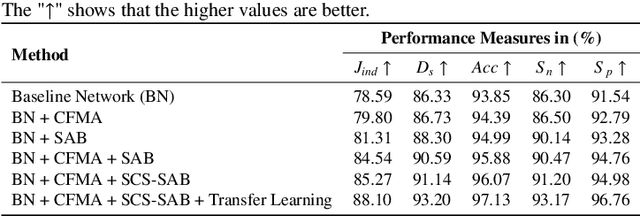
Accurate segmentation of skin lesions within dermoscopic images plays a crucial role in the timely identification of skin cancer for computer-aided diagnosis on mobile platforms. However, varying shapes of the lesions, lack of defined edges, and the presence of obstructions such as hair strands and marker colors make this challenge more complex. \textcolor{red}Additionally, skin lesions often exhibit subtle variations in texture and color that are difficult to differentiate from surrounding healthy skin, necessitating models that can capture both fine-grained details and broader contextual information. Currently, melanoma segmentation models are commonly based on fully connected networks and U-Nets. However, these models often struggle with capturing the complex and varied characteristics of skin lesions, such as the presence of indistinct boundaries and diverse lesion appearances, which can lead to suboptimal segmentation performance.To address these challenges, we propose a novel lightweight network specifically designed for skin lesion segmentation utilizing mobile devices, featuring a minimal number of learnable parameters (only 0.8 million). This network comprises an encoder-decoder architecture that incorporates conformer-based focal modulation attention, self-aware local and global spatial attention, and split channel-shuffle. The efficacy of our model has been evaluated on four well-established benchmark datasets for skin lesion segmentation: ISIC 2016, ISIC 2017, ISIC 2018, and PH2. Empirical findings substantiate its state-of-the-art performance, notably reflected in a high Jaccard index.
A Residual Encoder-Decoder Network for Segmentation of Retinal Image-Based Exudates in Diabetic Retinopathy Screening
Jan 16, 2022

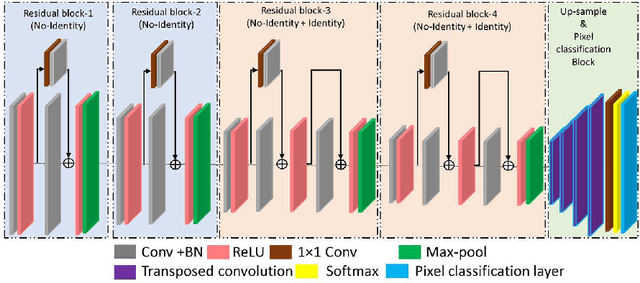
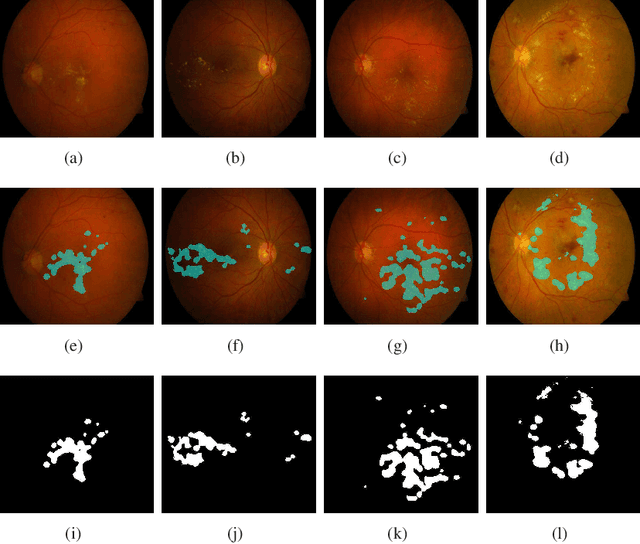
Diabetic retinopathy refers to the pathology of the retina induced by diabetes and is one of the leading causes of preventable blindness in the world. Early detection of diabetic retinopathy is critical to avoid vision problem through continuous screening and treatment. In traditional clinical practice, the involved lesions are manually detected using photographs of the fundus. However, this task is cumbersome and time-consuming and requires intense effort due to the small size of lesion and low contrast of the images. Thus, computer-assisted diagnosis of diabetic retinopathy based on the detection of red lesions is actively being explored recently. In this paper, we present a convolutional neural network with residual skip connection for the segmentation of exudates in retinal images. To improve the performance of network architecture, a suitable image augmentation technique is used. The proposed network can robustly segment exudates with high accuracy, which makes it suitable for diabetic retinopathy screening. Comparative performance analysis of three benchmark databases: HEI-MED, E-ophtha, and DiaretDB1 is presented. It is shown that the proposed method achieves accuracy (0.98, 0.99, 0.98) and sensitivity (0.97, 0.92, and 0.95) on E-ophtha, HEI-MED, and DiaReTDB1, respectively.