 Add to Chrome
 Add to Firefox
 Add to Edge
Simulated Micro Doppler Signatures
Papers and Code
Represent Micro-Doppler Signature in Orders
Feb 13, 2026
Non-line-of-sight sensing of human activities in complex environments is enabled by multiple-input multiple-output through-the-wall radar (TWR). However, the distinctiveness of micro-Doppler signature between similar indoor human activities such as gun carrying and normal walking is minimal, while the large scale of input images required for effective identification utilizing time-frequency spectrograms creates challenges for model training and inference efficiency. To address this issue, the Chebyshev-time map is proposed in this paper, which is a method characterizing micro-Doppler signature using polynomial orders. The parametric kinematic models for human motion and the TWR echo model are first established. Then, a time-frequency feature representation method based on orthogonal Chebyshev polynomial decomposition is proposed. The kinematic envelopes of the torso and limbs are extracted, and the time-frequency spectrum slices are mapped into a robust Chebyshev-time coefficient space, preserving the multi-order morphological detail information of time-frequency spectrum. Numerical simulations and experiments are conducted to verify the effectiveness of the proposed method, which demonstrates the capability to characterize armed and unarmed indoor human activities while effectively compressing the scale of the time-frequency spectrum to achieve a balance between recognition accuracy and input data dimensions. The open-source code of this paper can be found in: https://github.com/JoeyBGOfficial/Represent-Micro-Doppler-Signature-in-Orders.

Practical Evaluation of Quantum Kernel Methods for Radar Micro-Doppler Classification on Noisy Intermediate-Scale Quantum (NISQ) Hardware
Jan 29, 2026This paper examines the application of a Quantum Support Vector Machine (QSVM) for radarbased aerial target classification using micro-Doppler signatures. Classical features are extracted and reduced via Principal Component Analysis (PCA) to enable efficient quantum encoding. The reduced feature vectors are embedded into a quantum kernel-induced feature space using a fully entangled ZZFeatureMap and classified using a kernel based QSVM. Performance is first evaluated on a quantum simulator and subsequently validated on NISQ-era superconducting quantum hardware, specifically the IBM Torino (133-qubit) and IBM Fez (156-qubit) processors. Experimental results demonstrate that the QSVM achieves competitive classification performance relative to classical SVM baselines while operating on substantially reduced feature dimensionality. Hardware experiments reveal the impact of noise and decoherence and measurement shot count on quantum kernel estimation, and further show improved stability and fidelity on newer Heron r2 architecture. This study provides a systematic comparison between simulator-based and hardware-based QSVM implementations and highlights both the feasibility and current limitations of deploying quantum kernel methods for practical radar signal classification tasks.
Deep Learning-based Human Gesture Channel Modeling for Integrated Sensing and Communication Scenarios
Jul 09, 2025With the development of Integrated Sensing and Communication (ISAC) for Sixth-Generation (6G) wireless systems, contactless human recognition has emerged as one of the key application scenarios. Since human gesture motion induces subtle and random variations in wireless multipath propagation, how to accurately model human gesture channels has become a crucial issue for the design and validation of ISAC systems. To this end, this paper proposes a deep learning-based human gesture channel modeling framework for ISAC scenarios, in which the human body is decomposed into multiple body parts, and the mapping between human gestures and their corresponding multipath characteristics is learned from real-world measurements. Specifically, a Poisson neural network is employed to predict the number of Multi-Path Components (MPCs) for each human body part, while Conditional Variational Auto-Encoders (C-VAEs) are reused to generate the scattering points, which are further used to reconstruct continuous channel impulse responses and micro-Doppler signatures. Simulation results demonstrate that the proposed method achieves high accuracy and generalization across different gestures and subjects, providing an interpretable approach for data augmentation and the evaluation of gesture-based ISAC systems.
Through-the-Wall Radar Human Activity Recognition WITHOUT Using Neural Networks
Jun 05, 2025After a few years of research in the field of through-the-wall radar (TWR) human activity recognition (HAR), I found that we seem to be stuck in the mindset of training on radar image data through neural network models. The earliest related works in this field based on template matching did not require a training process, and I believe they have never died. Because these methods possess a strong physical interpretability and are closer to the basis of theoretical signal processing research. In this paper, I would like to try to return to the original path by attempting to eschew neural networks to achieve the TWR HAR task and challenge to achieve intelligent recognition as neural network models. In detail, the range-time map and Doppler-time map of TWR are first generated. Then, the initial regions of the human target foreground and noise background on the maps are determined using corner detection method, and the micro-Doppler signature is segmented using the multiphase active contour model. The micro-Doppler segmentation feature is discretized into a two-dimensional point cloud. Finally, the topological similarity between the resulting point cloud and the point clouds of the template data is calculated using Mapper algorithm to obtain the recognition results. The effectiveness of the proposed method is demonstrated by numerical simulated and measured experiments. The open-source code of this work is released at: https://github.com/JoeyBGOfficial/Through-the-Wall-Radar-Human-Activity-Recognition-Without-Using-Neural-Networks.
Modeling Micro-Doppler Signature of Multi-Propeller Drones in Distributed ISAC
Apr 07, 2025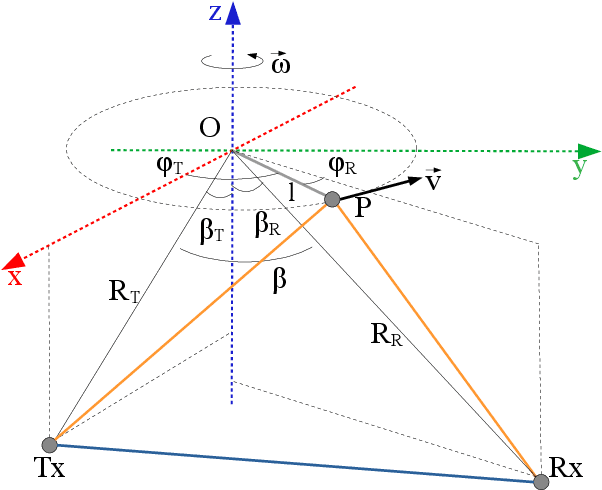
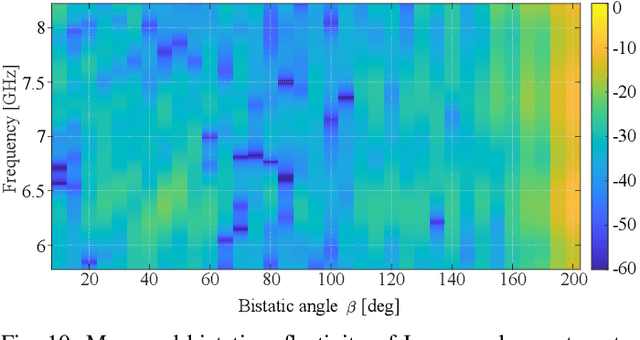
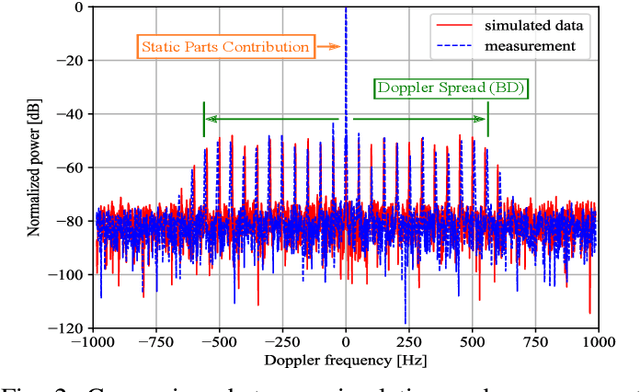
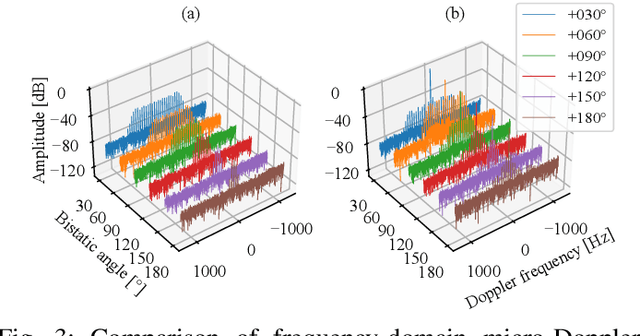
Integrated Sensing and Communication (ISAC) will be one key feature of future 6G networks, enabling simultaneous communication and radar sensing. The radar sensing geometry of ISAC will be multistatic since that corresponds to the common distributed structure of a mobile communication network. Within this framework, micro-Doppler analysis plays a vital role in classifying targets based on their micromotions, such as rotating propellers, vibration, or moving limbs. However, research on bistatic micro-Doppler effects, particularly in ISAC systems utilizing OFDM waveforms, remains limited. Existing methods, including electromagnetic simulations often lack scalability for generating the large datasets required to train machine learning algorithms. To address this gap, this work introduces an OFDM-based bistatic micro-Doppler model for multi-propeller drones. The proposed model adapts the classic thin-wire model to include bistatic sensing configuration with an OFDM-like signal. Then, it extends further by incorporating multiple propellers and integrating the reflectivity of the drone's static parts. Measurements were performed to collect ground truth data for verification of the proposed model. Validation results show that the model generates micro-Doppler signatures closely resembling those obtained from measurements, demonstrating its potential as a tool for data generation. In addition, it offers a comprehensive approach to analyzing bistatic micro-Doppler effects.
Through-the-Wall Radar Human Activity Micro-Doppler Signature Representation Method Based on Joint Boulic-Sinusoidal Pendulum Model
Aug 22, 2024
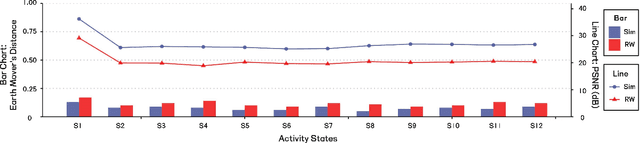
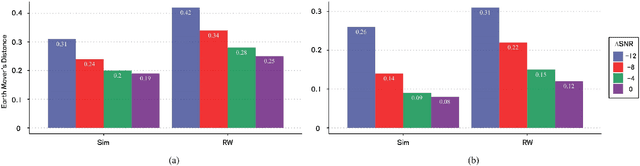

With the help of micro-Doppler signature, ultra-wideband (UWB) through-the-wall radar (TWR) enables the reconstruction of range and velocity information of limb nodes to accurately identify indoor human activities. However, existing methods are usually trained and validated directly using range-time maps (RTM) and Doppler-time maps (DTM), which have high feature redundancy and poor generalization ability. In order to solve this problem, this paper proposes a human activity micro-Doppler signature representation method based on joint Boulic-sinusoidal pendulum motion model. In detail, this paper presents a simplified joint Boulic-sinusoidal pendulum human motion model by taking head, torso, both hands and feet into consideration improved from Boulic-Thalmann kinematic model. The paper also calculates the minimum number of key points needed to describe the Doppler and micro-Doppler information sufficiently. Both numerical simulations and experiments are conducted to verify the effectiveness. The results demonstrate that the proposed number of key points of micro-Doppler signature can precisely represent the indoor human limb node motion characteristics, and substantially improve the generalization capability of the existing methods for different testers.
Synthesis of Through-Wall Micro-Doppler Signatures of Human Motions Using Generative Adversarial Networks
Apr 12, 2024Narrowband radar micro-Doppler signatures are heavily used to identify and classify human activities. When the radar is operated in through-wall environments, the complex electromagnetic propagation phenomenology introduces considerable distortions in the micro-Doppler signatures through attenuation and multipath. The problem is particularly severe in inhomogeneous wall scenarios involving multiple wall layers, air gaps, or metal reinforcements. Through-wall radar data collection using simulations and measurements involves significant time and effort. In this paper, we propose an alternative method of synthesizing through-wall radar micro-Doppler signatures from their free space counterparts using the generative adversarial network (GAN). We train the GAN using radar micro-Doppler signatures generated from electromagnetic simulations. We generate the radar data for different human motions, along different orientations, and under diverse through-wall conditions. The synthetic radar micro-Dopplers generated from the neural networks are then evaluated for their realism using a denoising autoencoder, which shows an excellent realism score.
Interference Motion Removal for Doppler Radar Vital Sign Detection Using Variational Encoder-Decoder Neural Network
Apr 12, 2024

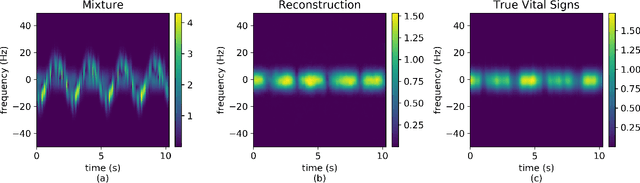

The treatment of interfering motion contributions remains one of the key challenges in the domain of radar-based vital sign monitoring. Removal of the interference to extract the vital sign contributions is demanding due to overlapping Doppler bands, the complex structure of the interference motions and significant variations in the power levels of their contributions. A novel approach to the removal of interference through the use of a probabilistic deep learning model is presented. Results show that a convolutional encoder-decoder neural network with a variational objective is capable of learning a meaningful representation space of vital sign Doppler-time distribution facilitating their extraction from a mixture signal. The approach is tested on semi-experimental data containing real vital sign signatures and simulated returns from interfering body motions. The application of the proposed network enhances the extraction of the micro-Doppler frequency corresponding to the respiration rate is demonstrated.
Sounding-Based Evaluation of Multi-Sensor ISAC Networks for Drone Applications: Measurement and Simulation Perspectives
Feb 26, 2024
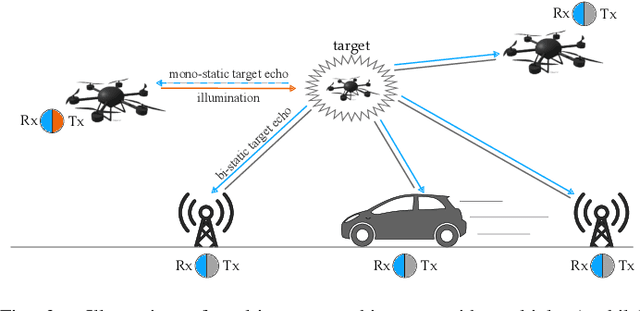
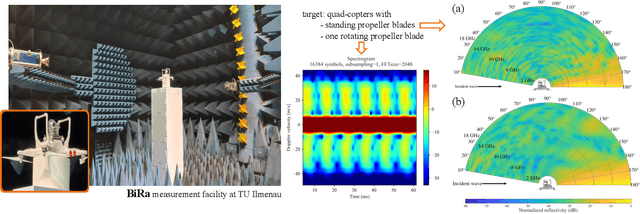
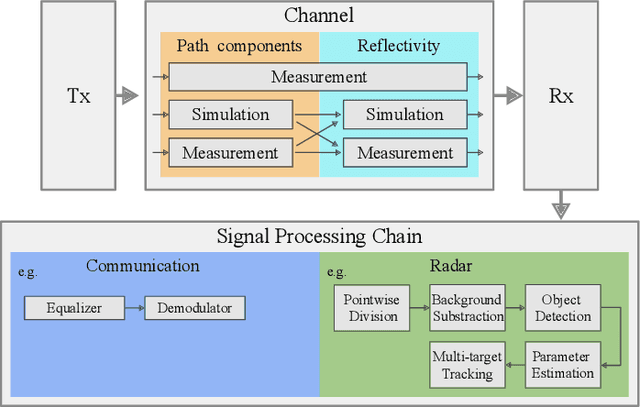
With the upcoming multitude of commercial and public applications envisioned in the mobile 6G radio landscape using unmanned aerial vehicles (UAVs), integrated sensing and communication (ISAC) plays a key role to enable the detection and localization of passive objects with radar sensing, while optimizing the utilization of scarce resources. To explore the potential of future ISAC architectures with UAVs as mobile nodes in distributed multi-sensor networks, the system's fundamental capability to detect static and dynamic objects that reveal themselves by their bi-static back-scattering needs to be evaluated. Therefore, this paper addresses simulation- and measurement based data acquisition methods to gather knowledge about the bistatic reflectivity of single objects including their Micro-Doppler signature for object identification as well as the influence of multipath propagation in different environments on the localization accuracy and radar tracking performance. We show exemplary results from simulation models, bi-static reflectivity measurements in laboratory environment and real-flight channel sounding experiments in selected scenarios showcasing the potential of synthetic and measured data sets for development and evaluation of ISAC algorithms. The presented measurement data sets are publicly available to encourage the academic RF community to validate future algorithms using realistic scenarios alongside simulations models.
Sensing with OFDM Waveform at mmWave Band based on Micro-Doppler Analysis
Mar 29, 2023Joint communication and sensing (JCAS) technology has been regarded as one of the innovations in the 6G network. With the channel modeling proposed by the 3rd Generation Partnership Project (3GPP) TR 38.901, this paper investigates the sensing capability using the millimeter-wave (mmWave) band with an orthogonal frequency division multiplexing (OFDM) waveform. Based on micro-Doppler (MD) analysis, we present two case studies, i.e., fan speed detection and human activity recognition, to demonstrate the target modeling with micro-motions, backscattering signal construction, and MD signature extraction using an OFDM waveform at 28 GHz. Simulated signatures demonstrate distinct fan rotation or human motion, and waveform parameters that affect the MD signature extraction are analyzed. Simulation results draw the validity of the proposed modeling and simulation methods, which also aim to facilitate the generation of data sets for various JCAS applications.