 Add to Chrome
 Add to Firefox
 Add to Edge
Super-Resolution Experimental Validation and Polarimetric Extension of the Effective Roughness Diffuse Scattering Models
May 29, 2026
The experimental validation of diffuse scattering models has long been limited by the inability to spatially separate specular and diffuse contributions in measured channels. This paper overcomes this limitation by combining super-resolution multipath component (MPC) extraction, which resolves individual propagation paths including the specular component, with digital-twin-assisted geometry, enabling the spatial separation of specular and diffuse contributions from bistatic measurements at 28~GHz. Using this framework, we provide the first measurement-driven validation of the Effective Roughness (ER) model with independent characterization of diffuse scattering across ten common building materials, each measured over 266 angular configurations and all polarization combinations (HH, HV, VH, VV). Furthermore, we extend the ER framework by proposing a novel angle-dependent cross-polarization discrimination (XPD) model, capturing the geometry-dependent nature of depolarization that is neglected in existing approaches. The proposed method reproduces the measured diffuse power trends, achieving RMSE values as low as 3 dB across the tested materials, and improves XPD prediction over the baseline constant-XPD model for nearly all material-polarization cases. These results establish a physically consistent and practically viable approach for high-fidelity channel modeling in mmWave systems.

Ray-Based Simulation of Scattering from Discretized Curved Bodies for Vehicular and ISAC Applications
Apr 07, 2026Realistic modeling of scattering from curved metallic bodies - such as vehicles and roadside structures - is essential for cellular and vehicular channel modeling as well as radar applications. A practical approach is to approximate curved surfaces with planar facets and apply ray-tracing with diffraction methods; however, accuracy depends critically on both geometric discretization and diffraction modeling. This work investigates ray-tracing-based modeling of near-field scattering from curved bodies, including the forward (shadow) region, using the Uniform Theory of Diffraction (UTD), extended with vertex diffraction and double-bounce interactions. A discretization strategy linking facet size to local curvature and wavelength is proposed to balance geometric fidelity, computational accuracy and efficiency. Validation is performed against analytical solutions and full-wave simulations for canonical geometries (sphere and circular cylinder), as well as a realistic vehicle model to demonstrate the method's practical relevance. Results show that appropriate discretization combined with extended diffraction modeling significantly improves scattering prediction from curved bodies, providing a computationally efficient framework for vehicular propagation and integrated sensing and communication (ISAC) channel modeling.
A Ray-Based Characterization of Satellite-to-Urban Propagation
Mar 26, 2026The evolution toward 6G communication systems is expected to rely on integrated three-dimensional network architectures where terrestrial infrastructures coexist with non-terrestrial stations such as satellites, enabling ubiquitous connectivity and service continuity. In this context, accurate channel models for satellite-to-ground propagation in urban environments are essential, particularly for user equipment located at street level where obstruction and multipath effects are significant. This work investigates satellite-to-urban propagation through deterministic ray-tracing simulations. Three representative urban layouts are considered, namely dense urban, urban, and suburban. Multiple use cases are investigated, including handheld devices, vehicular terminals, and fixed rooftop receivers operating across several frequency bands. The analysis focuses on the relative importance of competing propagation mechanisms and on two key channel parameters, namely the Rician K-factor and the delay spread, which are relevant for the calibration of channel models to be used in link- and system-level simulations. Results highlight the strong - and in some cases unconventional - dependence of channel dispersion and fading characteristics on satellite elevation, antenna placement, and urban morphology.
Transform-Invariant Generative Ray Path Sampling for Efficient Radio Propagation Modeling
Mar 02, 2026Ray tracing has become a standard for accurate radio propagation modeling, but suffers from exponential computational complexity, as the number of candidate paths scales with the number of objects raised to the power of the interaction order. This bottleneck limits its use in large-scale or real-time applications, forcing traditional tools to rely on heuristics to reduce the number of path candidates at the cost of potentially reduced accuracy. To overcome this limitation, we propose a comprehensive machine-learning-assisted framework that replaces exhaustive path searching with intelligent sampling via Generative Flow Networks. Applying such generative models to this domain presents significant challenges, particularly sparse rewards due to the rarity of valid paths, which can lead to convergence failures and trivial solutions when evaluating high-order interactions in complex environments. To ensure robust learning and efficient exploration, our framework incorporates three key architectural components. First, we implement an \emph{experience replay buffer} to capture and retain rare valid paths. Second, we adopt a uniform exploratory policy to improve generalization and prevent the model from overfitting to simple geometries. Third, we apply a physics-based action masking strategy that filters out physically impossible paths before the model even considers them. As demonstrated in our experimental validation, the proposed model achieves substantial speedups over exhaustive search -- up to $10\times$ faster on GPU and $1000\times$ faster on CPU -- while maintaining high coverage accuracy and successfully uncovering complex propagation paths. The complete source code, tests, and tutorial are available at https://github.com/jeertmans/sampling-paths.
Deep Learning-based Human Gesture Channel Modeling for Integrated Sensing and Communication Scenarios
Jul 09, 2025With the development of Integrated Sensing and Communication (ISAC) for Sixth-Generation (6G) wireless systems, contactless human recognition has emerged as one of the key application scenarios. Since human gesture motion induces subtle and random variations in wireless multipath propagation, how to accurately model human gesture channels has become a crucial issue for the design and validation of ISAC systems. To this end, this paper proposes a deep learning-based human gesture channel modeling framework for ISAC scenarios, in which the human body is decomposed into multiple body parts, and the mapping between human gestures and their corresponding multipath characteristics is learned from real-world measurements. Specifically, a Poisson neural network is employed to predict the number of Multi-Path Components (MPCs) for each human body part, while Conditional Variational Auto-Encoders (C-VAEs) are reused to generate the scattering points, which are further used to reconstruct continuous channel impulse responses and micro-Doppler signatures. Simulation results demonstrate that the proposed method achieves high accuracy and generalization across different gestures and subjects, providing an interpretable approach for data augmentation and the evaluation of gesture-based ISAC systems.
Methodologies for Future Vehicular Digital Twins
Dec 15, 2023
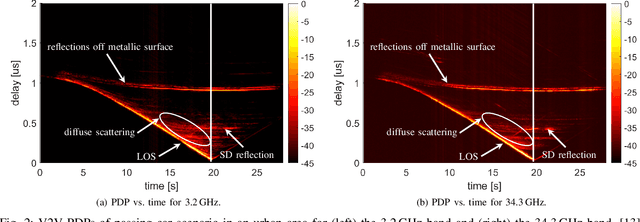
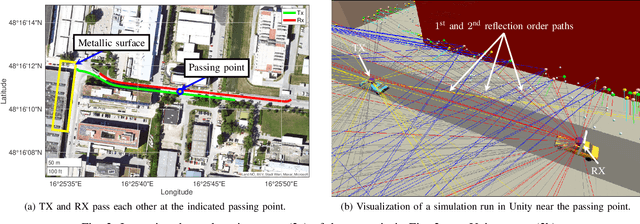
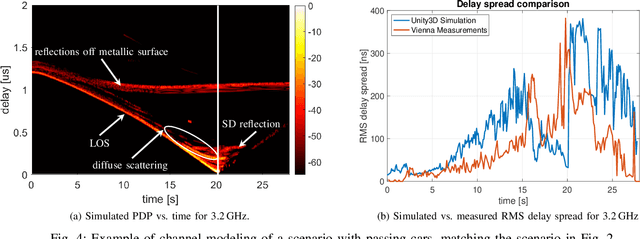
The role of wireless communications in various domains of intelligent transportation systems is significant; it is evident that dependable message exchange between nodes (cars, bikes, pedestrians, infrastructure, etc.) has to be guaranteed to fulfill the stringent requirements for future transportation systems. A precise site-specific digital twin is seen as a key enabler for the cost-effective development and validation of future vehicular communication systems. Furthermore, achieving a realistic digital twin for dependable wireless communications requires accurate measurement, modeling, and emulation of wireless communication channels. However, contemporary approaches in these domains are not efficient enough to satisfy the foreseen needs. In this position paper, we overview the current solutions, indicate their limitations, and discuss the most prospective paths for future investigation.
A Study on mm-wave Propagation in and around Buildings
Oct 13, 2022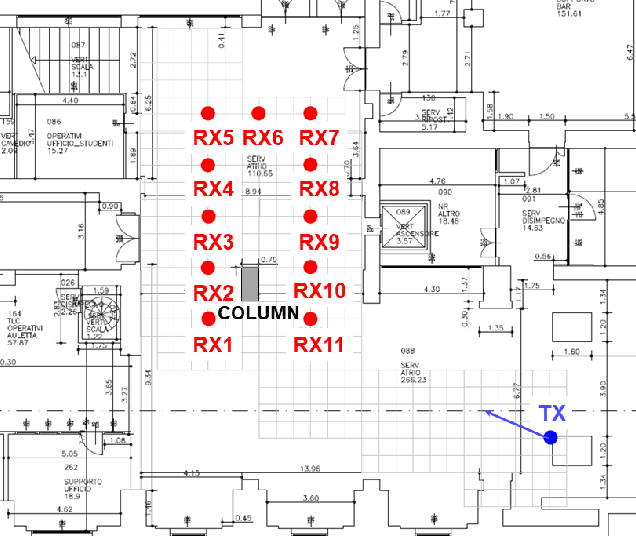
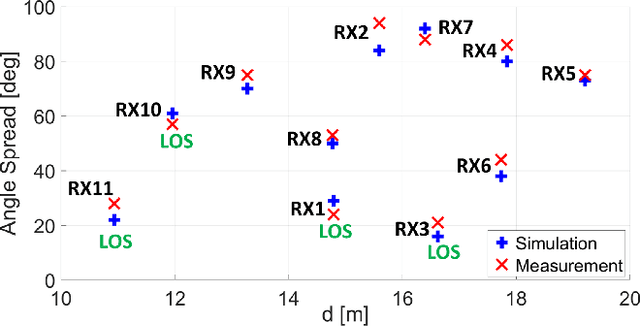
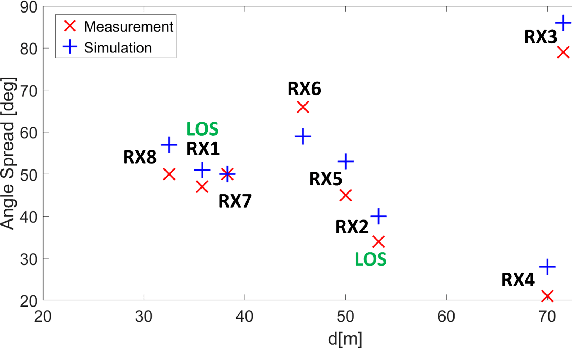
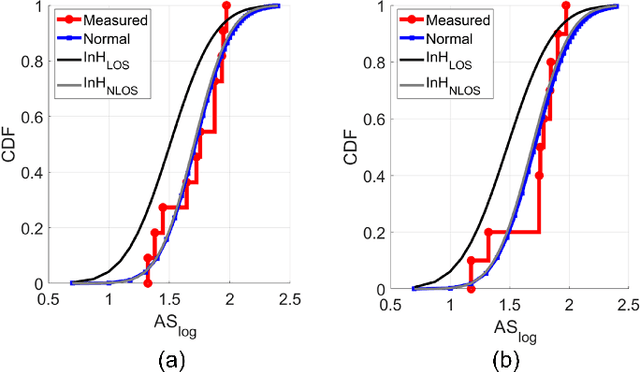
mm-waves are envisaged as key enabler for 5G and 6G wireless communications, thanks to the wider bandwidth and to the possibility of implementing large-scale antenna arrays and new advanced transmission techniques, such as massive MIMO and beamforming, that can take advantage of the multidimensional properties of the wireless channel. In order to further study the mm-wave wireless channel, where propagation shows different characteristics compared to the sub-6 GHz band, a joint measurement and simulation campaigns in indoor and outdoor microcellular environments has been carried out. The investigation highlights that the traditional assumption that mm-wave NLoS propagation is problematic is not true since significant reflections, scattering and even transmission mechanisms provide good NLoS coverage in most indoor and outdoor scenarios. This also reflects in the limited angle-spread differences between LoS and NLoS locations in some cases. Finally, the contribution of different propagation mechanisms (reflection, diffraction, scattering and combination of them) to the received power is analyzed in the paper with the help of ray tracing simulations.
On Dynamic Ray Tracing and Anticipative Channel Prediction for Dynamic Environments
Apr 30, 2022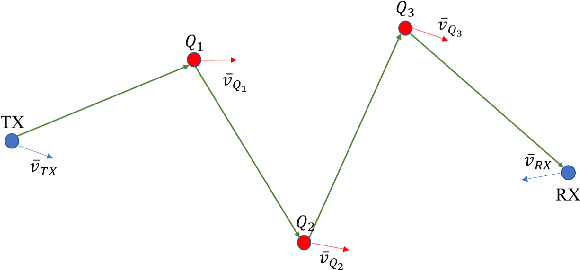
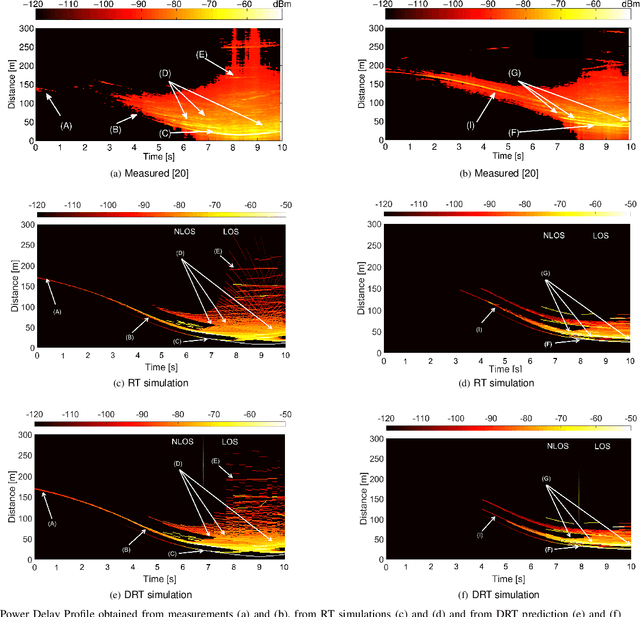
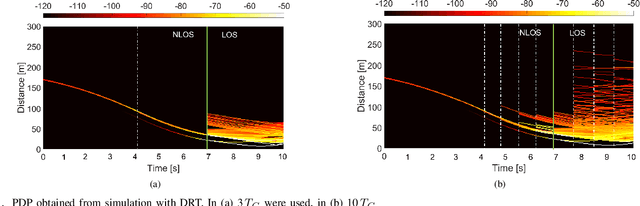
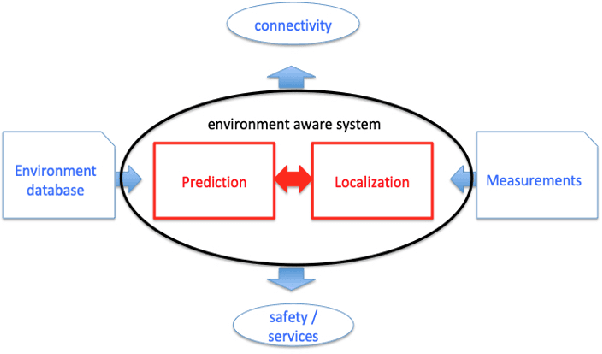
Ray tracing algorithms, that can simulate multipath radio propagation in presence of geometric obstacles such as buildings, objects or vehicles, are becoming quite popular, due to the increasing availability of digital environment databases and high-performance computation platforms, such as multicore computers and cloud computing services. When objects or vehicles are moving, which is the case of industrial or vehicular environments, multiple successive representations of the environment ("snapshots") and multiple ray tracing runs are often necessary, which require a great human effort and a great deal of computation resources. Recently, the Dynamic Ray Tracing (DRT) approach has been proposed to predict the multipath evolution within a given time lapse on the base of the current multipath geometry, assuming constant speeds and/or accelerations for moving objects, using analytical extrapolation formulas. This is done without re-running a full ray tracing for every "snapshot" of the environment, therefore with a great computation time saving. When DRT is embedded in a mobile radio system and used in real-time, ahead-of-time (or anticipative) field prediction is possible that opens the way to interesting applications. In the present work, a full-3D DRT algorithm is presented that allows to account for multiple reflections, edge diffraction and diffuse scattering for the general case where moving objects can translate and rotate. For the purpose of validation, the model is first applied to some ideal cases and then to realistic cases where results are compared with conventional ray tracing simulation and measurements available in the literature.
Characterizing the UAV-to-Machine UWB Radio Channel in Smart Factories
Apr 19, 2021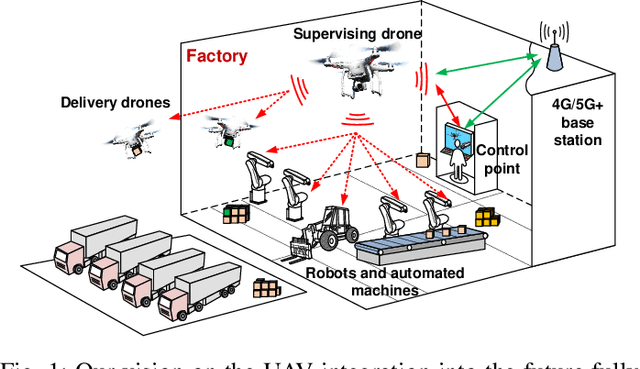
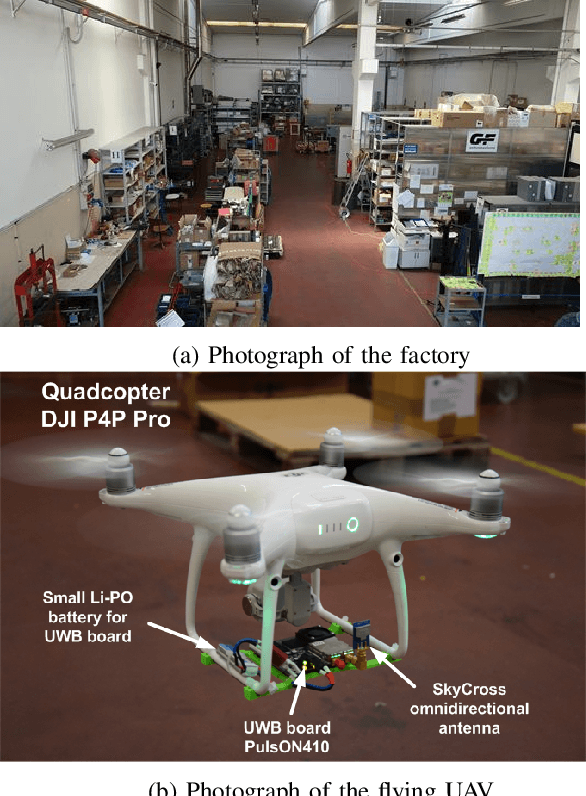
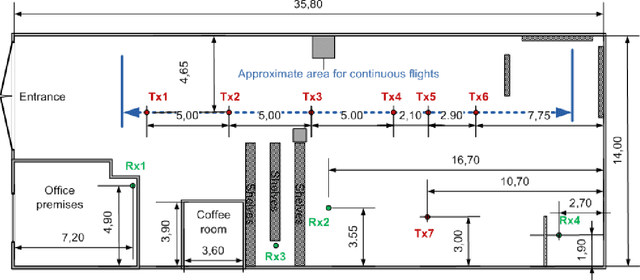
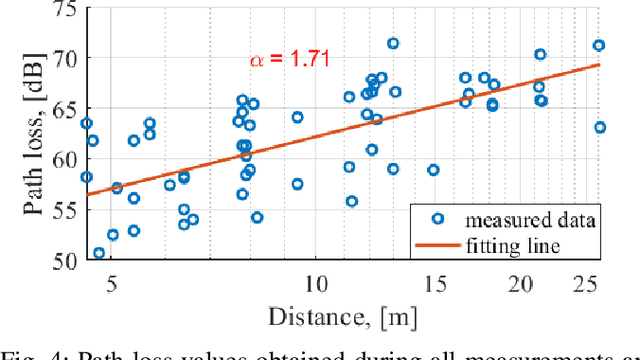
In this work, the results of Ultra-Wideband air-to-ground measurements carried out in a real-world factory environment are presented and discussed. With intelligent in-dustrial deployments in mind, we envision a scenario where the Unmanned Aerial Vehicle can be used as a supplementary tool for factory operation, optimization and control. Measurements address narrow band and wide band characterization of the wireless radio channel, and can be used for link budget calculation, interference studies and time dispersion assessment in real factories, without the usual limitation for both radio terminals to be close to ground. The measurements are performed at different locations and different heights over the 3.1-5.3 GHz band. Some fundamental propagation parameters values are determined vs. distance, height and propagation conditions. The measurements are complemented with, and compared to, conventional ground-to-ground measurements with the same setup. The conducted measurement campaign gives an insight for realizing wireless applications in smart connected factories, including UAV-assisted applications.
Empirical Characterization of Air-to-ground Propagation at mm-Wave Frequencies in Dense Urban Environment
Jan 04, 2021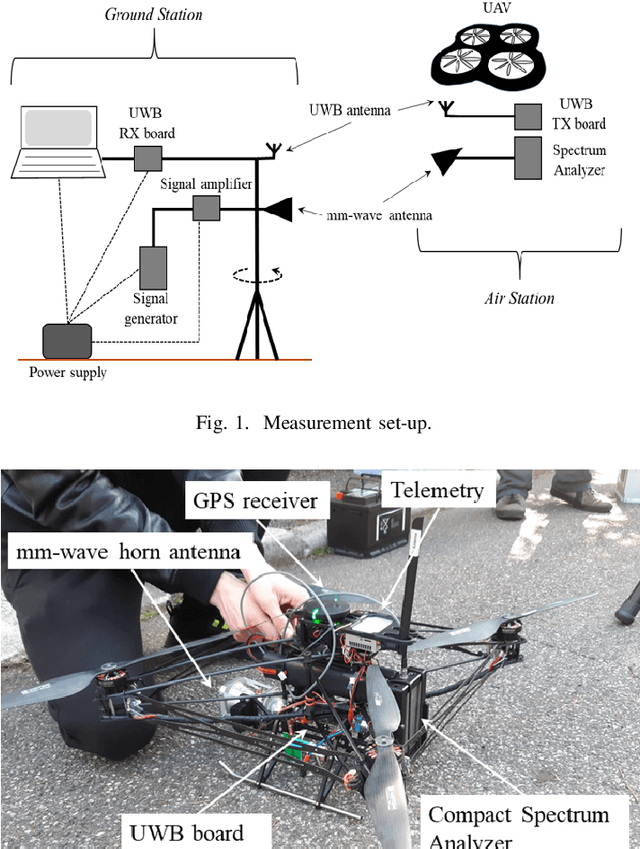
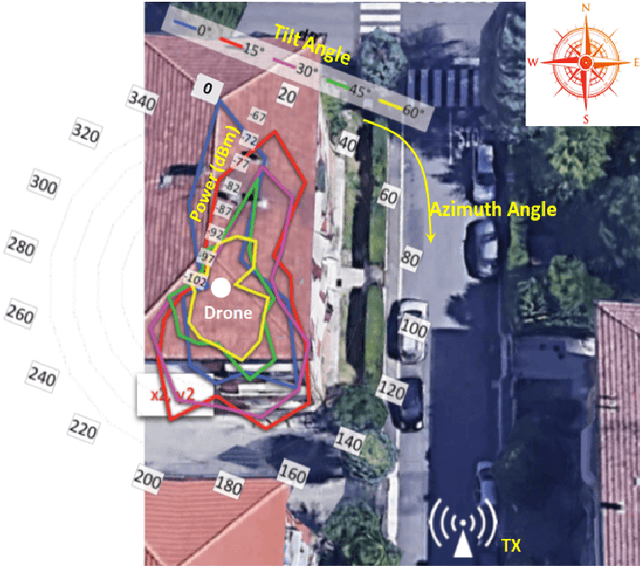
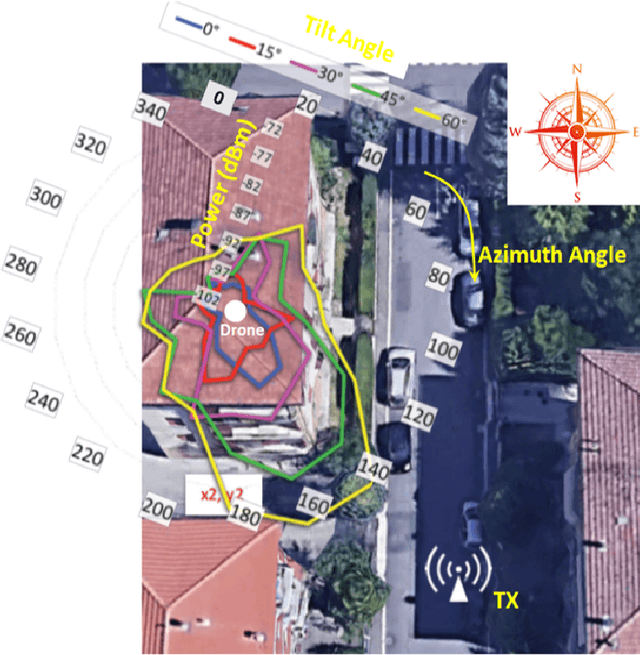
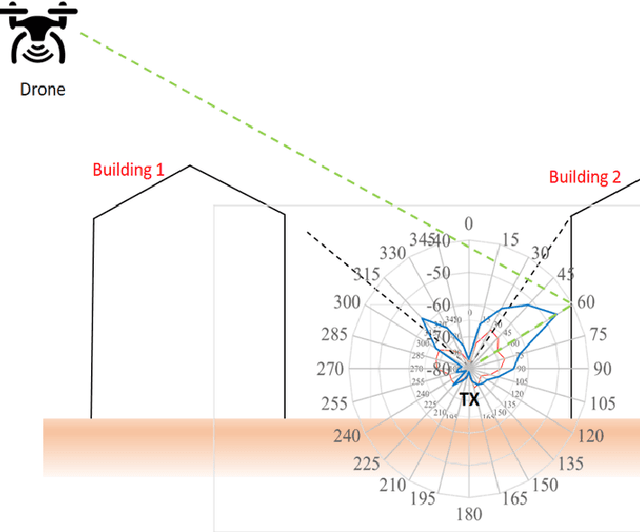
In the present study, a measurement setup utilizing mm-wave transceivers with steerable directive antennas, mounted on both a customized UAV and a ground station has been used to study Air-to-Ground (A2G) radio links and, more generally, full-3D mm-wave propagation in urban environment. We evaluate the double-directional characteristics of the channel by rotating the antennas, deriving Power-Angle Profiles at both link ends. Preliminary results provide useful understanding of A2G propagation, e.g. the influence of the antenna tilt angles, or the mechanisms allowing for the signal to propagate from street canyons to the air.