 Add to Chrome
 Add to Firefox
 Add to Edge
Detecting radar targets swarms in range profiles with a partially complex-valued neural network
Feb 10, 2026
Correctly detecting radar targets is usually challenged by clutter and waveform distortion. An additional difficulty stems from the relative proximity of several targets, the latter being perceived as a single target in the worst case, or influencing each other's detection thresholds. The negative impact of targets proximity notably depends on the range resolution defined by the radar parameters and the adaptive threshold adopted. This paper addresses the matter of targets detection in radar range profiles containing multiple targets with varying proximity and distorted echoes. Inspired by recent contributions in the radar and signal processing literature, this work proposes partially complex-valued neural networks as an adaptive range profile processing. Simulated datasets are generated and experiments are conducted to compare a common pulse compression approach with a simple neural network partially defined by complex-valued parameters. Whereas the pulse compression processes one pulse length at a time, the neural network put forward is a generative architecture going through the entire received signal in one go to generate a complete detection profile.

Near out-of-distribution detection for low-resolution radar micro-Doppler signatures
May 12, 2022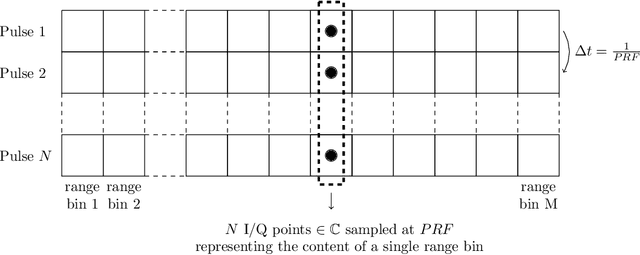
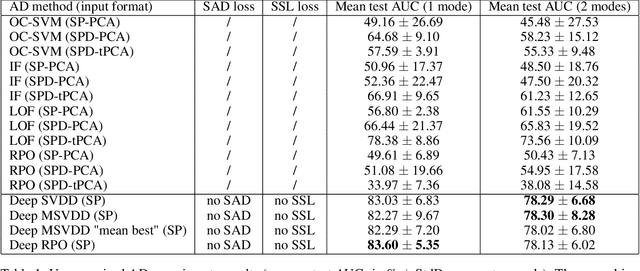
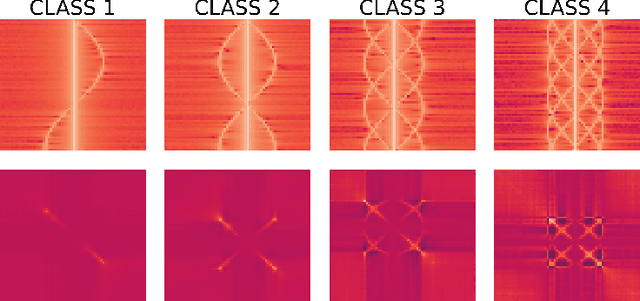
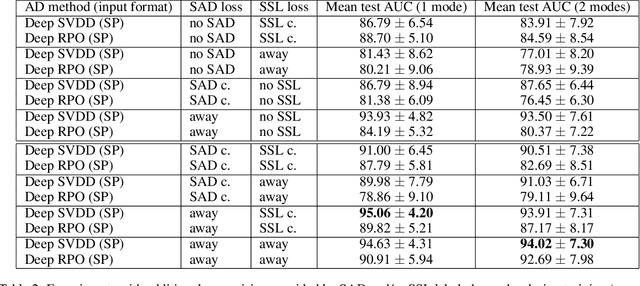
Near out-of-distribution detection (OOD) aims at discriminating semantically similar data points without the supervision required for classification. This paper puts forward an OOD use case for radar targets detection extensible to other kinds of sensors and detection scenarios. We emphasize the relevance of OOD and its specific supervision requirements for the detection of a multimodal, diverse targets class among other similar radar targets and clutter in real-life critical systems. We propose a comparison of deep and non-deep OOD methods on simulated low-resolution pulse radar micro-Doppler signatures, considering both a spectral and a covariance matrix input representation. The covariance representation aims at estimating whether dedicated second-order processing is appropriate to discriminate signatures. The potential contributions of labeled anomalies in training, self-supervised learning, contrastive learning insights and innovative training losses are discussed, and the impact of training set contamination caused by mislabelling is investigated.
From Unsupervised to Semi-supervised Anomaly Detection Methods for HRRP Targets
Jun 10, 2021
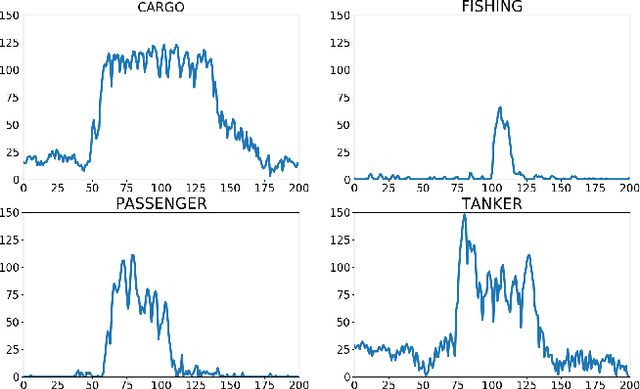
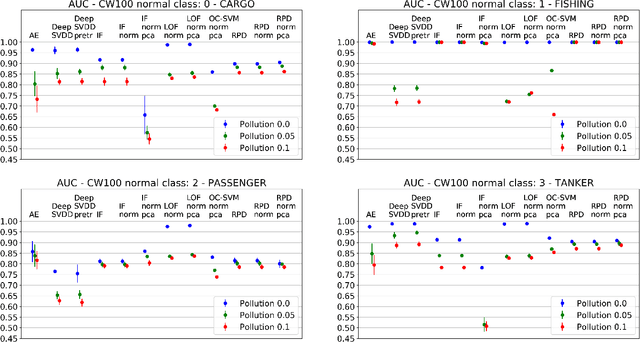
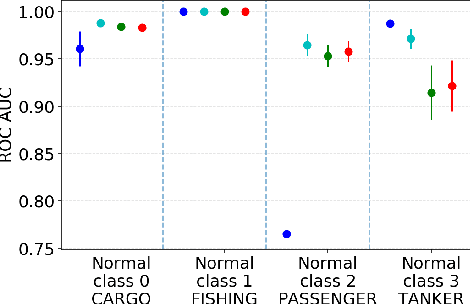
Responding to the challenge of detecting unusual radar targets in a well identified environment, innovative anomaly and novelty detection methods keep emerging in the literature. This work aims at presenting a benchmark gathering common and recently introduced unsupervised anomaly detection (AD) methods, the results being generated using high-resolution range profiles. A semi-supervised AD (SAD) is considered to demonstrate the added value of having a few labeled anomalies to improve performances. Experiments were conducted with and without pollution of the training set with anomalous samples in order to be as close as possible to real operational contexts. The common AD methods composing our baseline will be One-Class Support Vector Machines (OC-SVM), Isolation Forest (IF), Local Outlier Factor (LOF) and a Convolutional Autoencoder (CAE). The more innovative AD methods put forward by this work are Deep Support Vector Data Description (Deep SVDD) and Random Projection Depth (RPD), belonging respectively to deep and shallow AD. The semi-supervised adaptation of Deep SVDD constitutes our SAD method. HRRP data was generated by a coastal surveillance radar, our results thus suggest that AD can contribute to enhance maritime and coastal situation awareness.
Deep Random Projection Outlyingness for Unsupervised Anomaly Detection
Jun 08, 2021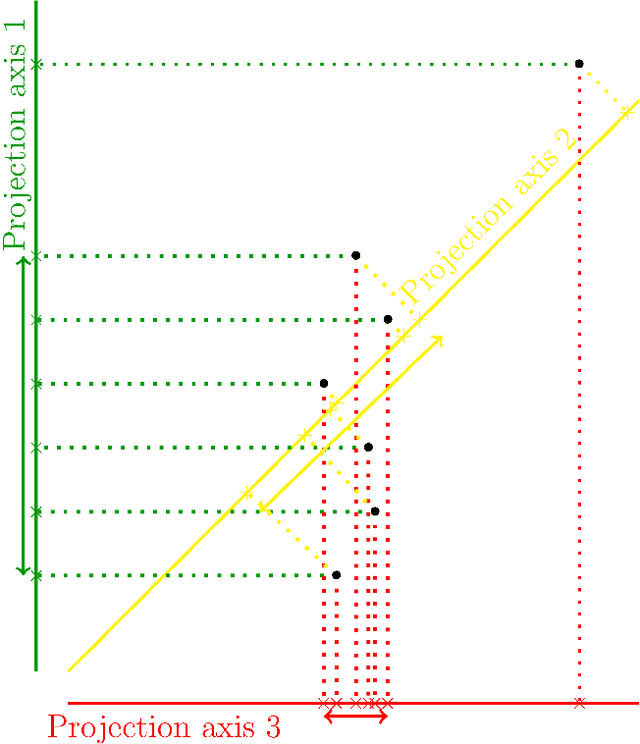
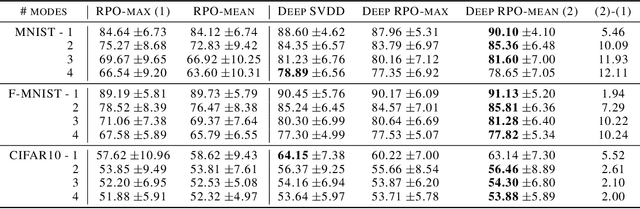
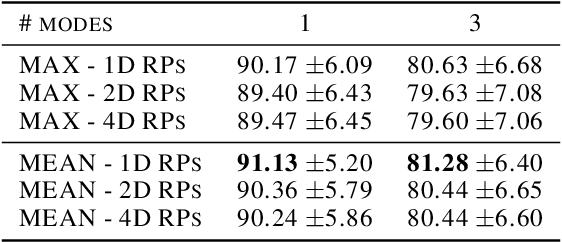
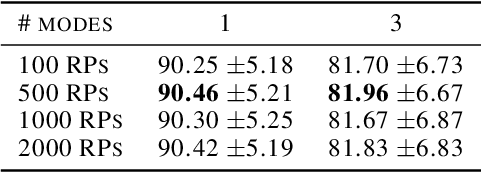
Random projection is a common technique for designing algorithms in a variety of areas, including information retrieval, compressive sensing and measuring of outlyingness. In this work, the original random projection outlyingness measure is modified and associated with a neural network to obtain an unsupervised anomaly detection method able to handle multimodal normality. Theoretical and experimental arguments are presented to justify the choices of the anomaly score estimator, the dimensions of the random projections, and the number of such projections. The contribution of adapted dropouts is investigated, along with the affine stability of the proposed method. The performance of the proposed neural network approach is comparable to a state-of-the-art anomaly detection method. Experiments conducted on the MNIST, Fashion-MNIST and CIFAR-10 datasets show the relevance of the proposed approach, and suggest a possible extension to a semi-supervised setup.