 Add to Chrome
 Add to Firefox
 Add to Edge
Padchest
Papers and Code
Consistent but Dangerous: Per-Sample Safety Classification Reveals False Reliability in Medical Vision-Language Models
Mar 22, 2026
Consistency under paraphrase, the property that semantically equivalent prompts yield identical predictions, is increasingly used as a proxy for reliability when deploying medical vision-language models (VLMs). We show this proxy is fundamentally flawed: a model can achieve perfect consistency by relying on text patterns rather than the input image. We introduce a four-quadrant per-sample safety taxonomy that jointly evaluates consistency (stable predictions across paraphrased prompts) and image reliance (predictions that change when the image is removed). Samples are classified as Ideal (consistent and image-reliant), Fragile (inconsistent but image-reliant), Dangerous (consistent but not image-reliant), or Worst (inconsistent and not image-reliant). Evaluating five medical VLM configurations across two chest X-ray datasets (MIMIC-CXR, PadChest), we find that LoRA fine-tuning dramatically reduces flip rates but shifts a majority of samples into the Dangerous quadrant: LLaVA-Rad Base achieves a 1.5% flip rate on PadChest while 98.5% of its samples are Dangerous. Critically, Dangerous samples exhibit high accuracy (up to 99.6%) and low entropy, making them invisible to standard confidence-based screening. We observe a negative correlation between flip rate and Dangerous fraction (r = -0.89, n=10) and recommend that deployment evaluations always pair consistency checks with a text-only baseline: a single additional forward pass that exposes the false reliability trap.

LoFi: Location-Aware Fine-Grained Representation Learning for Chest X-ray
Mar 19, 2026Fine-grained representation learning is crucial for retrieval and phrase grounding in chest X-rays, where clinically relevant findings are often spatially confined. However, the lack of region-level supervision in contrastive models and the limited ability of large vision language models to capture fine-grained representations in external validation lead to suboptimal performance on these tasks. To address these limitations, we propose Location-aware Fine-grained representation learning (LoFi), which jointly optimizes sigmoid, captioning, and location-aware captioning losses using a lightweight large language model. The location-aware captioning loss enables region-level supervision through grounding and dense captioning objectives, thereby facilitating fine-grained representation learning. Building upon these representations, we integrate a fine-grained encoder into retrieval-based in-context learning to enhance chest X-ray grounding across diverse settings. Extensive experiments demonstrate that our method achieves superior retrieval and phrase grounding performance on MIMIC-CXR and PadChest-GR.
Dataset Diversity Metrics and Impact on Classification Models
Mar 16, 2026The diversity of training datasets is usually perceived as an important aspect to obtain a robust model. However, the definition of diversity is often not defined or differs across papers, and while some metrics exist, the quantification of this diversity is often overlooked when developing new algorithms. In this work, we study the behaviour of multiple dataset diversity metrics for image, text and metadata using MorphoMNIST, a toy dataset with controlled perturbations, and PadChest, a publicly available chest X-ray dataset. We evaluate whether these metrics correlate with each other but also with the intuition of a clinical expert. We also assess whether they correlate with downstream-task performance and how they impact the training dynamic of the models. We find limited correlations between the AUC and image or metadata reference-free diversity metrics, but higher correlations with the FID and the semantic diversity metrics. Finally, the clinical expert indicates that scanners are the main source of diversity in practice. However, we find that the addition of another scanner to the training set leads to shortcut learning. The code used in this study is available at https://github.com/TheoSourget/dataset_diversity_evaluation
Loss Design and Architecture Selection for Long-Tailed Multi-Label Chest X-Ray Classification
Mar 02, 2026Long-tailed class distributions pose a significant challenge for multi-label chest X-ray (CXR) classification, where rare but clinically important findings are severely underrepresented. In this work, we present a systematic empirical evaluation of loss functions, CNN backbone architectures and post-training strategies on the CXR-LT 2026 benchmark, comprising approximately 143K images with 30 disease labels from PadChest. Our experiments demonstrate that LDAM with deferred re-weighting (LDAM-DRW) consistently outperforms standard BCE and asymmetric losses for rare class recognition. Amongst the architectures evaluated, ConvNeXt-Large achieves the best single-model performance with 0.5220 mAP and 0.3765 F1 on our development set, whilst classifier re-training and test-time augmentation further improve ranking metrics. On the official test leaderboard, our submission achieved 0.3950 mAP, ranking 5th amongst all 68 participating teams with total of 1528 submissions. We provide a candid analysis of the development-to-test performance gap and discuss practical insights for handling class imbalance in clinical imaging settings. Code is available at https://github.com/Nikhil-Rao20/Long_Tail.
Overview of the CXR-LT 2026 Challenge: Multi-Center Long-Tailed and Zero Shot Chest X-ray Classification
Feb 25, 2026Chest X-ray (CXR) interpretation is hindered by the long-tailed distribution of pathologies and the open-world nature of clinical environments. Existing benchmarks often rely on closed-set classes from single institutions, failing to capture the prevalence of rare diseases or the appearance of novel findings. To address this, we present the CXR-LT 2026 challenge. This third iteration of the benchmark introduces a multi-center dataset comprising over 145,000 images from PadChest and NIH Chest X-ray datasets. The challenge defines two core tasks: (1) Robust Multi-Label Classification on 30 known classes and (2) Open-World Generalization to 6 unseen (out-of-distribution) rare disease classes. We report the results of the top-performing teams, evaluating them via mean Average Precision (mAP), AUROC, and F1-score. The winning solutions achieved an mAP of 0.5854 on Task 1 and 0.4315 on Task 2, demonstrating that large-scale vision-language pre-training significantly mitigates the performance drop typically associated with zero-shot diagnosis.
PSF-Med: Measuring and Explaining Paraphrase Sensitivity in Medical Vision Language Models
Feb 24, 2026Medical Vision Language Models (VLMs) can change their answers when clinicians rephrase the same question, which raises deployment risks. We introduce Paraphrase Sensitivity Failure (PSF)-Med, a benchmark of 19,748 chest Xray questions paired with about 92,000 meaningpreserving paraphrases across MIMIC-CXR and PadChest. Across six medical VLMs, we measure yes/no flips for the same image and find flip rates from 8% to 58%. However, low flip rate does not imply visual grounding: text-only baselines show that some models stay consistent even when the image is removed, suggesting they rely on language priors. To study mechanisms in one model, we apply GemmaScope 2 Sparse Autoencoders (SAEs) to MedGemma 4B and analyze FlipBank, a curated set of 158 flip cases. We identify a sparse feature at layer 17 that correlates with prompt framing and predicts decision margin shifts. In causal patching, removing this feature's contribution recovers 45% of the yesminus-no logit margin on average and fully reverses 15% of flips. Acting on this finding, we show that clamping the identified feature at inference reduces flip rates by 31% relative with only a 1.3 percentage-point accuracy cost, while also decreasing text-prior reliance. These results suggest that flip rate alone is not enough; robustness evaluations should test both paraphrase stability and image reliance.
Handling Supervision Scarcity in Chest X-ray Classification: Long-Tailed and Zero-Shot Learning
Feb 13, 2026Chest X-ray (CXR) classification in clinical practice is often limited by imperfect supervision, arising from (i) extreme long-tailed multi-label disease distributions and (ii) missing annotations for rare or previously unseen findings. The CXR-LT 2026 challenge addresses these issues on a PadChest-based benchmark with a 36-class label space split into 30 in-distribution classes for training and 6 out-of-distribution (OOD) classes for zero-shot evaluation. We present task-specific solutions tailored to the distinct supervision regimes. For Task 1 (long-tailed multi-label classification), we adopt an imbalance-aware multi-label learning strategy to improve recognition of tail classes while maintaining stable performance on frequent findings. For Task 2 (zero-shot OOD recognition), we propose a prediction approach that produces scores for unseen disease categories without using any supervised labels or examples from the OOD classes during training. Evaluated with macro-averaged mean Average Precision (mAP), our method achieves strong performance on both tasks, ranking first on the public leaderboard of the development phase. Code and pre-trained models are available at https://github.com/hieuphamha19/CXR_LT.
Bi-MCQ: Reformulating Vision-Language Alignment for Negation Understanding
Jan 30, 2026Recent vision-language models (VLMs) achieve strong zero-shot performance via large-scale image-text pretraining and have been widely adopted in medical image analysis. However, existing VLMs remain notably weak at understanding negated clinical statements, largely due to contrastive alignment objectives that treat negation as a minor linguistic variation rather than a meaning-inverting operator. In multi-label settings, prompt-based InfoNCE fine-tuning further reinforces easy-positive image-prompt alignments, limiting effective learning of disease absence. To overcome these limitations, we reformulate vision-language alignment as a conditional semantic comparison problem, which is instantiated through a bi-directional multiple-choice learning framework(Bi-MCQ). By jointly training Image-to-Text and Text-to-Image MCQ tasks with affirmative, negative, and mixed prompts, our method implements fine-tuning as conditional semantic comparison instead of global similarity maximization. We further introduce direction-specific Cross-Attention fusion modules to address asymmetric cues required by bi-directional reasoning and reduce alignment interference. Experiments on ChestXray14, Open-I, CheXpert, and PadChest show that Bi-MCQ improves negation understanding by up to 0.47 AUC over the zero-shot performance of the state-of-the-art CARZero model, while achieving up to a 0.08 absolute gain on positive-negative combined (PNC) evaluation. Additionally, Bi-MCQ reduces the affirmative-negative AUC gap by an average of 0.12 compared to InfoNCE-based fine-tuning, demonstrating that objective reformulation can substantially enhance negation understanding in medical VLMs.
Limitations of Public Chest Radiography Datasets for Artificial Intelligence: Label Quality, Domain Shift, Bias and Evaluation Challenges
Sep 18, 2025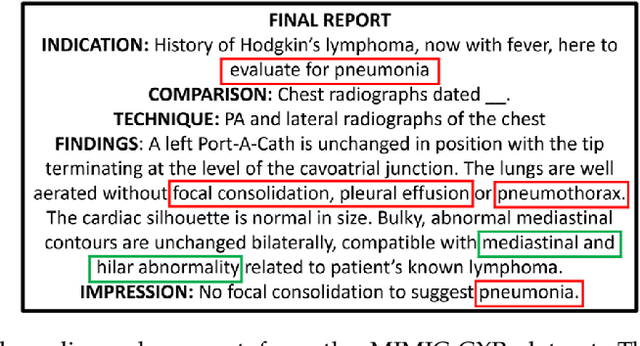
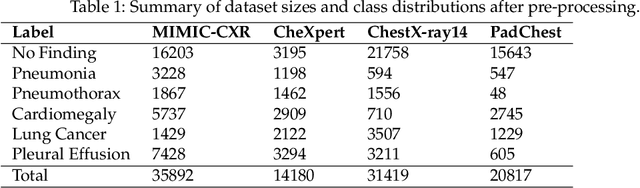
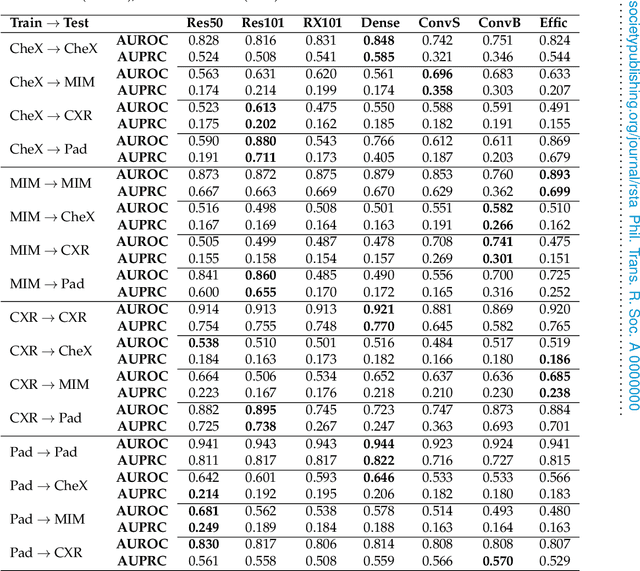
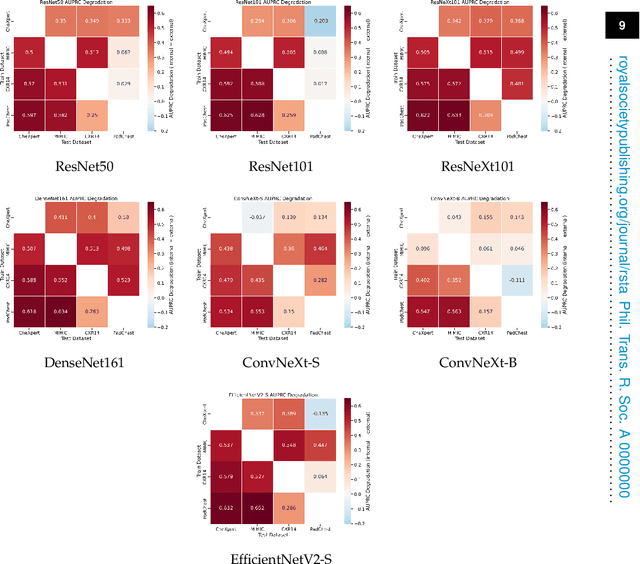
Artificial intelligence has shown significant promise in chest radiography, where deep learning models can approach radiologist-level diagnostic performance. Progress has been accelerated by large public datasets such as MIMIC-CXR, ChestX-ray14, PadChest, and CheXpert, which provide hundreds of thousands of labelled images with pathology annotations. However, these datasets also present important limitations. Automated label extraction from radiology reports introduces errors, particularly in handling uncertainty and negation, and radiologist review frequently disagrees with assigned labels. In addition, domain shift and population bias restrict model generalisability, while evaluation practices often overlook clinically meaningful measures. We conduct a systematic analysis of these challenges, focusing on label quality, dataset bias, and domain shift. Our cross-dataset domain shift evaluation across multiple model architectures revealed substantial external performance degradation, with pronounced reductions in AUPRC and F1 scores relative to internal testing. To assess dataset bias, we trained a source-classification model that distinguished datasets with near-perfect accuracy, and performed subgroup analyses showing reduced performance for minority age and sex groups. Finally, expert review by two board-certified radiologists identified significant disagreement with public dataset labels. Our findings highlight important clinical weaknesses of current benchmarks and emphasise the need for clinician-validated datasets and fairer evaluation frameworks.
Understanding Dataset Bias in Medical Imaging: A Case Study on Chest X-rays
Jul 10, 2025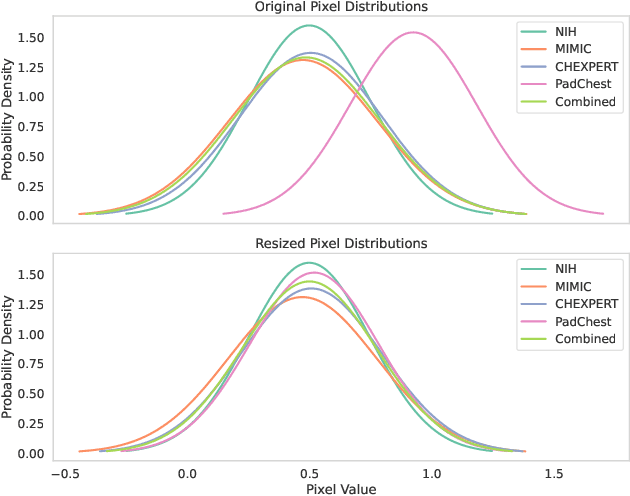
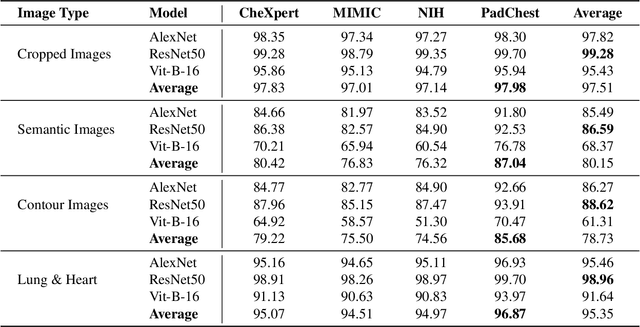
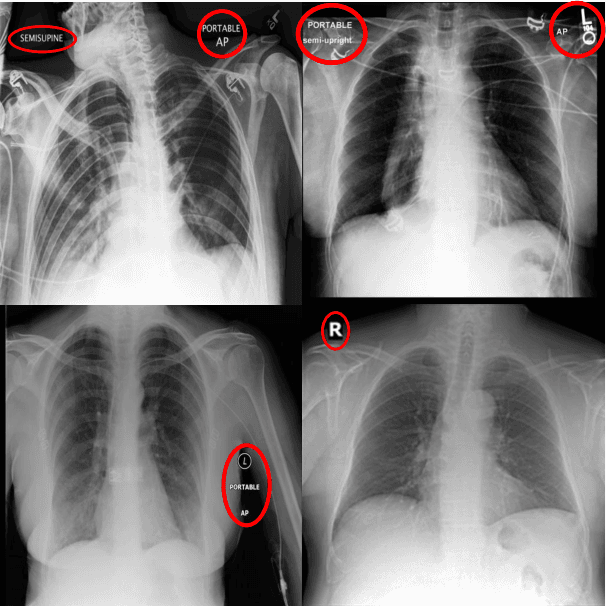
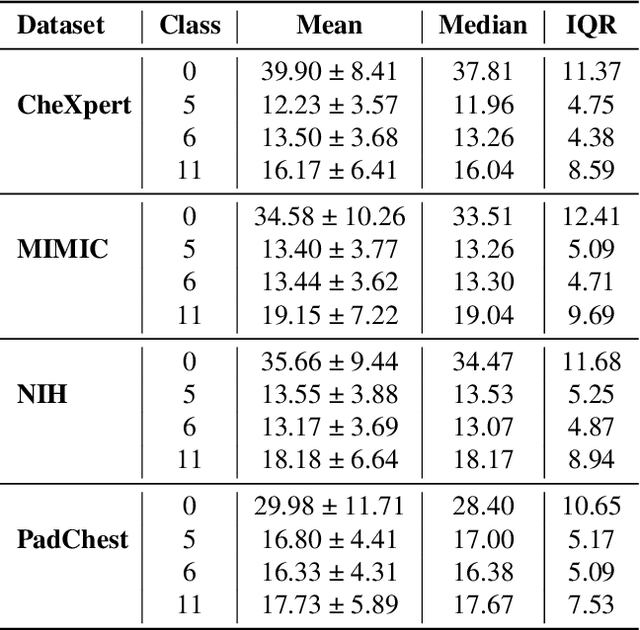
Recent work has revisited the infamous task Name that dataset and established that in non-medical datasets, there is an underlying bias and achieved high Accuracies on the dataset origin task. In this work, we revisit the same task applied to popular open-source chest X-ray datasets. Medical images are naturally more difficult to release for open-source due to their sensitive nature, which has led to certain open-source datasets being extremely popular for research purposes. By performing the same task, we wish to explore whether dataset bias also exists in these datasets. % We deliberately try to increase the difficulty of the task by dataset transformations. We apply simple transformations of the datasets to try to identify bias. Given the importance of AI applications in medical imaging, it's vital to establish whether modern methods are taking shortcuts or are focused on the relevant pathology. We implement a range of different network architectures on the datasets: NIH, CheXpert, MIMIC-CXR and PadChest. We hope this work will encourage more explainable research being performed in medical imaging and the creation of more open-source datasets in the medical domain. The corresponding code will be released upon acceptance.