 Add to Chrome
 Add to Firefox
 Add to Edge
Overview of the CXR-LT 2026 Challenge: Multi-Center Long-Tailed and Zero Shot Chest X-ray Classification
Feb 25, 2026
Chest X-ray (CXR) interpretation is hindered by the long-tailed distribution of pathologies and the open-world nature of clinical environments. Existing benchmarks often rely on closed-set classes from single institutions, failing to capture the prevalence of rare diseases or the appearance of novel findings. To address this, we present the CXR-LT 2026 challenge. This third iteration of the benchmark introduces a multi-center dataset comprising over 145,000 images from PadChest and NIH Chest X-ray datasets. The challenge defines two core tasks: (1) Robust Multi-Label Classification on 30 known classes and (2) Open-World Generalization to 6 unseen (out-of-distribution) rare disease classes. We report the results of the top-performing teams, evaluating them via mean Average Precision (mAP), AUROC, and F1-score. The winning solutions achieved an mAP of 0.5854 on Task 1 and 0.4315 on Task 2, demonstrating that large-scale vision-language pre-training significantly mitigates the performance drop typically associated with zero-shot diagnosis.

NNQS-Transformer: an Efficient and Scalable Neural Network Quantum States Approach for Ab initio Quantum Chemistry
Jul 01, 2023

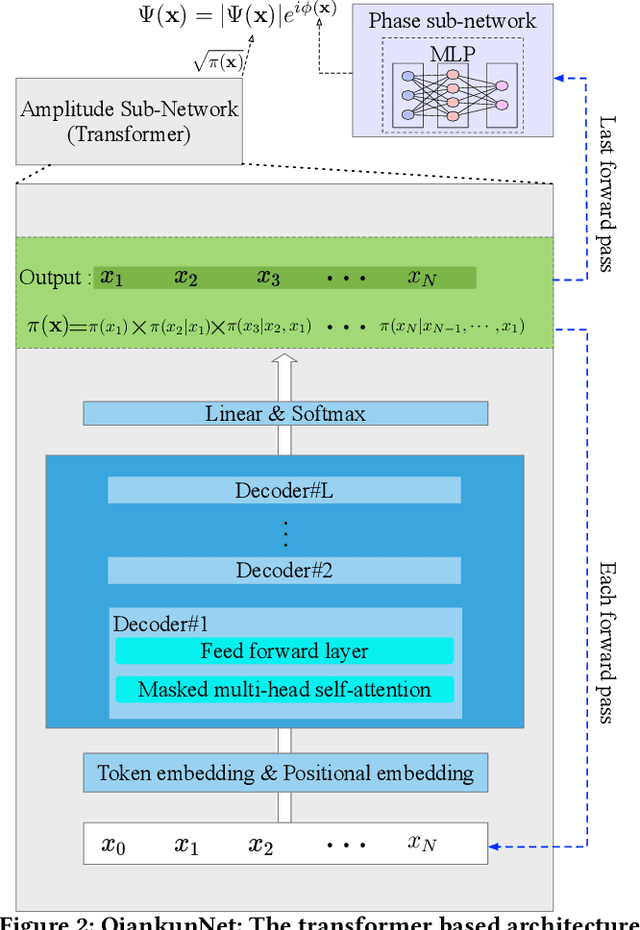
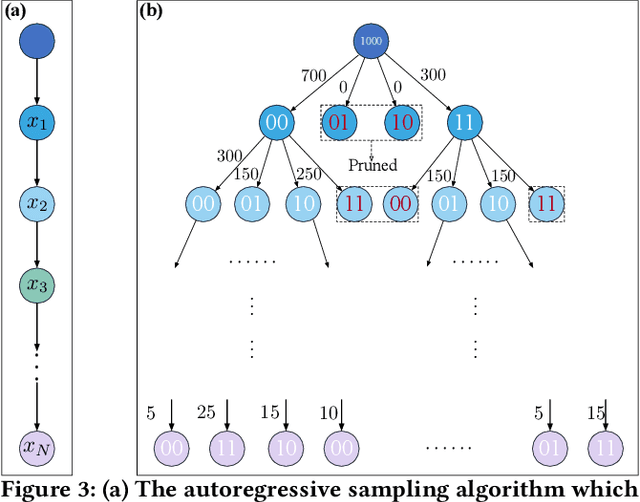
Neural network quantum state (NNQS) has emerged as a promising candidate for quantum many-body problems, but its practical applications are often hindered by the high cost of sampling and local energy calculation. We develop a high-performance NNQS method for \textit{ab initio} electronic structure calculations. The major innovations include: (1) A transformer based architecture as the quantum wave function ansatz; (2) A data-centric parallelization scheme for the variational Monte Carlo (VMC) algorithm which preserves data locality and well adapts for different computing architectures; (3) A parallel batch sampling strategy which reduces the sampling cost and achieves good load balance; (4) A parallel local energy evaluation scheme which is both memory and computationally efficient; (5) Study of real chemical systems demonstrates both the superior accuracy of our method compared to state-of-the-art and the strong and weak scalability for large molecular systems with up to $120$ spin orbitals.