 Add to Chrome
 Add to Firefox
 Add to Edge
Medical Concept Normalization
Papers and Code
Semantic NLP Pipelines for Interoperable Patient Digital Twins from Unstructured EHRs
Jan 09, 2026
Digital twins -- virtual replicas of physical entities -- are gaining traction in healthcare for personalized monitoring, predictive modeling, and clinical decision support. However, generating interoperable patient digital twins from unstructured electronic health records (EHRs) remains challenging due to variability in clinical documentation and lack of standardized mappings. This paper presents a semantic NLP-driven pipeline that transforms free-text EHR notes into FHIR-compliant digital twin representations. The pipeline leverages named entity recognition (NER) to extract clinical concepts, concept normalization to map entities to SNOMED-CT or ICD-10, and relation extraction to capture structured associations between conditions, medications, and observations. Evaluation on MIMIC-IV Clinical Database Demo with validation against MIMIC-IV-on-FHIR reference mappings demonstrates high F1-scores for entity and relation extraction, with improved schema completeness and interoperability compared to baseline methods.

IoMT-based Automated Leukemia Classification using CNN and Higher Order Singular Value
Dec 18, 2025

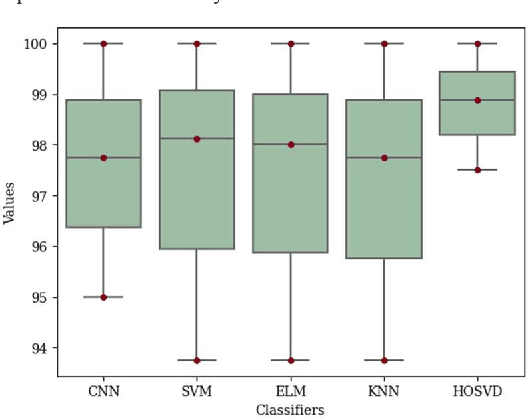
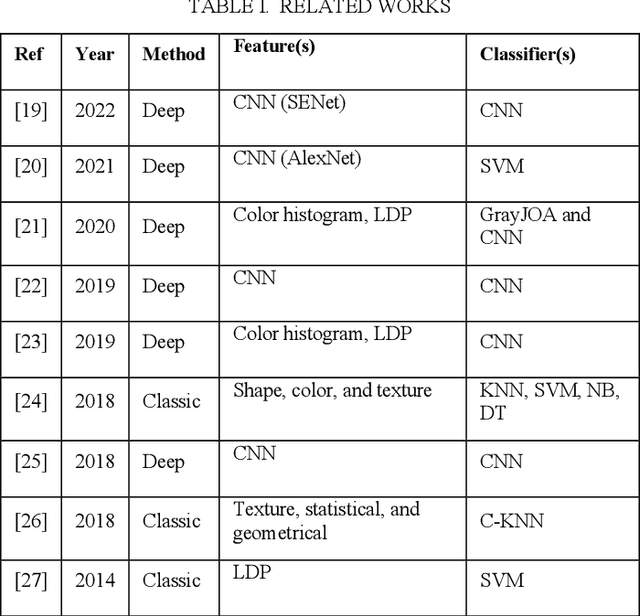
The Internet of Things (IoT) is a concept by which objects find identity and can communicate with each other in a network. One of the applications of the IoT is in the field of medicine, which is called the Internet of Medical Things (IoMT). Acute Lymphocytic Leukemia (ALL) is a type of cancer categorized as a hematic disease. It usually begins in the bone marrow due to the overproduction of immature White Blood Cells (WBCs or leukocytes). Since it has a high rate of spread to other body organs, it is a fatal disease if not diagnosed and treated early. Therefore, for identifying cancerous (ALL) cells in medical diagnostic laboratories, blood, as well as bone marrow smears, are taken by pathologists. However, manual examinations face limitations due to human error risk and time-consuming procedures. So, to tackle the mentioned issues, methods based on Artificial Intelligence (AI), capable of identifying cancer from non-cancer tissue, seem vital. Deep Neural Networks (DNNs) are the most efficient machine learning (ML) methods. These techniques employ multiple layers to extract higher-level features from the raw input. In this paper, a Convolutional Neural Network (CNN) is applied along with a new type of classifier, Higher Order Singular Value Decomposition (HOSVD), to categorize ALL and normal (healthy) cells from microscopic blood images. We employed the model on IoMT structure to identify leukemia quickly and safely. With the help of this new leukemia classification framework, patients and clinicians can have real-time communication. The model was implemented on the Acute Lymphoblastic Leukemia Image Database (ALL-IDB2) and achieved an average accuracy of %98.88 in the test step.
On the notion of missingness for path attribution explainability methods in medical settings: Guiding the selection of medically meaningful baselines
Aug 20, 2025The explainability of deep learning models remains a significant challenge, particularly in the medical domain where interpretable outputs are critical for clinical trust and transparency. Path attribution methods such as Integrated Gradients rely on a baseline input representing the absence of relevant features ("missingness"). Commonly used baselines, such as all-zero inputs, are often semantically meaningless, especially in medical contexts where missingness can itself be informative. While alternative baseline choices have been explored, existing methods lack a principled approach to dynamically select baselines tailored to each input. In this work, we examine the notion of missingness in the medical setting, analyze its implications for baseline selection, and introduce a counterfactual-guided approach to address the limitations of conventional baselines. We argue that a clinically normal but input-close counterfactual represents a more accurate representation of a meaningful absence of features in medical data. To implement this, we use a Variational Autoencoder to generate counterfactual baselines, though our concept is generative-model-agnostic and can be applied with any suitable counterfactual method. We evaluate the approach on three distinct medical data sets and empirically demonstrate that counterfactual baselines yield more faithful and medically relevant attributions compared to standard baseline choices.
Domain Adaptation of Attention Heads for Zero-shot Anomaly Detection
May 28, 2025Zero-shot anomaly detection (ZSAD) in images is an approach that can detect anomalies without access to normal samples, which can be beneficial in various realistic scenarios where model training is not possible. However, existing ZSAD research has shown limitations by either not considering domain adaptation of general-purpose backbone models to anomaly detection domains or by implementing only partial adaptation to some model components. In this paper, we propose HeadCLIP to overcome these limitations by effectively adapting both text and image encoders to the domain. HeadCLIP generalizes the concepts of normality and abnormality through learnable prompts in the text encoder, and introduces learnable head weights to the image encoder to dynamically adjust the features held by each attention head according to domain characteristics. Additionally, we maximize the effect of domain adaptation by introducing a joint anomaly score that utilizes domain-adapted pixel-level information for image-level anomaly detection. Experimental results using multiple real datasets in both industrial and medical domains show that HeadCLIP outperforms existing ZSAD techniques at both pixel and image levels. In the industrial domain, improvements of up to 4.9%p in pixel-level mean anomaly detection score (mAD) and up to 3.0%p in image-level mAD were achieved, with similar improvements (3.2%p, 3.1%p) in the medical domain.
A Rule Based Solution to Co-reference Resolution in Clinical Text
Mar 12, 2025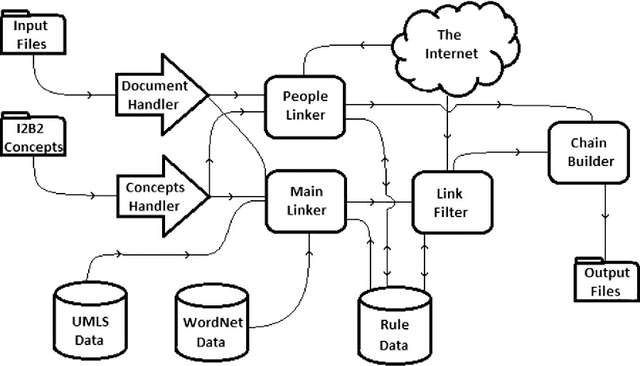
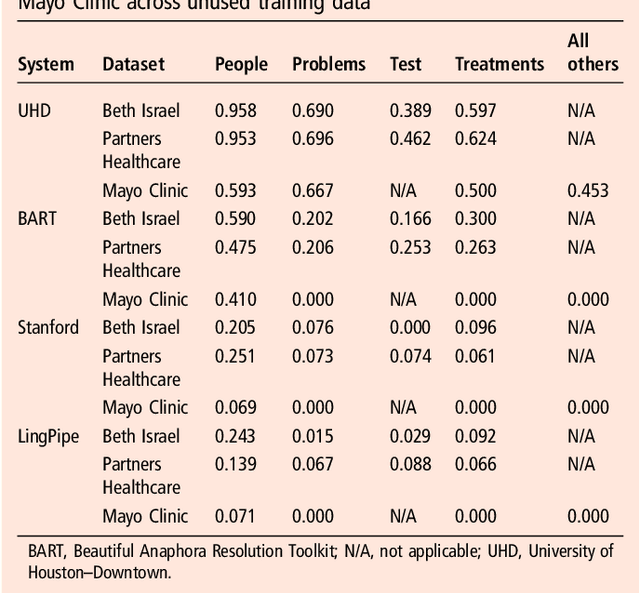
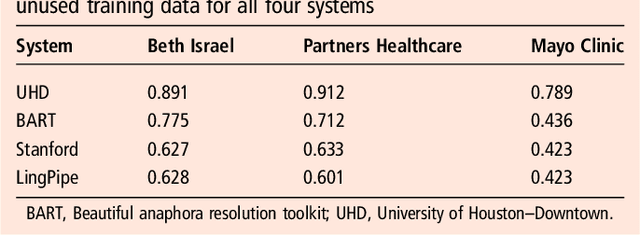
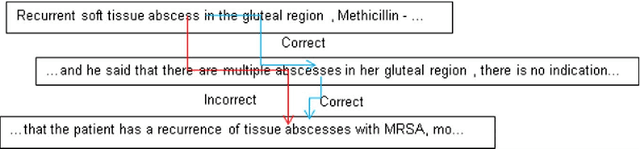
Objective: The aim of this study was to build an effective co-reference resolution system tailored for the biomedical domain. Materials and Methods: Experiment materials used in this study is provided by the 2011 i2b2 Natural Language Processing Challenge. The 2011 i2b2 challenge involves coreference resolution in medical documents. Concept mentions have been annotated in clinical texts, and the mentions that co-refer in each document are to be linked by coreference chains. Normally, there are two ways of constructing a system to automatically discover co-referent links. One is to manually build rules for co-reference resolution, and the other category of approaches is to use machine learning systems to learn automatically from training datasets and then perform the resolution task on testing datasets. Results: Experiments show the existing co-reference resolution systems are able to find some of the co-referent links, and our rule based system performs well finding the majority of the co-referent links. Our system achieved 89.6% overall performance on multiple medical datasets. Conclusion: The experiment results show that manually crafted rules based on observation of training data is a valid way to accomplish high performance in this coreference resolution task for the critical biomedical domain.
Developing and Evaluating an AI-Assisted Prediction Model for Unplanned Intensive Care Admissions following Elective Neurosurgery using Natural Language Processing within an Electronic Healthcare Record System
Mar 13, 2025Introduction: Timely care in a specialised neuro-intensive therapy unit (ITU) reduces mortality and hospital stays, with planned admissions being safer than unplanned ones. However, post-operative care decisions remain subjective. This study used artificial intelligence (AI), specifically natural language processing (NLP) to analyse electronic health records (EHRs) and predict ITU admissions for elective surgery patients. Methods: This study analysed the EHRs of elective neurosurgery patients from University College London Hospital (UCLH) using NLP. Patients were categorised into planned high dependency unit (HDU) or ITU admission; unplanned HDU or ITU admission; or ward / overnight recovery (ONR). The Medical Concept Annotation Tool (MedCAT) was used to identify SNOMED-CT concepts within the clinical notes. We then explored the utility of these identified concepts for a range of AI algorithms trained to predict ITU admission. Results: The CogStack-MedCAT NLP model, initially trained on hospital-wide EHRs, underwent two refinements: first with data from patients with Normal Pressure Hydrocephalus (NPH) and then with data from Vestibular Schwannoma (VS) patients, achieving a concept detection F1-score of 0.93. This refined model was then used to extract concepts from EHR notes of 2,268 eligible neurosurgical patients. We integrated the extracted concepts into AI models, including a decision tree model and a neural time-series model. Using the simpler decision tree model, we achieved a recall of 0.87 (CI 0.82 - 0.91) for ITU admissions, reducing the proportion of unplanned ITU cases missed by human experts from 36% to 4%. Conclusion: The NLP model, refined for accuracy, has proven its efficiency in extracting relevant concepts, providing a reliable basis for predictive AI models to use in clinically valid applications.
Disease Entity Recognition and Normalization is Improved with Large Language Model Derived Synthetic Normalized Mentions
Oct 10, 2024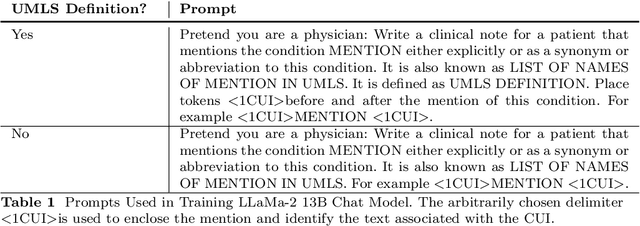
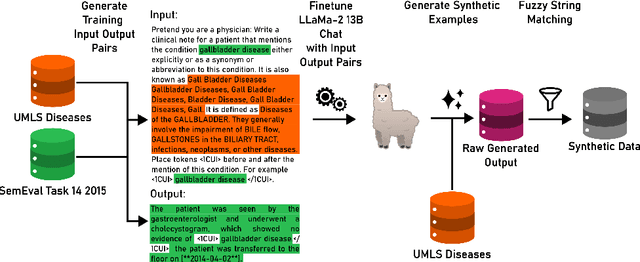
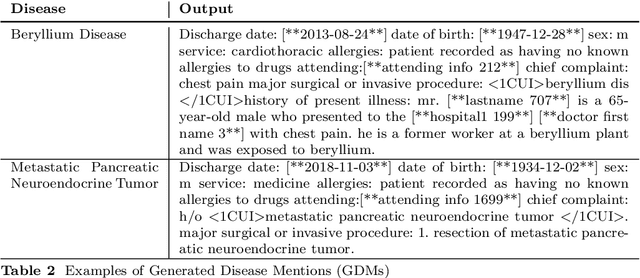
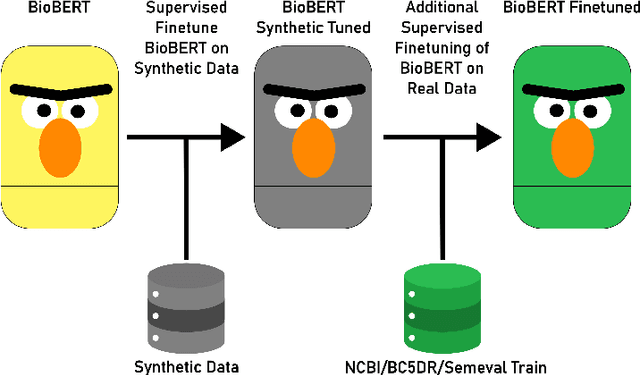
Background: Machine learning methods for clinical named entity recognition and entity normalization systems can utilize both labeled corpora and Knowledge Graphs (KGs) for learning. However, infrequently occurring concepts may have few mentions in training corpora and lack detailed descriptions or synonyms, even in large KGs. For Disease Entity Recognition (DER) and Disease Entity Normalization (DEN), this can result in fewer high quality training examples relative to the number of known diseases. Large Language Model (LLM) generation of synthetic training examples could improve performance in these information extraction tasks. Methods: We fine-tuned a LLaMa-2 13B Chat LLM to generate a synthetic corpus containing normalized mentions of concepts from the Unified Medical Language System (UMLS) Disease Semantic Group. We measured overall and Out of Distribution (OOD) performance for DER and DEN, with and without synthetic data augmentation. We evaluated performance on 3 different disease corpora using 4 different data augmentation strategies, assessed using BioBERT for DER and SapBERT and KrissBERT for DEN. Results: Our synthetic data yielded a substantial improvement for DEN, in all 3 training corpora the top 1 accuracy of both SapBERT and KrissBERT improved by 3-9 points in overall performance and by 20-55 points in OOD data. A small improvement (1-2 points) was also seen for DER in overall performance, but only one dataset showed OOD improvement. Conclusion: LLM generation of normalized disease mentions can improve DEN relative to normalization approaches that do not utilize LLMs to augment data with synthetic mentions. Ablation studies indicate that performance gains for DEN were only partially attributable to improvements in OOD performance. The same approach has only a limited ability to improve DER. We make our software and dataset publicly available.
A Cost-effective, Stand-alone, and Real-time TinyML-Based Gait Diagnosis Unit Aimed at Lower-limb Robotic Prostheses and Exoskeletons
Nov 13, 2024Robotic prostheses and exoskeletons can do wonders compared to their non-robotic counterpart. However, in a cost-soaring world where 1 in every 10 patients has access to normal medical prostheses, access to advanced ones is, unfortunately, extremely limited especially due to their high cost, a significant portion of which is contributed to by the diagnosis and controlling units. However, affordability is often not a major concern for developing such devices as with cost reduction, performance is also found to be deducted due to the cost vs. performance trade-off. Considering the gravity of such circumstances, the goal of this research was to propose an affordable wearable real-time gait diagnosis unit (GDU) aimed at robotic prostheses and exoskeletons. As a proof of concept, it has also developed the GDU prototype which leveraged TinyML to run two parallel quantized int8 models into an ESP32 NodeMCU development board (7.30 USD) to effectively classify five gait scenarios (idle, walk, run, hopping, and skip) and generate an anomaly score based on acceleration data received from two attached IMUs. The developed wearable gait diagnosis stand-alone unit could be fitted to any prosthesis or exoskeleton and could effectively classify the gait scenarios with an overall accuracy of 92% and provide anomaly scores within 95-96 ms with only 3 seconds of gait data in real-time.
ClinLinker: Medical Entity Linking of Clinical Concept Mentions in Spanish
Apr 09, 2024Advances in natural language processing techniques, such as named entity recognition and normalization to widely used standardized terminologies like UMLS or SNOMED-CT, along with the digitalization of electronic health records, have significantly advanced clinical text analysis. This study presents ClinLinker, a novel approach employing a two-phase pipeline for medical entity linking that leverages the potential of in-domain adapted language models for biomedical text mining: initial candidate retrieval using a SapBERT-based bi-encoder and subsequent re-ranking with a cross-encoder, trained by following a contrastive-learning strategy to be tailored to medical concepts in Spanish. This methodology, focused initially on content in Spanish, substantially outperforming multilingual language models designed for the same purpose. This is true even for complex scenarios involving heterogeneous medical terminologies and being trained on a subset of the original data. Our results, evaluated using top-k accuracy at 25 and other top-k metrics, demonstrate our approach's performance on two distinct clinical entity linking Gold Standard corpora, DisTEMIST (diseases) and MedProcNER (clinical procedures), outperforming previous benchmarks by 40 points in DisTEMIST and 43 points in MedProcNER, both normalized to SNOMED-CT codes. These findings highlight our approach's ability to address language-specific nuances and set a new benchmark in entity linking, offering a potent tool for enhancing the utility of digital medical records. The resulting system is of practical value, both for large scale automatic generation of structured data derived from clinical records, as well as for exhaustive extraction and harmonization of predefined clinical variables of interest.
Efficient Biomedical Entity Linking: Clinical Text Standardization with Low-Resource Techniques
May 27, 2024Clinical text is rich in information, with mentions of treatment, medication and anatomy among many other clinical terms. Multiple terms can refer to the same core concepts which can be referred as a clinical entity. Ontologies like the Unified Medical Language System (UMLS) are developed and maintained to store millions of clinical entities including the definitions, relations and other corresponding information. These ontologies are used for standardization of clinical text by normalizing varying surface forms of a clinical term through Biomedical entity linking. With the introduction of transformer-based language models, there has been significant progress in Biomedical entity linking. In this work, we focus on learning through synonym pairs associated with the entities. As compared to the existing approaches, our approach significantly reduces the training data and resource consumption. Moreover, we propose a suite of context-based and context-less reranking techniques for performing the entity disambiguation. Overall, we achieve similar performance to the state-of-the-art zero-shot and distant supervised entity linking techniques on the Medmentions dataset, the largest annotated dataset on UMLS, without any domain-based training. Finally, we show that retrieval performance alone might not be sufficient as an evaluation metric and introduce an article level quantitative and qualitative analysis to reveal further insights on the performance of entity linking methods.