 Add to Chrome
 Add to Firefox
 Add to Edge
League Of Legends
Papers and Code
Robust Player-Conditional Champion Ranking for League of Legends: Style Similarity, Mastery Priors, and Archetype-Constrained Discovery
May 18, 2026
Champion recommendation in multiplayer online battle arena games is usually framed informally as a problem of metagame strength, personal comfort, or global win rate. We formalize champion recommendation in League of Legends as an interpretable, player-conditional ranking problem under sparse, noisy, and non-stationary behavioral data. The proposed framework combines four information sources: a population-strength proxy, player-style similarity, direct and indirect mastery priors, and archetype-level guardrails. The method uses robust median/MAD normalization, logarithmic transforms for skewed event counts, recency-weighted player style vectors, mastery-weighted champion-pool vectors, weighted cosine similarity, rank-scaled score components, and k-means++ clustering for coarse archetype support. The implemented prototype uses a Python/Pandas modeling layer, Supabase-backed storage, and a web-facing recommendation interface. Unlike black-box supervised win-prediction systems, the proposed method returns decomposed recommendation scores that can be inspected as expected-performance proxy, fit, mastery, and archetype compatibility. A single-player case study on a 100-game history for the player identifier DIVINERAINRACCON is included as an end-to-end sanity check. The manuscript is therefore a methods and systems contribution: it specifies a reproducible, modular, and auditable champion recommender and gives a validation protocol for future large-scale evaluation through temporal train-test splits, next-champion recovery, calibration analysis, and ablation studies.

"bot lane noob" Towards Deployment of NLP-based Toxicity Detectors in Video Games
Apr 11, 2026Toxicity and harassment are widespread in the video-gaming context. Especially in competitive online multiplayer scenarios, gamers oftentimes send harmful messages to other players (teammates or opponents) whose consequences span from mild annoyance to withdrawal and depression. Abundant prior work tackled these problems, e.g., pointing out the negative effects of toxic interactions. However, few works proposed countermeasures specifically developed and tested on textual messages sent during a match -- i.e., when the "harassment" actually occurs. We posit that such a scarcity stems from the lack of high-quality datasets that can be used to devise "automated" detectors based on natural-language processing (NLP) and machine learning (ML), and which can -- ideally -- mitigate the harm of toxic comments during a gaming session. This work provides a foundation for addressing the problem of toxicity and harassment in video games. First, through a systematic literature review (n=1,039), we provide evidence that only few works proposed ML/NLP-based detectors of toxicity/harassment during live matches. Then, we partner-up with 8 expert League of Legend (LoL) players and create a fine-grained labelled dataset, L2DTnH, containing 1.4k toxic and 13.8k non-toxic messages exchanged during LoL matches. We use L2DTnH to develop a detector that we then empirically show outperforms general-purpose and state-of-the-art toxicity detectors reliant on NLP. To further demonstrate the practicality of our resources, we test our detector on game-related data beyond that included in L2DTnH; and we develop a Web-browser extension that flags toxic content in Webpages -- without querying third-party servers owned by AI companies. We publicly release all of our resources. Our contributions pave the way for more applied research devoted to fighting the spread of toxicity and harassment in video games.
PandaSkill -- Player Performance and Skill Rating in Esports: Application to League of Legends
Jan 20, 2025To take the esports scene to the next level, we introduce PandaSkill, a framework for assessing player performance and skill rating. Traditional rating systems like Elo and TrueSkill often overlook individual contributions and face challenges in professional esports due to limited game data and fragmented competitive scenes. PandaSkill leverages machine learning to estimate in-game player performance from individual player statistics. Each in-game role is modeled independently, ensuring a fair comparison between them. Then, using these performance scores, PandaSkill updates the player skill ratings using the Bayesian framework OpenSkill in a free-for-all setting. In this setting, skill ratings are updated solely based on performance scores rather than game outcomes, hightlighting individual contributions. To address the challenge of isolated rating pools that hinder cross-regional comparisons, PandaSkill introduces a dual-rating system that combines players' regional ratings with a meta-rating representing each region's overall skill level. Applying PandaSkill to five years of professional League of Legends matches worldwide, we show that our method produces skill ratings that better predict game outcomes and align more closely with expert opinions compared to existing methods.
Voice Communication Analysis in Esports
Nov 21, 2024


In most team-based esports, voice communications are prominent in the team efficiency and synergy. In fact it has been observed that not only the skill aspect of the team but also the team effective voice communication comes into play when trying to have good performance in official matches. With the recent emergence of LLM (Large Language Models) tools regarding NLP (Natural Language Processing) (Vaswani et. al.), we decided to try applying them in order to have a better understanding on how to improve the effectiveness of the voice communications. In this paper the study has been made through the prism of League of Legends esport. However the main concepts and ideas can be easily applicable in any other team related esports.
A Framework for Predicting the Impact of Game Balance Changes through Meta Discovery
Sep 11, 2024A metagame is a collection of knowledge that goes beyond the rules of a game. In competitive, team-based games like Pok\'emon or League of Legends, it refers to the set of current dominant characters and/or strategies within the player base. Developer changes to the balance of the game can have drastic and unforeseen consequences on these sets of meta characters. A framework for predicting the impact of balance changes could aid developers in making more informed balance decisions. In this paper we present such a Meta Discovery framework, leveraging Reinforcement Learning for automated testing of balance changes. Our results demonstrate the ability to predict the outcome of balance changes in Pok\'emon Showdown, a collection of competitive Pok\'emon tiers, with high accuracy.
Identifying and Clustering Counter Relationships of Team Compositions in PvP Games for Efficient Balance Analysis
Aug 30, 2024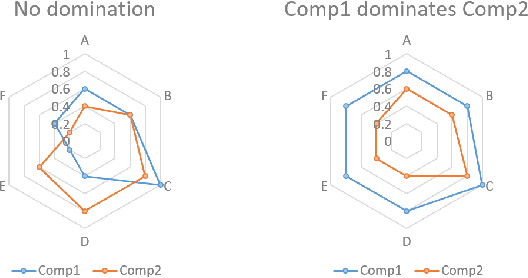

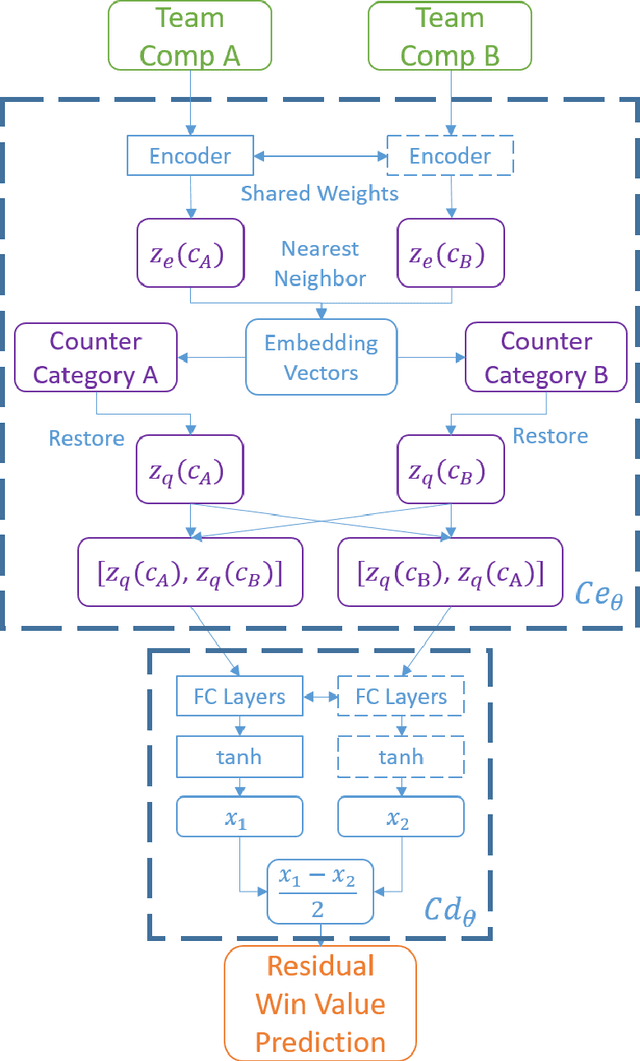
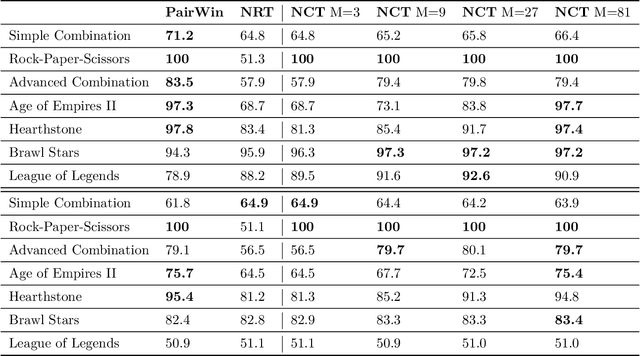
How can balance be quantified in game settings? This question is crucial for game designers, especially in player-versus-player (PvP) games, where analyzing the strength relations among predefined team compositions-such as hero combinations in multiplayer online battle arena (MOBA) games or decks in card games-is essential for enhancing gameplay and achieving balance. We have developed two advanced measures that extend beyond the simplistic win rate to quantify balance in zero-sum competitive scenarios. These measures are derived from win value estimations, which employ strength rating approximations via the Bradley-Terry model and counter relationship approximations via vector quantization, significantly reducing the computational complexity associated with traditional win value estimations. Throughout the learning process of these models, we identify useful categories of compositions and pinpoint their counter relationships, aligning with the experiences of human players without requiring specific game knowledge. Our methodology hinges on a simple technique to enhance codebook utilization in discrete representation with a deterministic vector quantization process for an extremely small state space. Our framework has been validated in popular online games, including Age of Empires II, Hearthstone, Brawl Stars, and League of Legends. The accuracy of the observed strength relations in these games is comparable to traditional pairwise win value predictions, while also offering a more manageable complexity for analysis. Ultimately, our findings contribute to a deeper understanding of PvP game dynamics and present a methodology that significantly improves game balance evaluation and design.
League of Legends: Real-Time Result Prediction
Sep 02, 2023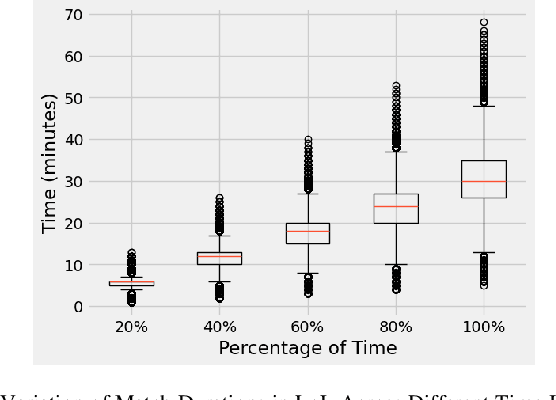
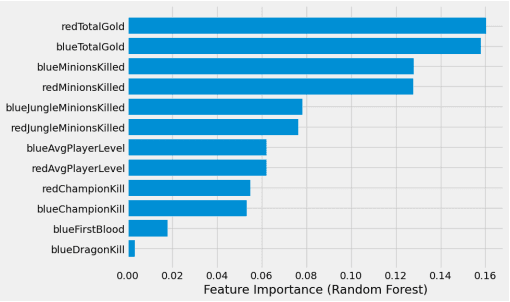
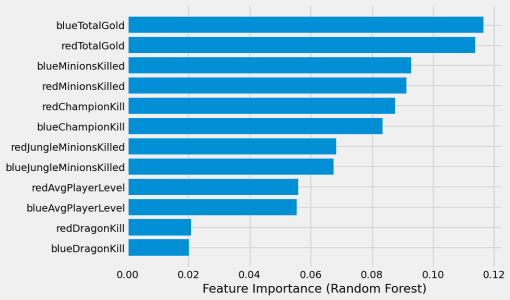

This paper presents a study on the prediction of outcomes in matches of the electronic game League of Legends (LoL) using machine learning techniques. With the aim of exploring the ability to predict real-time results, considering different variables and stages of the match, we highlight the use of unpublished data as a fundamental part of this process. With the increasing popularity of LoL and the emergence of tournaments, betting related to the game has also emerged, making the investigation in this area even more relevant. A variety of models were evaluated and the results were encouraging. A model based on LightGBM showed the best performance, achieving an average accuracy of 81.62\% in intermediate stages of the match when the percentage of elapsed time was between 60\% and 80\%. On the other hand, the Logistic Regression and Gradient Boosting models proved to be more effective in early stages of the game, with promising results. This study contributes to the field of machine learning applied to electronic games, providing valuable insights into real-time prediction in League of Legends. The results obtained may be relevant for both players seeking to improve their strategies and the betting industry related to the game.
Esports Data-to-commentary Generation on Large-scale Data-to-text Dataset
Dec 21, 2022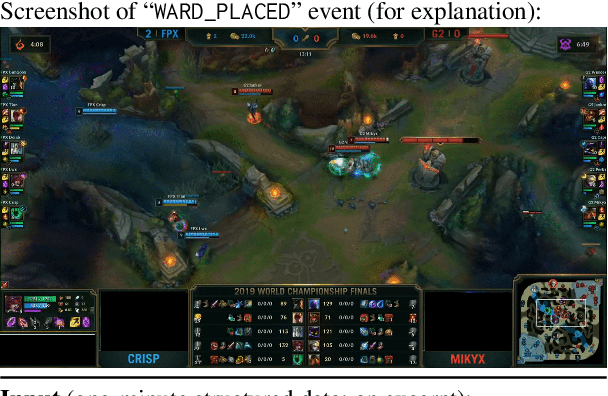
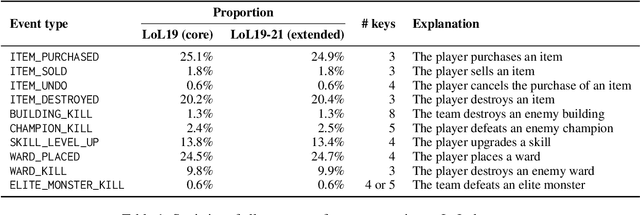
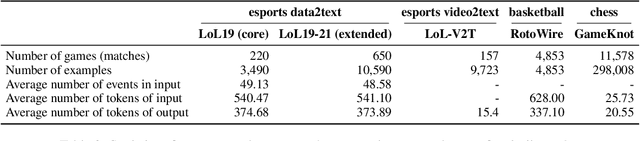
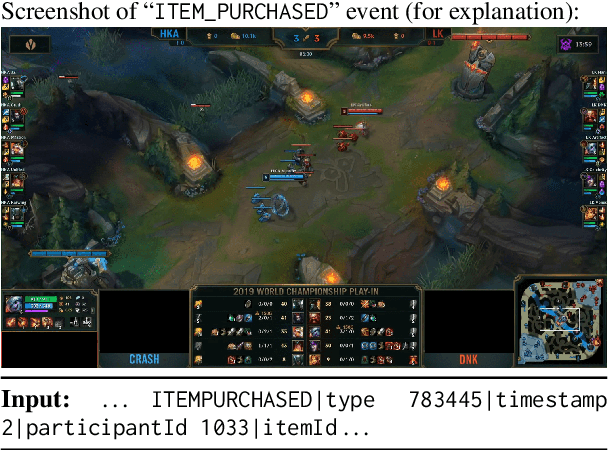
Esports, a sports competition using video games, has become one of the most important sporting events in recent years. Although the amount of esports data is increasing than ever, only a small fraction of those data accompanies text commentaries for the audience to retrieve and understand the plays. Therefore, in this study, we introduce a task of generating game commentaries from structured data records to address the problem. We first build a large-scale esports data-to-text dataset using structured data and commentaries from a popular esports game, League of Legends. On this dataset, we devise several data preprocessing methods including linearization and data splitting to augment its quality. We then introduce several baseline encoder-decoder models and propose a hierarchical model to generate game commentaries. Considering the characteristics of esports commentaries, we design evaluation metrics including three aspects of the output: correctness, fluency, and strategic depth. Experimental results on our large-scale esports dataset confirmed the advantage of the hierarchical model, and the results revealed several challenges of this novel task.
Action2Score: An Embedding Approach To Score Player Action
Jul 21, 2022
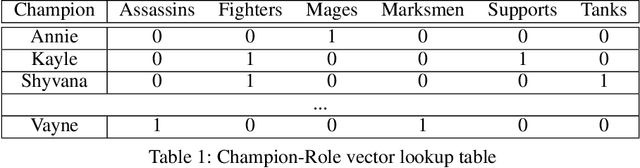

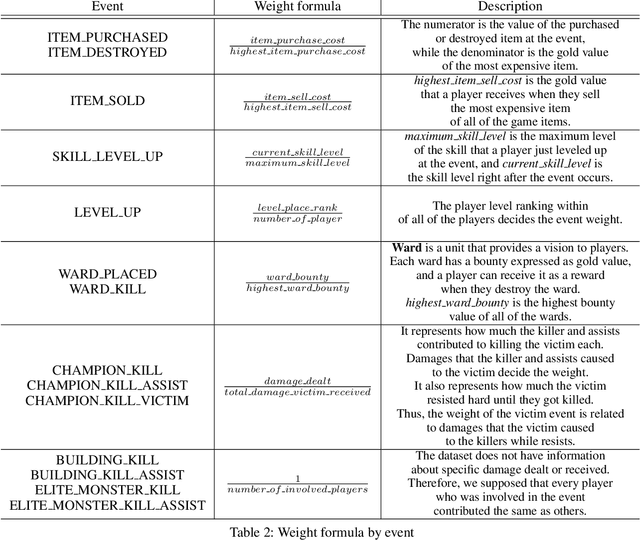
Multiplayer Online Battle Arena (MOBA) is one of the most successful game genres. MOBA games such as League of Legends have competitive environments where players race for their rank. In most MOBA games, a player's rank is determined by the match result (win or lose). It seems natural because of the nature of team play, but in some sense, it is unfair because the players who put a lot of effort lose their rank just in case of loss and some players even get free-ride on teammates' efforts in case of a win. To reduce the side-effects of the team-based ranking system and evaluate a player's performance impartially, we propose a novel embedding model that converts a player's actions into quantitative scores based on the actions' respective contribution to the team's victory. Our model is built using a sequence-based deep learning model with a novel loss function working on the team match. The sequence-based deep learning model process the action sequence from the game start to the end of a player in a team play using a GRU unit that takes a hidden state from the previous step and the current input selectively. The loss function is designed to help the action score to reflect the final score and the success of the team. We showed that our model can evaluate a player's individual performance fairly and analyze the contributions of the player's respective actions.
Mastering Strategy Card Game (Hearthstone) with Improved Techniques
Mar 09, 2023Strategy card game is a well-known genre that is demanding on the intelligent game-play and can be an ideal test-bench for AI. Previous work combines an end-to-end policy function and an optimistic smooth fictitious play, which shows promising performances on the strategy card game Legend of Code and Magic. In this work, we apply such algorithms to Hearthstone, a famous commercial game that is more complicated in game rules and mechanisms. We further propose several improved techniques and consequently achieve significant progress. For a machine-vs-human test we invite a Hearthstone streamer whose best rank was top 10 of the official league in China region that is estimated to be of millions of players. Our models defeat the human player in all Best-of-5 tournaments of full games (including both deck building and battle), showing a strong capability of decision making.