 Add to Chrome
 Add to Firefox
 Add to Edge
Game Of Chess
Papers and Code
Verification of the Implicit World Model in a Generative Model via Adversarial Sequences
Feb 05, 2026
Generative sequence models are typically trained on sample sequences from natural or formal languages. It is a crucial question whether -- or to what extent -- sample-based training is able to capture the true structure of these languages, often referred to as the ``world model''. Theoretical results indicate that we can hope for soundness at best, that is, generating valid sequences, but not necessarily all of them. However, it is still important to have practical tools that are able to verify whether a given sequence model is sound. In this study, we focus on chess, as it is a domain that provides enough complexity while having a simple rule-based world model. We propose adversarial sequence generation for verifying the soundness of the sequence model. Our adversaries generate valid sequences so as to force the sequence model to generate an invalid next move prediction. Apart from the falsification of soundness, this method is also suitable for a more fine-grained analysis of the failure modes and the effects of different choices during training. To demonstrate this, we propose a number of methods for adversarial sequence generation and evaluate the approach on a large set of chess models. We train models on random as well as high-quality chess games, using several training recipes. We find that none of the models are sound, but some training techniques and dataset choices are able to improve soundness remarkably. We also investigate the potential application of board state probes in both our training and attack methods. Our findings indicate that the extracted board states have no causal role in next token prediction in most of the models.

Mixture of Masters: Sparse Chess Language Models with Player Routing
Feb 04, 2026Modern chess language models are dense transformers trained on millions of games played by thousands of high-rated individuals. However, these monolithic networks tend to collapse into mode-averaged behavior, where stylistic boundaries are blurred, and rare but effective strategies are suppressed. To counteract homogenization, we introduce Mixture-of-Masters (MoM), the first chess mixture-of-experts model with small-sized GPT experts emulating world-class grandmasters. Each expert is trained with a combination of self-supervised learning and reinforcement learning guided by chess-specific rewards. For each move, a post-hoc learnable gating network selects the most appropriate persona to channel depending on the game state, allowing MoM to switch its style dynamically$--$e.g., Tal's offensive vocation or Petrosian's defensive solidity. When evaluated against Stockfish on unseen standard games, MoM outperforms both dense individual expert networks and popular GPT baselines trained on aggregated data, while ensuring generation variety, control, and interpretability.
Abstract Concept Modelling in Conceptual Spaces: A Study on Chess Strategies
Jan 29, 2026We present a conceptual space framework for modelling abstract concepts that unfold over time, demonstrated through a chess-based proof-of-concept. Strategy concepts, such as attack or sacrifice, are represented as geometric regions across interpretable quality dimensions, with chess games instantiated and analysed as trajectories whose directional movement toward regions enables recognition of intended strategies. This approach also supports dual-perspective modelling, capturing how players interpret identical situations differently. Our implementation demonstrates the feasibility of trajectory-based concept recognition, with movement patterns aligning with expert commentary. This work explores extending the conceptual spaces theory to temporally realised, goal-directed concepts. The approach establishes a foundation for broader applications involving sequential decision-making and supports integration with knowledge evolution mechanisms for learning and refining abstract concepts over time.
Trapped in the past? Disentangling fluid and crystallized intelligence of large language models using chess
Jan 23, 2026Large Language Models (LLMs) exhibit remarkable capabilities, yet it remains unclear to what extent these reflect sophisticated recall (crystallized intelligence) or reasoning ability (fluid intelligence). We introduce chess as a controlled testbed for disentangling these faculties. Leveraging the game's structure and scalable engine evaluations, we construct a taxonomy of positions varying in training corpus proximity--ranging from common states solvable by memorization to novel ones requiring first-principles reasoning. We systematically evaluate multiple GPT generations under varying reasoning intensities. Our analysis reveals a clear gradient: performance consistently degrades as fluid intelligence demands increase. Notably, in out-of-distribution tasks, performance collapses to random levels. While newer models improve, progress slows significantly for tasks outside the training distribution. Furthermore, while reasoning-augmented inference improves performance, its marginal benefit per token decreases with distributional proximity. These results suggest current architectures remain limited in systematic generalization, highlighting the need for mechanisms beyond scale to achieve robust fluid intelligence.
Emergent World Beliefs: Exploring Transformers in Stochastic Games
Dec 18, 2025Transformer-based large language models (LLMs) have demonstrated strong reasoning abilities across diverse fields, from solving programming challenges to competing in strategy-intensive games such as chess. Prior work has shown that LLMs can develop emergent world models in games of perfect information, where internal representations correspond to latent states of the environment. In this paper, we extend this line of investigation to domains of incomplete information, focusing on poker as a canonical partially observable Markov decision process (POMDP). We pretrain a GPT-style model on Poker Hand History (PHH) data and probe its internal activations. Our results demonstrate that the model learns both deterministic structure, such as hand ranks, and stochastic features, such as equity, without explicit instruction. Furthermore, by using primarily nonlinear probes, we demonstrated that these representations are decodeable and correlate with theoretical belief states, suggesting that LLMs are learning their own representation of the stochastic environment of Texas Hold'em Poker.
CVChess: A Deep Learning Framework for Converting Chessboard Images to Forsyth-Edwards Notation
Nov 18, 2025Chess has experienced a large increase in viewership since the pandemic, driven largely by the accessibility of online learning platforms. However, no equivalent assistance exists for physical chess games, creating a divide between analog and digital chess experiences. This paper presents CVChess, a deep learning framework for converting chessboard images to Forsyth-Edwards Notation (FEN), which is later input into online chess engines to provide you with the best next move. Our approach employs a convolutional neural network (CNN) with residual layers to perform piece recognition from smartphone camera images. The system processes RGB images of a physical chess board through a multistep process: image preprocessing using the Hough Line Transform for edge detection, projective transform to achieve a top-down board alignment, segmentation into 64 individual squares, and piece classification into 13 classes (6 unique white pieces, 6 unique black pieces and an empty square) using the residual CNN. Residual connections help retain low-level visual features while enabling deeper feature extraction, improving accuracy and stability during training. We train and evaluate our model using the Chess Recognition Dataset (ChessReD), containing 10,800 annotated smartphone images captured under diverse lighting conditions and angles. The resulting classifications are encoded as an FEN string, which can be fed into a chess engine to generate the most optimal move
Out-of-distribution Tests Reveal Compositionality in Chess Transformers
Oct 23, 2025Chess is a canonical example of a task that requires rigorous reasoning and long-term planning. Modern decision Transformers - trained similarly to LLMs - are able to learn competent gameplay, but it is unclear to what extent they truly capture the rules of chess. To investigate this, we train a 270M parameter chess Transformer and test it on out-of-distribution scenarios, designed to reveal failures of systematic generalization. Our analysis shows that Transformers exhibit compositional generalization, as evidenced by strong rule extrapolation: they adhere to fundamental syntactic rules of the game by consistently choosing valid moves even in situations very different from the training data. Moreover, they also generate high-quality moves for OOD puzzles. In a more challenging test, we evaluate the models on variants including Chess960 (Fischer Random Chess) - a variant of chess where starting positions of pieces are randomized. We found that while the model exhibits basic strategy adaptation, they are inferior to symbolic AI algorithms that perform explicit search, but gap is smaller when playing against users on Lichess. Moreover, the training dynamics revealed that the model initially learns to move only its own pieces, suggesting an emergent compositional understanding of the game.
Speculative Actions: A Lossless Framework for Faster Agentic Systems
Oct 05, 2025Despite growing interest in AI agents across industry and academia, their execution in an environment is often slow, hampering training, evaluation, and deployment. For example, a game of chess between two state-of-the-art agents may take hours. A critical bottleneck is that agent behavior unfolds sequentially: each action requires an API call, and these calls can be time-consuming. Inspired by speculative execution in microprocessors and speculative decoding in LLM inference, we propose speculative actions, a lossless framework for general agentic systems that predicts likely actions using faster models, enabling multiple steps to be executed in parallel. We evaluate this framework across three agentic environments: gaming, e-commerce, web search, and a "lossy" extension for an operating systems environment. In all cases, speculative actions achieve substantial accuracy in next-action prediction (up to 55%), translating into significant reductions in end-to-end latency. Moreover, performance can be further improved through stronger guessing models, top-K action prediction, multi-step speculation, and uncertainty-aware optimization, opening a promising path toward deploying low-latency agentic systems in the real world.
Drawing Conclusions from Draws: Rethinking Preference Semantics in Arena-Style LLM Evaluation
Oct 02, 2025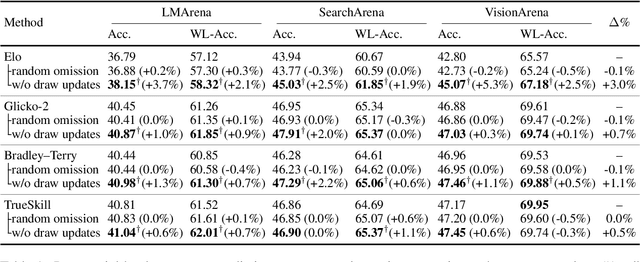
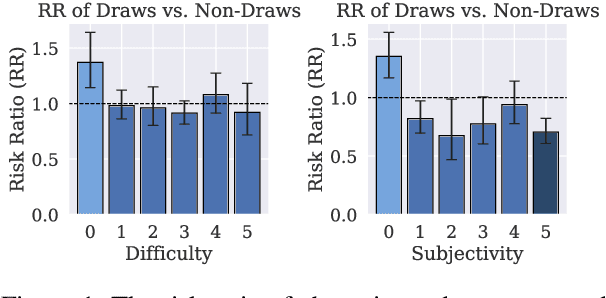
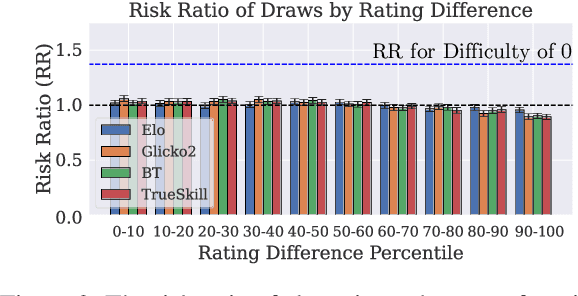
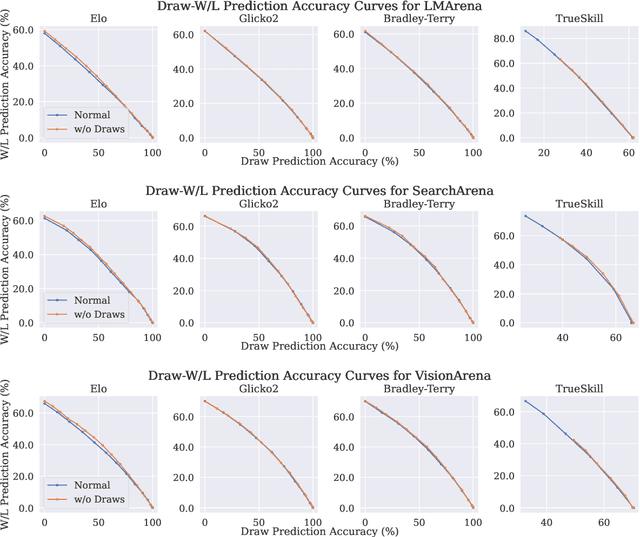
In arena-style evaluation of large language models (LLMs), two LLMs respond to a user query, and the user chooses the winning response or deems the "battle" a draw, resulting in an adjustment to the ratings of both models. The prevailing approach for modeling these rating dynamics is to view battles as two-player game matches, as in chess, and apply the Elo rating system and its derivatives. In this paper, we critically examine this paradigm. Specifically, we question whether a draw genuinely means that the two models are equal and hence whether their ratings should be equalized. Instead, we conjecture that draws are more indicative of query difficulty: if the query is too easy, then both models are more likely to succeed equally. On three real-world arena datasets, we show that ignoring rating updates for draws yields a 1-3% relative increase in battle outcome prediction accuracy (which includes draws) for all four rating systems studied. Further analyses suggest that draws occur more for queries rated as very easy and those as highly objective, with risk ratios of 1.37 and 1.35, respectively. We recommend future rating systems to reconsider existing draw semantics and to account for query properties in rating updates.
Exploring Human-AI Conceptual Alignment through the Prism of Chess
Oct 29, 2025Do AI systems truly understand human concepts or merely mimic surface patterns? We investigate this through chess, where human creativity meets precise strategic concepts. Analyzing a 270M-parameter transformer that achieves grandmaster-level play, we uncover a striking paradox: while early layers encode human concepts like center control and knight outposts with up to 85\% accuracy, deeper layers, despite driving superior performance, drift toward alien representations, dropping to 50-65\% accuracy. To test conceptual robustness beyond memorization, we introduce the first Chess960 dataset: 240 expert-annotated positions across 6 strategic concepts. When opening theory is eliminated through randomized starting positions, concept recognition drops 10-20\% across all methods, revealing the model's reliance on memorized patterns rather than abstract understanding. Our layer-wise analysis exposes a fundamental tension in current architectures: the representations that win games diverge from those that align with human thinking. These findings suggest that as AI systems optimize for performance, they develop increasingly alien intelligence, a critical challenge for creative AI applications requiring genuine human-AI collaboration. Dataset and code are available at: https://github.com/slomasov/ChessConceptsLLM.