 Add to Chrome
 Add to Firefox
 Add to Edge
Cfar
Papers and Code
Standard Condition Number-Based Detection for MIMO ISAC Systems under Noise Uncertainty
Mar 12, 2026
This paper presents a unified analytical and optimization framework for Standard Condition Number (SCN)-based detection in MIMO Integrated Sensing and Communication (ISAC) systems operating under noise uncertainty. Conventional detectors such as the Likelihood Ratio Test (LRT) and Energy Detector (ED) suffer from false-alarm inflation when interference or jamming alters the noise covariance. To overcome this limitation, the SCN detector, defined as the ratio of the largest to smallest eigenvalues of the sample covariance matrix is analytically characterized for the first time in an ISAC setting. Closed-form expressions for the false-alarm and detection probabilities are derived using random matrix theory for a two-antenna sensing receiver and generalized to arbitrary MIMO dimensions. The analysis proves that the SCN maintains a constant false alarm rate (CFAR) property and remains resilient to covariance mismatch, providing theoretical justification for its robustness in dynamic environments. Leveraging these results, a tractable ISAC power-allocation problem is formulated to minimize total detection error subject to communication rate and power constraints, yielding an interpretable sequential solution. Numerical evaluations verify the theory and demonstrate that the proposed SCN detector consistently outperforms LRT and eigenvalue-based benchmarks, particularly under strong interference and jamming typical of modern multiuser networks.

Active RIS-Assisted MIMO System for Vital Signs Extraction: ISAC Modeling, Deep Learning, and Prototype Measurements
Feb 18, 2026We present the RIS-VSign system, an active reconfigurable intelligent surface (RIS)-assisted multiple-input multiple-output orthogonal frequency division multiplexing (MIMO-OFDM) framework for vital signs extraction under an integrated sensing and communication (ISAC) model. The system consists of two stages: the phase selector of RIS and the extraction of respiration rate. To mitigate synchronization-induced common phase drifts, the difference of Möbius transformation (DMT) is integrated into the deep learning framework, named DMTNet, to jointly configure multiple active RIS elements. Notably, the training data are generated in simulation without collecting real-world measurements, and the resulting phase selector is validated experimentally. For sensing, multi-antenna measurements are fused by the DC-offset calibration and the DeepMining-MMV processing with CA-CFAR detection and Newton's refinements. Prototype experiments indicate that active RIS deployment improves respiration detectability while simultaneously enabling higher-order modulation; without RIS, respiration detection is unreliable and only lower-order modulation is supported.
Lightweight Range-Angle Imaging Based Algorithm for Quasi-Static Human Detection on Low-Cost FMCW Radar
Feb 15, 2026Quasi-static human activities such as lying, standing or sitting produce very low Doppler shifts and highly spread radar signatures, making them difficult to detect with conventional constant-false-alarm rate (CFAR) detectors tuned for point targets. Moreover, privacy concerns and low lighting conditions limit the use of cameras in long-term care (LTC) facilities. This paper proposes a lightweight, non-visual image-based method for robust quasi-static human presence detection using a low-cost 60 GHz FMCW radar. On a dataset covering five semi-static activities, the proposed method improves average detection accuracy from 68.3% for Cell-Averaging CFAR (CA-CFAR) and 78.8% for Order-Statistics CFAR (OS-CFAR) to 93.24% for Subject 1, from 51.3%, 68.3% to 92.3% for Subject 2, and 57.72%, 69.94% to 94.82% for Subject 3, respectively. Finally, we benchmarked all three detectors across all activities on a Raspberry Pi 4B using a shared Range-Angle (RA) preprocessing pipeline. The proposed algorithm obtains an average 8.2 ms per frame, resulting in over 120 frames per second (FPS) and a 74 times speed-up over OS-CFAR. These results demonstrate that simple image-based processing can provide robust and deployable quasi-static human sensing in cluttered indoor environments.
Reliable Quasi-Static Post-Fall Floor-Occupancy Detection Using Low-Cost Millimetre-Wave Radar
Jan 25, 2026As the population ages rapidly, long-term care (LTC) facilities across North America face growing pressure to monitor residents safely while keeping staff workload manageable. Falls are among the most critical events to monitor due to their timely response requirement, yet frequent false alarms or uncertain detections can overwhelm caregivers and contribute to alarm fatigue. This motivates the design of reliable, whole end-to-end ambient monitoring systems from occupancy and activity awareness to fall and post-fall detection. In this paper, we focus on robust post-fall floor-occupancy detection using an off-the-shelf 60 GHz FMCW radar and evaluate its deployment in a realistic, furnished indoor environment representative of LTC facilities. Post-fall detection is challenging since motion is minimal, and reflections from the floor and surrounding objects can dominate the radar signal return. We compare a vendor-provided digital beamforming (DBF) pipeline against a proposed preprocessing approach based on Capon or minimum variance distortionless response (MVDR) beamforming. A cell-averaging constant false alarm rate (CA-CFAR) detector is applied and evaluated on the resulting range-azimuth maps across 7 participants. The proposed method improves the mean frame-positive rate from 0.823 (DBF) to 0.916 (Proposed).
Real-Time Multi-Target Detection and Tracking with mmWave 5G NR Waveforms on RFSoC
Dec 27, 2025We demonstrate a real-time implementation of multi-target detection and tracking using 5G New Radio (NR) physical downlink shared channel (PDSCH) waveform with 400 MHz bandwidth at 28 GHz carrier frequency. The hardware platform is built on a radio frequency system-on-chip (RFSoC) 4x2 board connected with a pair of Sivers EVK02001 mmWave beamformers for transmission and reception. The entire sensing transceiver processing and fast beam control are realized purely in the programmable logic (PL) part of the RFSoC, enabling low-latency and fully hardware-accelerated operation. The continuously acquired sensing data constitute 3D range-angle (RA) tensors, which are processed on a host PC using adaptive background subtraction, cell-averaging constant false alarm rate (CA-CFAR) detection with density-based spatial clustering of applications with noise (DBSCAN) clustering, and extended Kalman filtering (EKF), to detect and track targets in the environment. Our software-defined radio (SDR) testbed integrates heterogeneous computing resources, including CPUs, GPUs, and FPGAs, thereby providing design flexibility for a wide range of tasks.
On the Asymptotic Performance of Diagonally Loaded Detectors for Large Arrays: To Achieve CFAR and Optimality
Dec 17, 2025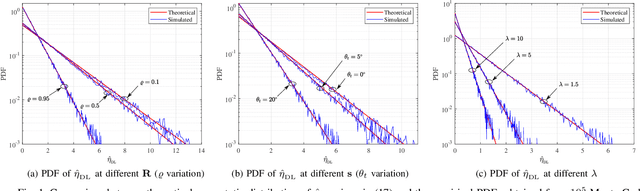
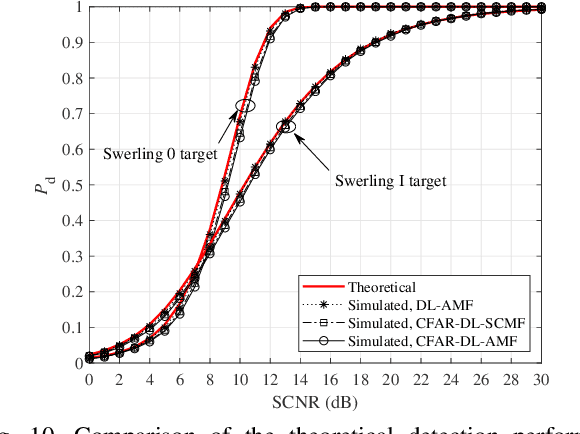
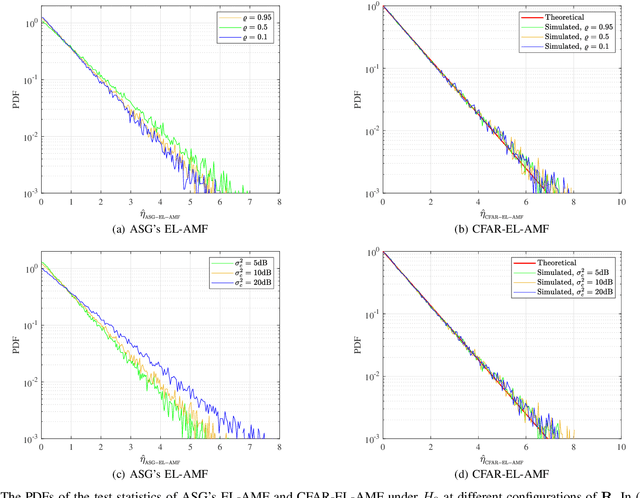
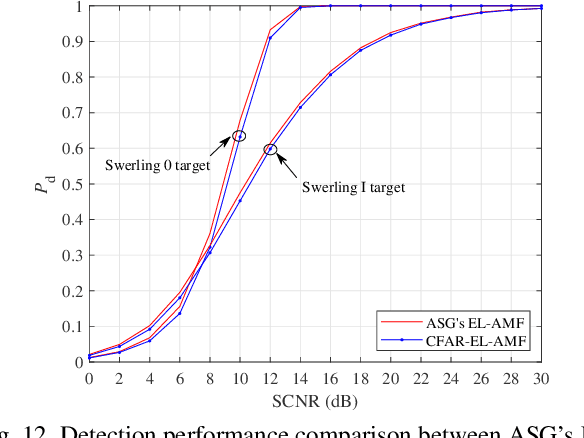
This paper addresses two critical limitations in diagonally loaded (DL) adaptive matched filter (AMF) detector: (1) the lack of CFAR property with respect to arbitrary covariance matrices, and (2) the absence of selection criteria for optimal loading factor from the perspective of maximizing the detection probability (Pd). We provide solutions to both challenges through a comprehensive analysis for the asymptotic performance of DL-AMF under large dimensional regime (LDR) where the dimension N and sample size K tend to infinity whereas their ratio N/K converges to a constant c\in(0,1). The analytical results show that any DL detectors constructed by normalizing the random variable |a|2=|sH(R+λIN)-1y0|2 with a deterministic quantity or a random variable that converges almost surely to a deterministic value will exhibit equivalent performance under LDR. Following this idea, we derive two CFAR DL detectors: CFAR DL semi-clairvoyant matched filter (CFAR-DL-SCMF) detector and CFAR DL adaptive matched filter (CFAR-DL-AMF) detector, by normalizing |a|2 with an appropriate deterministic quantity and its consistent estimate, respectively. The theoretical analysis and simulations show that both CFAR-DL-SCMF and CFAR-DL-AMF achieve CFAR with respect to covariance matrix, target steering vector and loading factor. Furthermore, we derive the asymptotically optimal loading factor λ_opt by maximizing the explicit expression of asymptotic Pd. For practical implementation, we provide a consistent estimator for λ_opt under LDR. Based on λ_opt and its consistent estimate, we establish the optimal CFAR-DL-SCMF (opt-CFAR-DL-SCMF) and the optimal CFAR-DL-AMF (opt-CFAR-DL-AMF). Numerical examples demonstrate that the proposed opt-CFAR-DL-SCMF and opt-CFAR-DL-AMF consistently outperform EL-AMF and persymmetric AMF in both full-rank and low-rank clutter plus noise environments.
Statistical Inference Framework for Extended Target Detection in mmWave Automotive Radar
Sep 30, 2025Millimeter wave (mmWave) radar systems, owing to their large bandwidth, provide fine range resolution that enables the observation of multiple scatterers originating from a single automotive target commonly referred to as an extended target. Conventional CFAR-based detection algorithms typically treat these scatterers as independent detections, thereby discarding the spatial scattering structure intrinsic to the target. To preserve this scattering spread, this paper proposes a Range-Doppler (RD) segment framework designed to encapsulate the typical scattering profile of an automobile. The statistical characterization of the segment is performed using Maximum Likelihood Estimation (MLE) and posterior density modeling facilitated through Gibbs Markov Chain Monte Carlo (MCMC) sampling. A skewness-based test statistic, derived from the estimated statistical model, is introduced for binary hypothesis classification of extended targets. Additionally, the paper presents a detection pipeline that incorporates Intersection over Union (IoU) and segment centering based on peak response, optimized to work within a single dwell. Extensive evaluations using both simulated and real-world datasets demonstrate the effectiveness of the proposed approach, underscoring its suitability for automotive radar applications through improved detection accuracy.
Eigenvalue-Based Detection in MIMO Systems for Integrated Sensing and Communication
Jun 11, 2025This paper considers a MIMO Integrated Sensing and Communication (ISAC) system, where a base station simultaneously serves a MIMO communication user and a remote MIMO sensing receiver, without channel state information (CSI) at the transmitter. Existing MIMO ISAC literature often prioritizes communication rate or detection probability, typically under constant false-alarm rate (CFAR) assumptions, without jointly analyzing detection reliability and communication constraints. To address this gap, we adopt an eigenvalue-based detector for robust sensing and use a performance metric, the total detection error, that jointly captures false-alarm and missed-detection probabilities. We derive novel closed-form expressions for both probabilities under the eigenvalue detector, enabling rigorous sensing analysis. Using these expressions, we formulate and solve a joint power allocation and threshold optimization problem that minimizes total detection error while meeting a minimum communication rate requirement. Simulation results demonstrate that the proposed joint design substantially outperforms conventional CFAR-based schemes, highlighting the benefits of power- and threshold-aware optimization in MIMO ISAC systems.
Benchmarking CFAR and CNN-based Peak Detection Algorithms in ISAC under Hardware Impairments
May 16, 2025
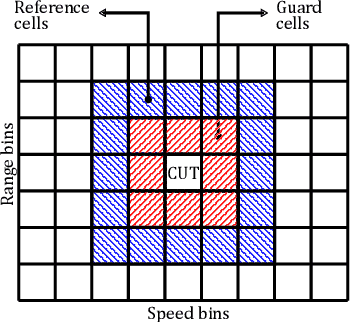
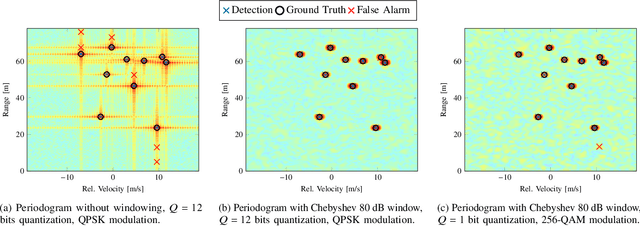
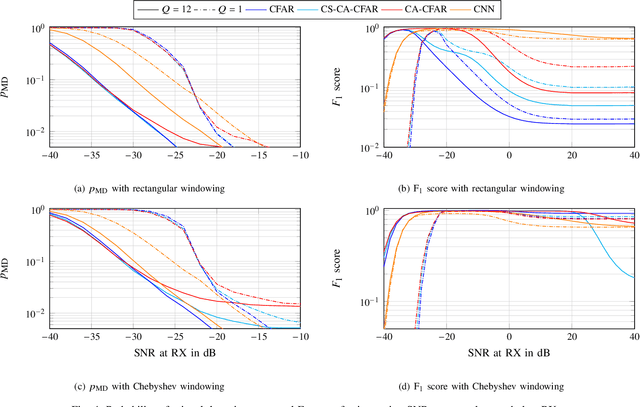
Peak detection is a fundamental task in radar and has therefore been studied extensively in radar literature. However, Integrated Sensing and Communication (ISAC) systems for sixth generation (6G) cellular networks need to perform peak detection under hardware impairments and constraints imposed by the underlying system designed for communications. This paper presents a comparative study of classical Constant False Alarm Rate (CFAR)-based algorithms and a recently proposed Convolutional Neural Network (CNN)-based method for peak detection in ISAC radar images. To impose practical constraints of ISAC systems, we model the impact of hardware impairments, such as power amplifier nonlinearities and quantization noise. We perform extensive simulation campaigns focusing on multi-target detection under varying noise as well as on target separation in resolution-limited scenarios. The results show that CFAR detectors require approximate knowledge of the operating scenario and the use of window functions for reliable performance. The CNN, on the other hand, achieves high performance in all scenarios, but requires a preprocessing step for the input data.
CFARNet: Learning-Based High-Resolution Multi-Target Detection for Rainbow Beam Radar
May 15, 2025Millimeter-wave (mmWave) OFDM radar equipped with rainbow beamforming, enabled by joint phase-time arrays (JPTAs), provides wide-angle coverage and is well-suited for fast real-time target detection and tracking. However, accurate detection of multiple closely spaced targets remains a key challenge for conventional signal processing pipelines, particularly those relying on constant false alarm rate (CFAR) detectors. This paper presents CFARNet, a learning-based processing framework that replaces CFAR with a convolutional neural network (CNN) for peak detection in the angle-Doppler domain. The network predicts target subcarrier indices, which guide angle estimation via a known frequency-angle mapping and enable high-resolution range and velocity estimation using the MUSIC algorithm. Extensive simulations demonstrate that CFARNet significantly outperforms a CFAR+MUSIC baseline, especially under low transmit power and dense multi-target conditions. The proposed method offers superior angular resolution, enhanced robustness in low-SNR scenarios, and improved computational efficiency, highlighting the potential of data-driven approaches for high-resolution mmWave radar sensing.