 Add to Chrome
 Add to Firefox
 Add to Edge
Acoustic Scene Classification
Papers and Code
Class-Aware Permutation-Invariant Signal-to-Distortion Ratio for Semantic Segmentation of Sound Scene with Same-Class Sources
Jan 30, 2026
To advance immersive communication, the Detection and Classification of Acoustic Scenes and Events (DCASE) 2025 Challenge recently introduced Task 4 on Spatial Semantic Segmentation of Sound Scenes (S5). An S5 system takes a multi-channel audio mixture as input and outputs single-channel dry sources along with their corresponding class labels. Although the DCASE 2025 Challenge simplifies the task by constraining class labels in each mixture to be mutually exclusive, real-world mixtures frequently contain multiple sources from the same class. The presence of duplicated labels can significantly degrade the performance of the label-queried source separation (LQSS) model, which is the key component of many existing S5 systems, and can also limit the validity of the official evaluation metric of DCASE 2025 Task 4. To address these issues, we propose a class-aware permutation-invariant loss function that enables the LQSS model to handle queries involving duplicated labels. In addition, we redesign the S5 evaluation metric to eliminate ambiguities caused by these same-class sources. To evaluate the proposed method within the S5 system, we extend the label prediction model to support same-class labels. Experimental results demonstrate the effectiveness of the proposed methods and the robustness of the new metric on mixtures both with and without same-class sources.

Integrating Fine-Grained Audio-Visual Evidence for Robust Multimodal Emotion Reasoning
Jan 26, 2026Multimodal emotion analysis is shifting from static classification to generative reasoning. Beyond simple label prediction, robust affective reasoning must synthesize fine-grained signals such as facial micro-expressions and prosodic which shifts to decode the latent causality within complex social contexts. However, current Multimodal Large Language Models (MLLMs) face significant limitations in fine-grained perception, primarily due to data scarcity and insufficient cross-modal fusion. As a result, these models often exhibit unimodal dominance which leads to hallucinations in complex multimodal interactions, particularly when visual and acoustic cues are subtle, ambiguous, or even contradictory (e.g., in sarcastic scenery). To address this, we introduce SABER-LLM, a framework designed for robust multimodal reasoning. First, we construct SABER, a large-scale emotion reasoning dataset comprising 600K video clips, annotated with a novel six-dimensional schema that jointly captures audiovisual cues and causal logic. Second, we propose the structured evidence decomposition paradigm, which enforces a "perceive-then-reason" separation between evidence extraction and reasoning to alleviate unimodal dominance. The ability to perceive complex scenes is further reinforced by consistency-aware direct preference optimization, which explicitly encourages alignment among modalities under ambiguous or conflicting perceptual conditions. Experiments on EMER, EmoBench-M, and SABER-Test demonstrate that SABER-LLM significantly outperforms open-source baselines and achieves robustness competitive with closed-source models in decoding complex emotional dynamics. The dataset and model are available at https://github.com/zxzhao0/SABER-LLM.
Event Classification by Physics-informed Inpainting for Distributed Multichannel Acoustic Sensor with Partially Degraded Channels
Jan 20, 2026Distributed multichannel acoustic sensing (DMAS) enables large-scale sound event classification (SEC), but performance drops when many channels are degraded and when sensor layouts at test time differ from training layouts. We propose a learning-free, physics-informed inpainting frontend based on reverse time migration (RTM). In this approach, observed multichannel spectrograms are first back-propagated on a 3D grid using an analytic Green's function to form a scene-consistent image, and then forward-projected to reconstruct inpainted signals before log-mel feature extraction and Transformer-based classification. We evaluate the method on ESC-50 with 50 sensors and three layouts (circular, linear, right-angle), where per-channel SNRs are sampled from -30 to 0 dB. Compared with an AST baseline, scaling-sparsemax channel selection, and channel-swap augmentation, the proposed RTM frontend achieves the best or competitive accuracy across all layouts, improving accuracy by 13.1 points on the right-angle layout (from 9.7% to 22.8%). Correlation analyses show that spatial weights align more strongly with SNR than with channel--source distance, and that higher SNR--weight correlation corresponds to higher SEC accuracy. These results demonstrate that a reconstruct-then-project, physics-based preprocessing effectively complements learning-only methods for DMAS under layout-open configurations and severe channel degradation.
Adaptive Knowledge Distillation using a Device-Aware Teacher for Low-Complexity Acoustic Scene Classification
Sep 11, 2025In this technical report, we describe our submission for Task 1, Low-Complexity Device-Robust Acoustic Scene Classification, of the DCASE 2025 Challenge. Our work tackles the dual challenges of strict complexity constraints and robust generalization to both seen and unseen devices, while also leveraging the new rule allowing the use of device labels at test time. Our proposed system is based on a knowledge distillation framework where an efficient CP-MobileNet student learns from a compact, specialized two-teacher ensemble. This ensemble combines a baseline PaSST teacher, trained with standard cross-entropy, and a 'generalization expert' teacher. This expert is trained using our novel Device-Aware Feature Alignment (DAFA) loss, adapted from prior work, which explicitly structures the feature space for device robustness. To capitalize on the availability of test-time device labels, the distilled student model then undergoes a final device-specific fine-tuning stage. Our proposed system achieves a final accuracy of 57.93\% on the development set, demonstrating a significant improvement over the official baseline, particularly on unseen devices.
Enhancing Situational Awareness in Wearable Audio Devices Using a Lightweight Sound Event Localization and Detection System
Sep 18, 2025Wearable audio devices with active noise control (ANC) enhance listening comfort but often at the expense of situational awareness. However, this auditory isolation may mask crucial environmental cues, posing significant safety risks. To address this, we propose an environmental intelligence framework that combines Acoustic Scene Classification (ASC) with Sound Event Localization and Detection (SELD). Our system first employs a lightweight ASC model to infer the current environment. The scene prediction then dynamically conditions a SELD network, tuning its sensitivity to detect and localize sounds that are most salient to the current context. On simulated headphone data, the proposed ASC-conditioned SELD system demonstrates improved spatial intelligence over a conventional baseline. This work represents a crucial step towards creating intelligent hearables that can deliver crucial environmental information, fostering a safer and more context-aware listening experience.
Improving Anomalous Sound Detection with Attribute-aware Representation from Domain-adaptive Pre-training
Sep 16, 2025Anomalous Sound Detection (ASD) is often formulated as a machine attribute classification task, a strategy necessitated by the common scenario where only normal data is available for training. However, the exhaustive collection of machine attribute labels is laborious and impractical. To address the challenge of missing attribute labels, this paper proposes an agglomerative hierarchical clustering method for the assignment of pseudo-attribute labels using representations derived from a domain-adaptive pre-trained model, which are expected to capture machine attribute characteristics. We then apply model adaptation to this pre-trained model through supervised fine-tuning for machine attribute classification, resulting in a new state-of-the-art performance. Evaluation on the Detection and Classification of Acoustic Scenes and Events (DCASE) 2025 Challenge dataset demonstrates that our proposed approach yields significant performance gains, ultimately outperforming our previous top-ranking system in the challenge.
Clustering of Acoustic Environments with Variational Autoencoders for Hearing Devices
Oct 02, 2025Particularly in hearing devices, the environmental context is taken into account for audio processing, often through classification. Traditional acoustic environment classification relies on classical algorithms, which are unable to extract meaningful representations of high-dimensionality data, or on supervised learning, being limited by the availability of labels. Knowing that human-imposed labels do not always reflect the true structure of acoustic scenes, we explore the (unsupervised) clustering of acoustic environments using variational autoencoders (VAEs), presenting a structured latent space suitable for the task. We propose a VAE model for categorical latent clustering employing a Gumbel-Softmax reparameterization with a time-context windowing scheme, tailored for real-world hearing device scenarios. Additionally, general adaptations on VAE architectures for audio clustering are also proposed. The approaches are validated through the clustering of spoken digits, a simpler task where labels are meaningful, and urban soundscapes, which recordings present strong overlap in time and frequency. While all variational methods succeeded when clustering spoken digits, only the proposed model achieved effective clustering performance on urban acoustic scenes, given its categorical nature.
Auditory Intelligence: Understanding the World Through Sound
Aug 11, 2025Recent progress in auditory intelligence has yielded high-performing systems for sound event detection (SED), acoustic scene classification (ASC), automated audio captioning (AAC), and audio question answering (AQA). Yet these tasks remain largely constrained to surface-level recognition-capturing what happened but not why, what it implies, or how it unfolds in context. I propose a conceptual reframing of auditory intelligence as a layered, situated process that encompasses perception, reasoning, and interaction. To instantiate this view, I introduce four cognitively inspired task paradigms-ASPIRE, SODA, AUX, and AUGMENT-those structure auditory understanding across time-frequency pattern captioning, hierarchical event/scene description, causal explanation, and goal-driven interpretation, respectively. Together, these paradigms provide a roadmap toward more generalizable, explainable, and human-aligned auditory intelligence, and are intended to catalyze a broader discussion of what it means for machines to understand sound.
Resnet-conformer network with shared weights and attention mechanism for sound event localization, detection, and distance estimation
Jul 23, 2025This technical report outlines our approach to Task 3A of the Detection and Classification of Acoustic Scenes and Events (DCASE) 2024, focusing on Sound Event Localization and Detection (SELD). SELD provides valuable insights by estimating sound event localization and detection, aiding in various machine cognition tasks such as environmental inference, navigation, and other sound localization-related applications. This year's challenge evaluates models using either audio-only (Track A) or audiovisual (Track B) inputs on annotated recordings of real sound scenes. A notable change this year is the introduction of distance estimation, with evaluation metrics adjusted accordingly for a comprehensive assessment. Our submission is for Task A of the Challenge, which focuses on the audio-only track. Our approach utilizes log-mel spectrograms, intensity vectors, and employs multiple data augmentations. We proposed an EINV2-based [1] network architecture, achieving improved results: an F-score of 40.2%, Angular Error (DOA) of 17.7 degrees, and Relative Distance Error (RDE) of 0.32 on the test set of the Development Dataset [2 ,3].
Online incremental learning for audio classification using a pretrained audio model
Aug 28, 2025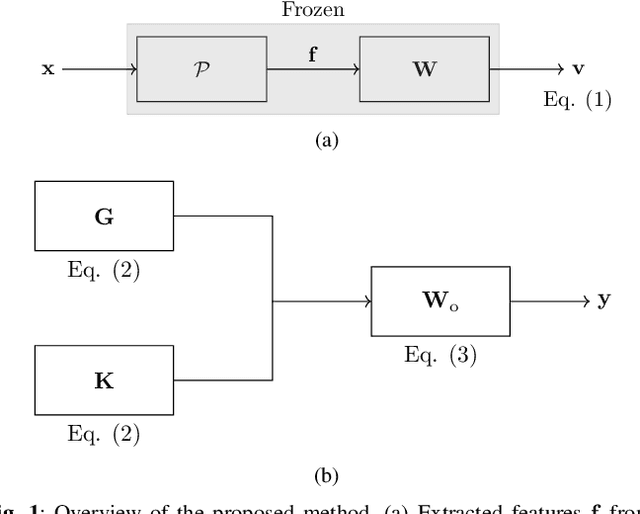
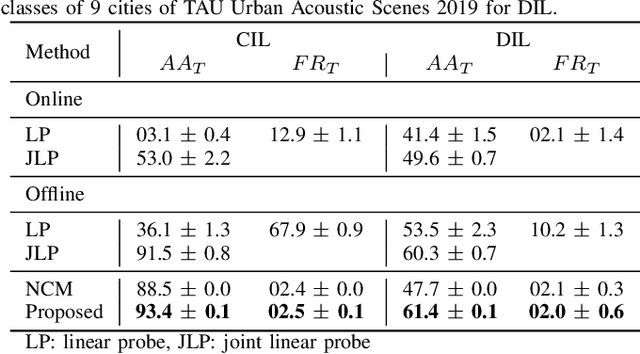
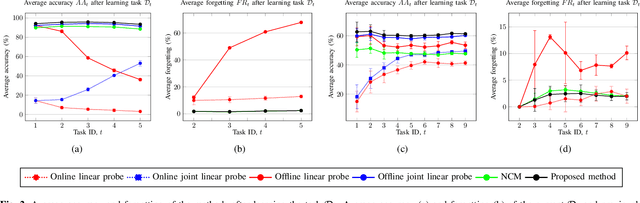
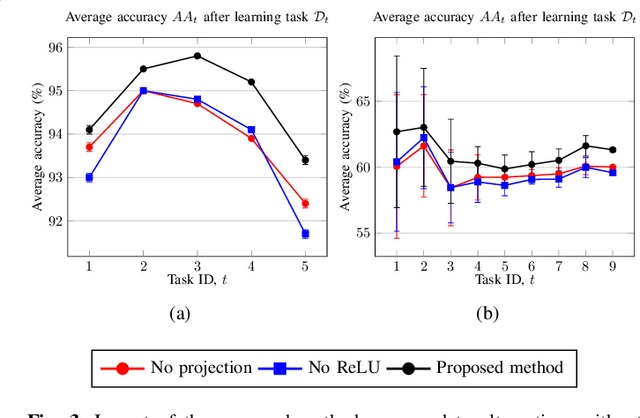
Incremental learning aims to learn new tasks sequentially without forgetting the previously learned ones. Most of the existing incremental learning methods for audio focus on training the model from scratch on the initial task, and the same model is used to learn upcoming incremental tasks. The model is trained for several iterations to adapt to each new task, using some specific approaches to reduce the forgetting of old tasks. In this work, we propose a method for using generalizable audio embeddings produced by a pre-trained model to develop an online incremental learner that solves sequential audio classification tasks over time. Specifically, we inject a layer with a nonlinear activation function between the pre-trained model's audio embeddings and the classifier; this layer expands the dimensionality of the embeddings and effectively captures the distinct characteristics of sound classes. Our method adapts the model in a single forward pass (online) through the training samples of any task, with minimal forgetting of old tasks. We demonstrate the performance of the proposed method in two incremental learning setups: one class-incremental learning using ESC-50 and one domain-incremental learning of different cities from the TAU Urban Acoustic Scenes 2019 dataset; for both cases, the proposed approach outperforms other methods.