 Add to Chrome
 Add to Firefox
 Add to Edge
TRACE: Ergodic Trajectory Optimization for Active Scene Reconstruction
Aug 03, 2026
Existing active reconstruction systems with Gaussian-splatting maps select observations greedily, optimizing a single next-best-view (NBV) at each step and connecting the chosen views by short-horizon path planning. This greedy decoupling disregards the global structure of scene information, producing inefficient trajectories that waste sensing capacity in transit between selected views. In this work, we study active reconstruction as an ergodic coverage problem: the time-averaged spatial statistics of the sensor trajectory should match a target information distribution induced by the current map. Our approach derives this target distribution online from uncertainty and visibility, and calculates ergodic trajectories via a kernel-ergodic horizon planner with gradient flow and footprint depletion, closing the loop between mapping and trajectory optimization. We thoroughly evaluate TRACE on the Replica dataset against the Next-Best-View (NBV) baselines, improving PSNR by 1.5 dB. Code: https://github.com/spikelab-jhu/trace-active-reconstruction.

EVIS: A Physics-Grounded Event Camera Plugin for NVIDIA Isaac Sim
Jul 09, 2026Event cameras offer microsecond temporal resolution, low latency, and high dynamic range, making them attractive for robotics. However, labeled event-camera data for a specific robot and scene is scarce and expensive to collect, which slows the development of event-based perception and control. We present EVIS: a physics-grounded event camera plugin for NVIDIA Isaac Sim that generates high-rate, fully labeled event streams directly inside a physics simulator. The plugin implements a faithful log-intensity contrast event model with per-pixel asynchronous reference updates; it migrates from a normal RGB camera with few changes and integrates into any Isaac Sim / Isaac Lab scene, inheriting the simulator's physics and frame-perfect ground truth. It is fully configurable, and offers an interpolation option that renders only sparse keyframes and synthesizes the in-between frames through bidirectional motion-vector warping, making real-time generation on a single GPU possible. Optional sensor noise and motion blur further narrow the gap to real cameras. The generated streams are directly usable by pretrained event networks for downstream tasks. Code repository: https://github.com/spikelab-jhu/isaac-sim-event-camera-plugin
Match-Any-Events: Zero-Shot Motion-Robust Feature Matching Across Wide Baselines for Event Cameras
Apr 20, 2026Event cameras have recently shown promising capabilities in instantaneous motion estimation due to their robustness to low light and fast motions. However, computing wide-baseline correspondence between two arbitrary views remains a significant challenge, since event appearance changes substantially with motion, and learning-based approaches are constrained by both scalability and limited wide-baseline supervision. We therefore introduce the first event matching model that achieves cross-dataset wide-baseline correspondence in a zero-shot manner: a single model trained once is deployed on unseen datasets without any target-domain fine-tuning or adaptation. To enable this capability, we introduce a motion-robust and computationally efficient attention backbone that learns multi-timescale features from event streams, augmented with sparsity-aware event token selection, making large-scale training on diverse wide-baseline supervision computationally feasible. To provide the supervision needed for wide-baseline generalization, we develop a robust event motion synthesis framework to generate large-scale event-matching datasets with augmented viewpoints, modalities, and motions. Extensive experiments across multiple benchmarks show that our framework achieves a 37.7% improvement over the previous best event feature matching methods. Code and data are available at: https://github.com/spikelab-jhu/Match-Any-Events.
Continuous-Time Human Motion Field from Events
Dec 02, 2024This paper addresses the challenges of estimating a continuous-time human motion field from a stream of events. Existing Human Mesh Recovery (HMR) methods rely predominantly on frame-based approaches, which are prone to aliasing and inaccuracies due to limited temporal resolution and motion blur. In this work, we predict a continuous-time human motion field directly from events by leveraging a recurrent feed-forward neural network to predict human motion in the latent space of possible human motions. Prior state-of-the-art event-based methods rely on computationally intensive optimization across a fixed number of poses at high frame rates, which becomes prohibitively expensive as we increase the temporal resolution. In comparison, we present the first work that replaces traditional discrete-time predictions with a continuous human motion field represented as a time-implicit function, enabling parallel pose queries at arbitrary temporal resolutions. Despite the promises of event cameras, few benchmarks have tested the limit of high-speed human motion estimation. We introduce Beam-splitter Event Agile Human Motion Dataset-a hardware-synchronized high-speed human dataset to fill this gap. On this new data, our method improves joint errors by 23.8% compared to previous event human methods while reducing the computational time by 69%.
EqNIO: Subequivariant Neural Inertial Odometry
Aug 12, 2024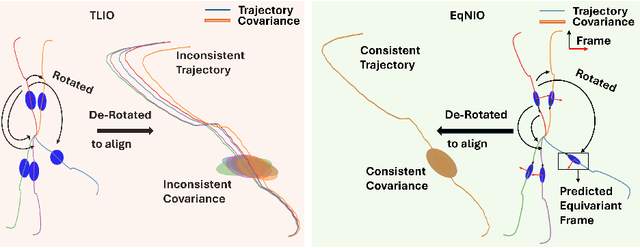
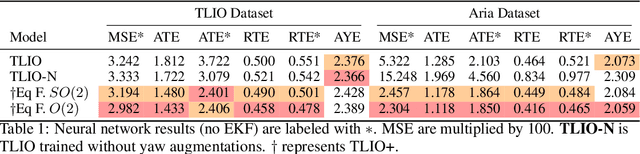
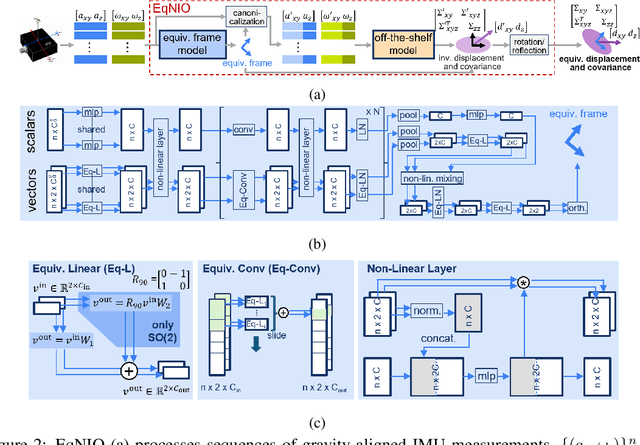
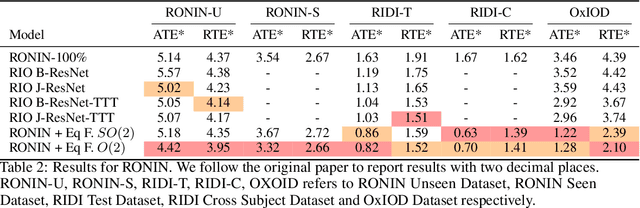
Presently, neural networks are widely employed to accurately estimate 2D displacements and associated uncertainties from Inertial Measurement Unit (IMU) data that can be integrated into stochastic filter networks like the Extended Kalman Filter (EKF) as measurements and uncertainties for the update step in the filter. However, such neural approaches overlook symmetry which is a crucial inductive bias for model generalization. This oversight is notable because (i) physical laws adhere to symmetry principles when considering the gravity axis, meaning there exists the same transformation for both the physical entity and the resulting trajectory, and (ii) displacements should remain equivariant to frame transformations when the inertial frame changes. To address this, we propose a subequivariant framework by: (i) deriving fundamental layers such as linear and nonlinear layers for a subequivariant network, designed to handle sequences of vectors and scalars, (ii) employing the subequivariant network to predict an equivariant frame for the sequence of inertial measurements. This predicted frame can then be utilized for extracting invariant features through projection, which are integrated with arbitrary network architectures, (iii) transforming the invariant output by frame transformation to obtain equivariant displacements and covariances. We demonstrate the effectiveness and generalization of our Equivariant Framework on a filter-based approach with TLIO architecture for TLIO and Aria datasets, and an end-to-end deep learning approach with RONIN architecture for RONIN, RIDI and OxIOD datasets.
Motion-prior Contrast Maximization for Dense Continuous-Time Motion Estimation
Jul 15, 2024Current optical flow and point-tracking methods rely heavily on synthetic datasets. Event cameras are novel vision sensors with advantages in challenging visual conditions, but state-of-the-art frame-based methods cannot be easily adapted to event data due to the limitations of current event simulators. We introduce a novel self-supervised loss combining the Contrast Maximization framework with a non-linear motion prior in the form of pixel-level trajectories and propose an efficient solution to solve the high-dimensional assignment problem between non-linear trajectories and events. Their effectiveness is demonstrated in two scenarios: In dense continuous-time motion estimation, our method improves the zero-shot performance of a synthetically trained model on the real-world dataset EVIMO2 by 29%. In optical flow estimation, our method elevates a simple UNet to achieve state-of-the-art performance among self-supervised methods on the DSEC optical flow benchmark. Our code is available at https://github.com/tub-rip/MotionPriorCMax.
* 24 pages, 8 figures, 8 tables, Project Page: https://github.com/tub-rip/MotionPriorCMax
TRAM: Global Trajectory and Motion of 3D Humans from in-the-wild Videos
Mar 26, 2024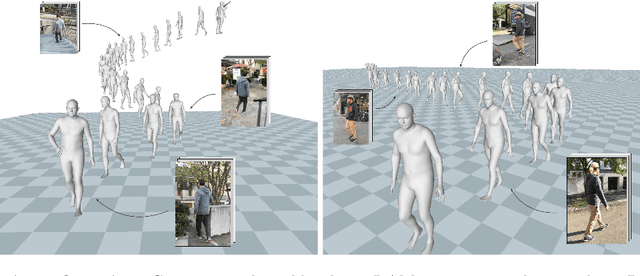
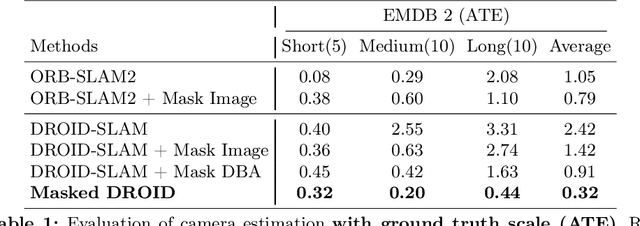
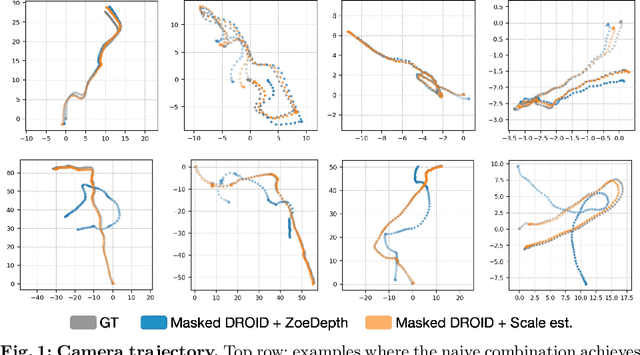
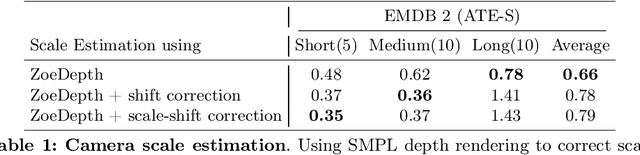
We propose TRAM, a two-stage method to reconstruct a human's global trajectory and motion from in-the-wild videos. TRAM robustifies SLAM to recover the camera motion in the presence of dynamic humans and uses the scene background to derive the motion scale. Using the recovered camera as a metric-scale reference frame, we introduce a video transformer model (VIMO) to regress the kinematic body motion of a human. By composing the two motions, we achieve accurate recovery of 3D humans in the world space, reducing global motion errors by 60% from prior work. https://yufu-wang.github.io/tram4d/
Track Everything Everywhere Fast and Robustly
Mar 26, 2024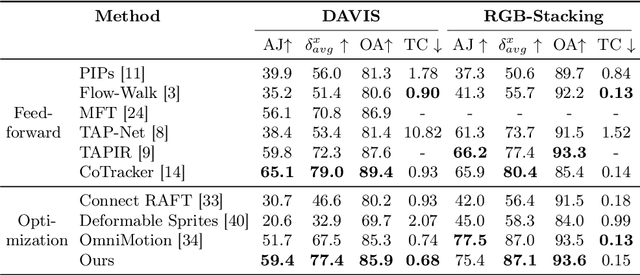
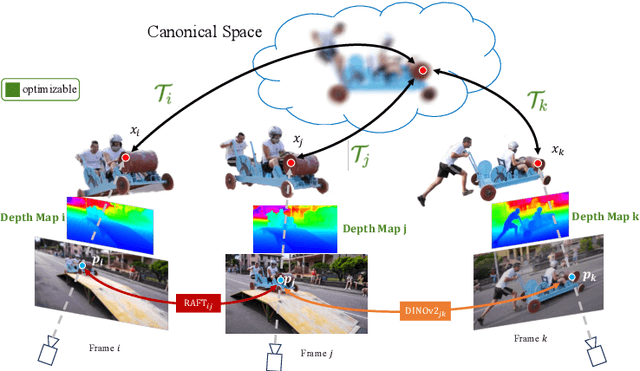
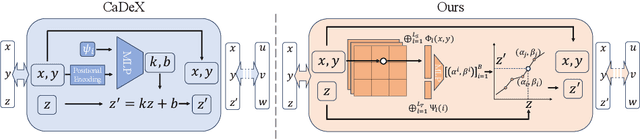
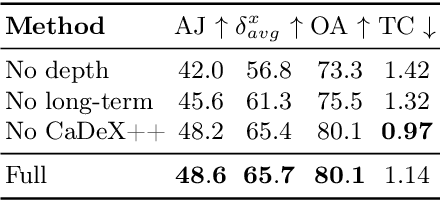
We propose a novel test-time optimization approach for efficiently and robustly tracking any pixel at any time in a video. The latest state-of-the-art optimization-based tracking technique, OmniMotion, requires a prohibitively long optimization time, rendering it impractical for downstream applications. OmniMotion is sensitive to the choice of random seeds, leading to unstable convergence. To improve efficiency and robustness, we introduce a novel invertible deformation network, CaDeX++, which factorizes the function representation into a local spatial-temporal feature grid and enhances the expressivity of the coupling blocks with non-linear functions. While CaDeX++ incorporates a stronger geometric bias within its architectural design, it also takes advantage of the inductive bias provided by the vision foundation models. Our system utilizes monocular depth estimation to represent scene geometry and enhances the objective by incorporating DINOv2 long-term semantics to regulate the optimization process. Our experiments demonstrate a substantial improvement in training speed (more than \textbf{10 times} faster), robustness, and accuracy in tracking over the SoTA optimization-based method OmniMotion.
Event-based Continuous Color Video Decompression from Single Frames
Nov 30, 2023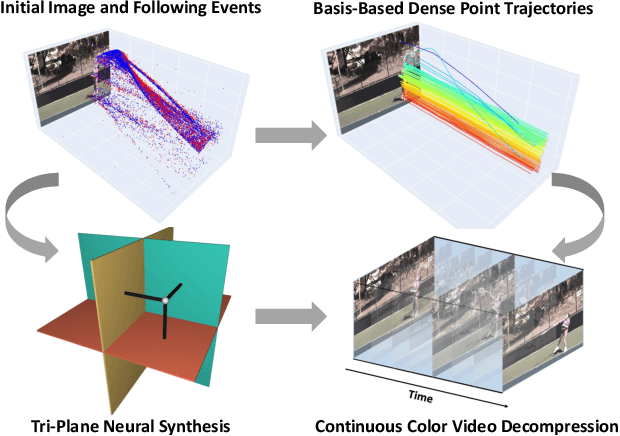
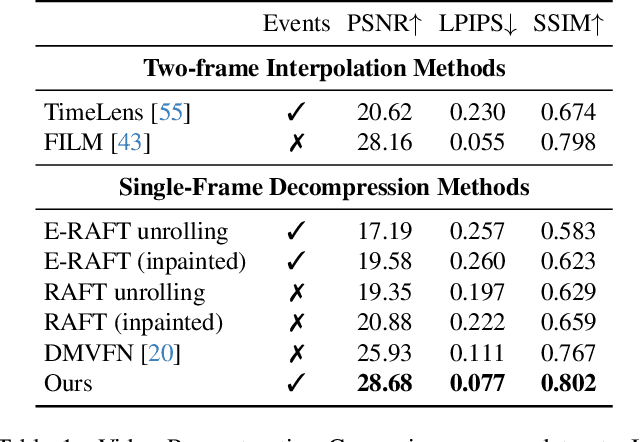
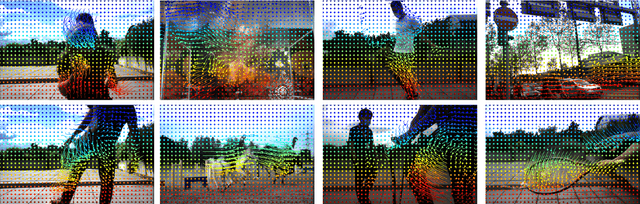
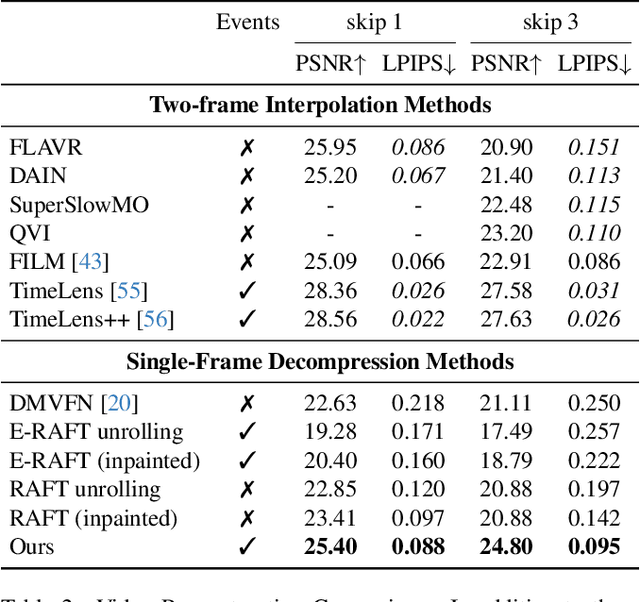
We present ContinuityCam, a novel approach to generate a continuous video from a single static RGB image, using an event camera. Conventional cameras struggle with high-speed motion capture due to bandwidth and dynamic range limitations. Event cameras are ideal sensors to solve this problem because they encode compressed change information at high temporal resolution. In this work, we propose a novel task called event-based continuous color video decompression, pairing single static color frames and events to reconstruct temporally continuous videos. Our approach combines continuous long-range motion modeling with a feature-plane-based synthesis neural integration model, enabling frame prediction at arbitrary times within the events. Our method does not rely on additional frames except for the initial image, increasing, thus, the robustness to sudden light changes, minimizing the prediction latency, and decreasing the bandwidth requirement. We introduce a novel single objective beamsplitter setup that acquires aligned images and events and a novel and challenging Event Extreme Decompression Dataset (E2D2) that tests the method in various lighting and motion profiles. We thoroughly evaluate our method through benchmarking reconstruction as well as various downstream tasks. Our approach significantly outperforms the event- and image- based baselines in the proposed task.
Un-EvMoSeg: Unsupervised Event-based Independent Motion Segmentation
Nov 30, 2023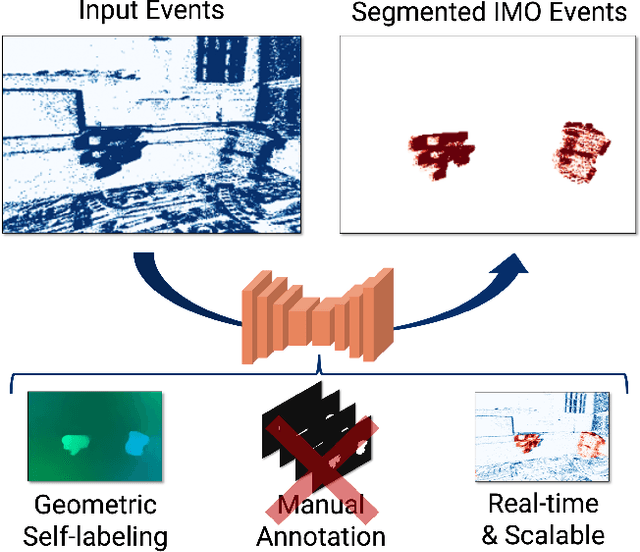
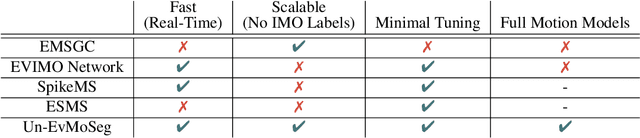
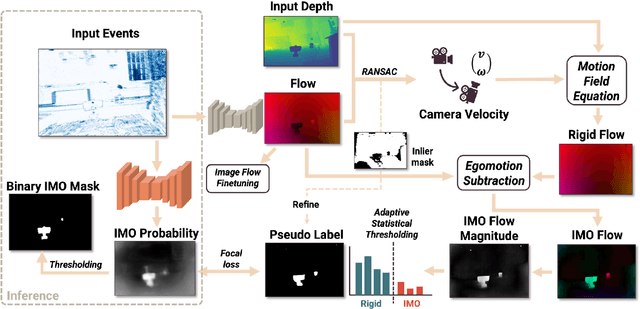
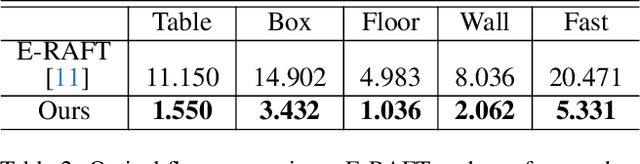
Event cameras are a novel type of biologically inspired vision sensor known for their high temporal resolution, high dynamic range, and low power consumption. Because of these properties, they are well-suited for processing fast motions that require rapid reactions. Although event cameras have recently shown competitive performance in unsupervised optical flow estimation, performance in detecting independently moving objects (IMOs) is lacking behind, although event-based methods would be suited for this task based on their low latency and HDR properties. Previous approaches to event-based IMO segmentation have been heavily dependent on labeled data. However, biological vision systems have developed the ability to avoid moving objects through daily tasks without being given explicit labels. In this work, we propose the first event framework that generates IMO pseudo-labels using geometric constraints. Due to its unsupervised nature, our method can handle an arbitrary number of not predetermined objects and is easily scalable to datasets where expensive IMO labels are not readily available. We evaluate our approach on the EVIMO dataset and show that it performs competitively with supervised methods, both quantitatively and qualitatively.