 Add to Chrome
 Add to Firefox
 Add to Edge
Can We Really Learn One Representation to Optimize All Rewards?
Feb 11, 2026
As machine learning has moved towards leveraging large models as priors for downstream tasks, the community has debated the right form of prior for solving reinforcement learning (RL) problems. If one were to try to prefetch as much computation as possible, they would attempt to learn a prior over the policies for some yet-to-be-determined reward function. Recent work (forward-backward (FB) representation learning) has tried this, arguing that an unsupervised representation learning procedure can enable optimal control over arbitrary rewards without further fine-tuning. However, FB's training objective and learning behavior remain mysterious. In this paper, we demystify FB by clarifying when such representations can exist, what its objective optimizes, and how it converges in practice. We draw connections with rank matching, fitted Q-evaluation, and contraction mapping. Our analysis suggests a simplified unsupervised pre-training method for RL that, instead of enabling optimal control, performs one step of policy improvement. We call our proposed method $\textbf{one-step forward-backward representation learning (one-step FB)}$. Experiments in didactic settings, as well as in $10$ state-based and image-based continuous control domains, demonstrate that one-step FB converges to errors $10^5$ smaller and improves zero-shot performance by $+24\%$ on average. Our project website is available at https://chongyi-zheng.github.io/onestep-fb.

Neural Inertial Odometry from Lie Events
May 14, 2025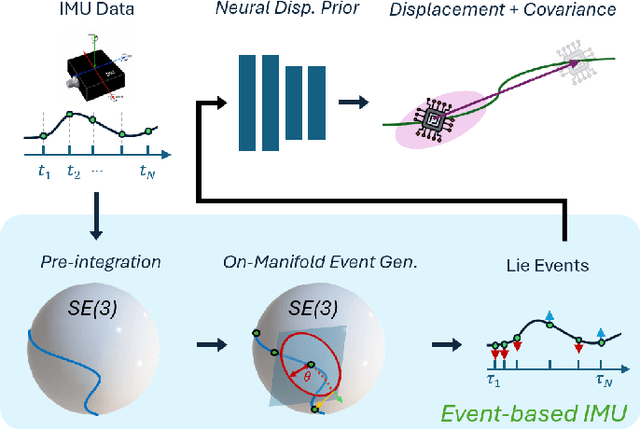
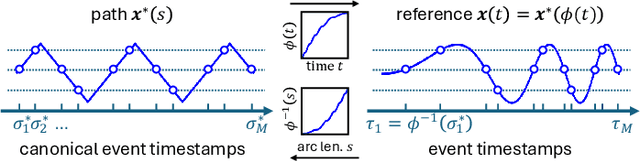
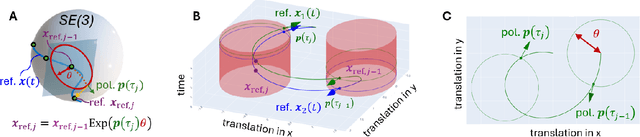

Neural displacement priors (NDP) can reduce the drift in inertial odometry and provide uncertainty estimates that can be readily fused with off-the-shelf filters. However, they fail to generalize to different IMU sampling rates and trajectory profiles, which limits their robustness in diverse settings. To address this challenge, we replace the traditional NDP inputs comprising raw IMU data with Lie events that are robust to input rate changes and have favorable invariances when observed under different trajectory profiles. Unlike raw IMU data sampled at fixed rates, Lie events are sampled whenever the norm of the IMU pre-integration change, mapped to the Lie algebra of the SE(3) group, exceeds a threshold. Inspired by event-based vision, we generalize the notion of level-crossing on 1D signals to level-crossings on the Lie algebra and generalize binary polarities to normalized Lie polarities within this algebra. We show that training NDPs on Lie events incorporating these polarities reduces the trajectory error of off-the-shelf downstream inertial odometry methods by up to 21% with only minimal preprocessing. We conjecture that many more sensors than IMUs or cameras can benefit from an event-based sampling paradigm and that this work makes an important first step in this direction.
EqNIO: Subequivariant Neural Inertial Odometry
Aug 12, 2024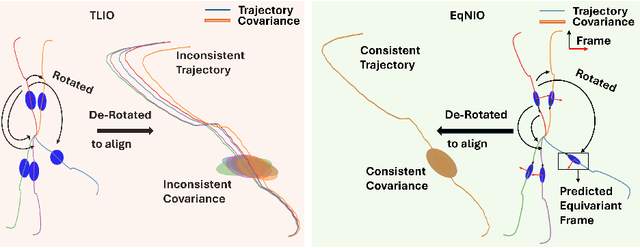
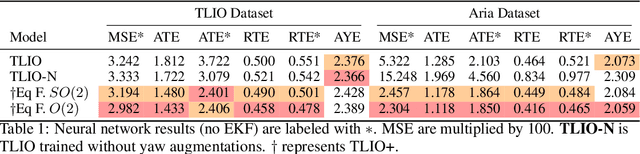
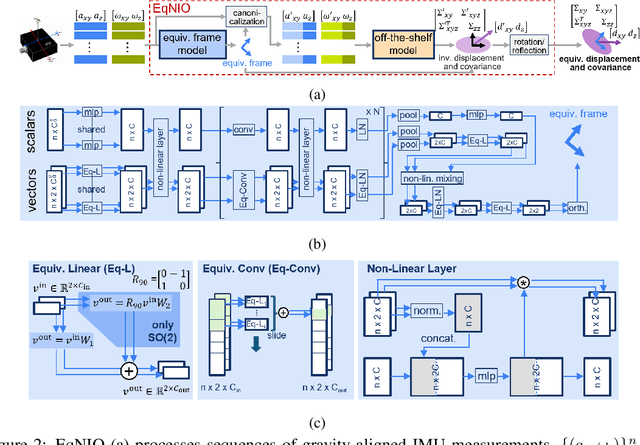
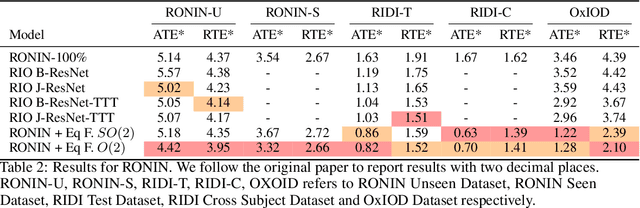
Presently, neural networks are widely employed to accurately estimate 2D displacements and associated uncertainties from Inertial Measurement Unit (IMU) data that can be integrated into stochastic filter networks like the Extended Kalman Filter (EKF) as measurements and uncertainties for the update step in the filter. However, such neural approaches overlook symmetry which is a crucial inductive bias for model generalization. This oversight is notable because (i) physical laws adhere to symmetry principles when considering the gravity axis, meaning there exists the same transformation for both the physical entity and the resulting trajectory, and (ii) displacements should remain equivariant to frame transformations when the inertial frame changes. To address this, we propose a subequivariant framework by: (i) deriving fundamental layers such as linear and nonlinear layers for a subequivariant network, designed to handle sequences of vectors and scalars, (ii) employing the subequivariant network to predict an equivariant frame for the sequence of inertial measurements. This predicted frame can then be utilized for extracting invariant features through projection, which are integrated with arbitrary network architectures, (iii) transforming the invariant output by frame transformation to obtain equivariant displacements and covariances. We demonstrate the effectiveness and generalization of our Equivariant Framework on a filter-based approach with TLIO architecture for TLIO and Aria datasets, and an end-to-end deep learning approach with RONIN architecture for RONIN, RIDI and OxIOD datasets.