 Add to Chrome
 Add to Firefox
 Add to Edge
SP-TransientBench: A Real-Captured Single Photon Perception Benchmark
Jun 16, 2026
Single-photon LiDAR (SPL) based on single-photon avalanche diode (SPAD) sensing enables time-resolved photon measurements with extreme sensitivity, offering unique potential for active 3D perception in photon-starved scenarios.However, real-world single photon perception remains fundamentally challenging due to unique measurement noise and complex multi-return transient phenomena, which jointly complicate geometric reconstruction and semantic scene understanding. Despite growing interest in SPAD-based sensing, existing studies are largely limited to simulated data or small-scale controlled captures. As a result, systematic evaluation of real-world single photon perception across depth estimation, multi-view reconstruction, and 3D semantic understanding remains underexplored. To bridge this gap, we introduce SP-TransientBench (STB), a real-captured multi-task benchmark for single photon perception. SP-TransientBenc comprises 10 diverse scenes and 10,297 views captured using a solid-state single-photon LiDAR at $256\times192$ resolution. Each view provides full time-of-flight histograms with multi-return behavior,standardized metadata, and calibrated camera poses for multi-view evaluation. We further provide 13-class 3D semantic annotations for selected scenes. By providing dedicated data splits and evaluation protocols for each task, STB enables consistent and reproducible benchmarking of real-world single photon perception across multiple 3D vision problems. The dataset and code will be released upon acceptance.

Intelligent Request Strategy Design in Recommender System
Jun 23, 2022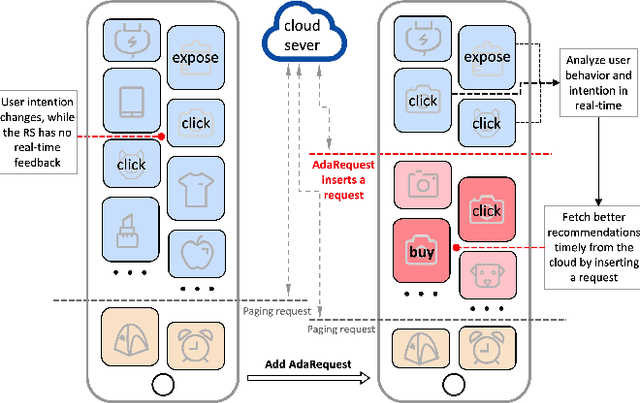

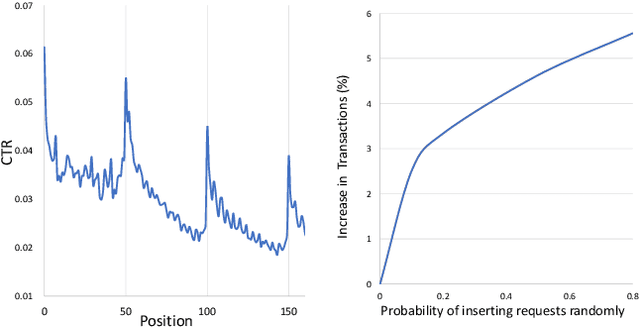
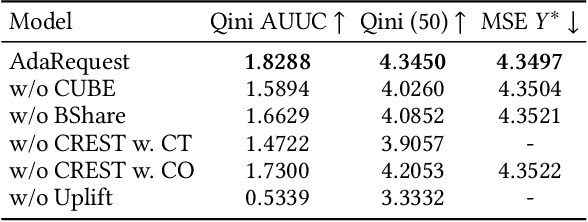
Waterfall Recommender System (RS), a popular form of RS in mobile applications, is a stream of recommended items consisting of successive pages that can be browsed by scrolling. In waterfall RS, when a user finishes browsing a page, the edge (e.g., mobile phones) would send a request to the cloud server to get a new page of recommendations, known as the paging request mechanism. RSs typically put a large number of items into one page to reduce excessive resource consumption from numerous paging requests, which, however, would diminish the RSs' ability to timely renew the recommendations according to users' real-time interest and lead to a poor user experience. Intuitively, inserting additional requests inside pages to update the recommendations with a higher frequency can alleviate the problem. However, previous attempts, including only non-adaptive strategies (e.g., insert requests uniformly), would eventually lead to resource overconsumption. To this end, we envision a new learning task of edge intelligence named Intelligent Request Strategy Design (IRSD). It aims to improve the effectiveness of waterfall RSs by determining the appropriate occasions of request insertion based on users' real-time intention. Moreover, we propose a new paradigm of adaptive request insertion strategy named Uplift-based On-edge Smart Request Framework (AdaRequest). AdaRequest 1) captures the dynamic change of users' intentions by matching their real-time behaviors with their historical interests based on attention-based neural networks. 2) estimates the counterfactual uplift of user purchase brought by an inserted request based on causal inference. 3) determines the final request insertion strategy by maximizing the utility function under online resource constraints. We conduct extensive experiments on both offline dataset and online A/B test to verify the effectiveness of AdaRequest.