 Add to Chrome
 Add to Firefox
 Add to Edge
LAST: Leveraging Tools as Hints to Enhance Spatial Reasoning for Multimodal Large Language Models
Apr 08, 2026
Spatial reasoning is a cornerstone capability for intelligent systems to perceive and interact with the physical world. However, multimodal large language models (MLLMs) frequently suffer from hallucinations and imprecision when parsing complex geometric layouts. As data-driven scaling struggles to internalize structured geometric priors and spatial constraints, integrating mature, specialized vision models presents a compelling alternative. Despite its promise, applying this paradigm to spatial reasoning is hindered by two key challenges: The difficulty of invoking heterogeneous, parameter-rich tools, as well as the challenge of understanding and effectively leveraging their diverse low-level outputs (e.g., segmentation masks, depth maps) in high-level reasoning. To address these challenges, we propose LAST, a unified framework for tool-augmented spatial reasoning. LAST features an extensible interactive sandbox, termed LAST-Box, which abstracts heterogeneous tool invocations into atomic instructions and reusable spatial skills, returning multimodal hints (e.g., annotated images and textual descriptions) that can be directly consumed by LLMs. We further design a three-stage progressive training strategy that guides models from understanding tool outputs to proficient and adaptive tool invocation. Experiments on four datasets show that LAST-7B achieves around 20\% performance gains over its backbone and outperforms strong proprietary closed-source LLMs, substantially enhancing reasoning on complex spatial tasks.

Variational Bayesian Personalized Ranking
Mar 14, 2025Recommendation systems have found extensive applications across diverse domains. However, the training data available typically comprises implicit feedback, manifested as user clicks and purchase behaviors, rather than explicit declarations of user preferences. This type of training data presents three main challenges for accurate ranking prediction: First, the unobservable nature of user preferences makes likelihood function modeling inherently difficult. Second, the resulting false positives (FP) and false negatives (FN) introduce noise into the learning process, disrupting parameter learning. Third, data bias arises as observed interactions tend to concentrate on a few popular items, exacerbating the feedback loop of popularity bias. To address these issues, we propose Variational BPR, a novel and easily implementable learning objective that integrates key components for enhancing collaborative filtering: likelihood optimization, noise reduction, and popularity debiasing. Our approach involves decomposing the pairwise loss under the ELBO-KL framework and deriving its variational lower bound to establish a manageable learning objective for approximate inference. Within this bound, we introduce an attention-based latent interest prototype contrastive mechanism, replacing instance-level contrastive learning, to effectively reduce noise from problematic samples. The process of deriving interest prototypes implicitly incorporates a flexible hard sample mining strategy, capable of simultaneously identifying hard positive and hard negative samples. Furthermore, we demonstrate that this hard sample mining strategy promotes feature distribution uniformity, thereby alleviating popularity bias. Empirically, we demonstrate the effectiveness of Variational BPR on popular backbone recommendation models. The code and data are available at: https://github.com/liubin06/VariationalBPR
Learning Contrastive Feature Representations for Facial Action Unit Detection
Feb 09, 2024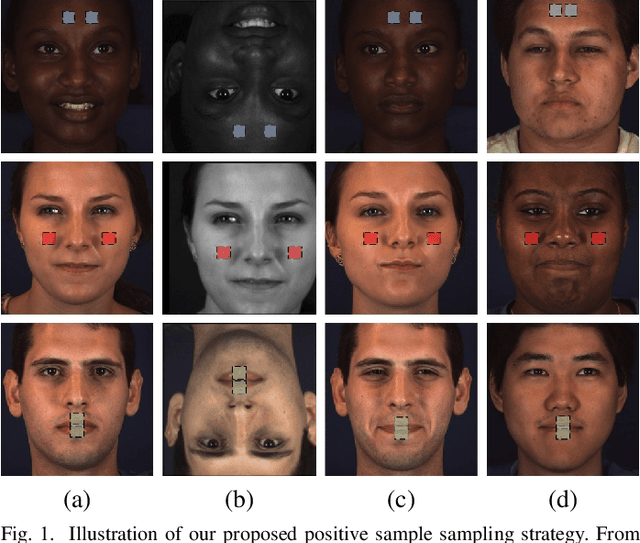
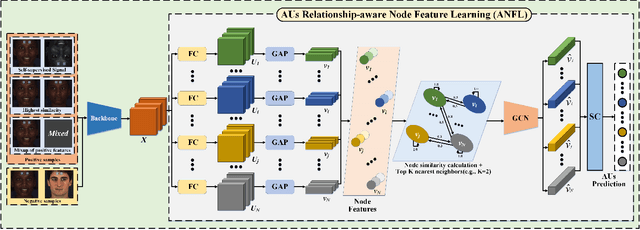
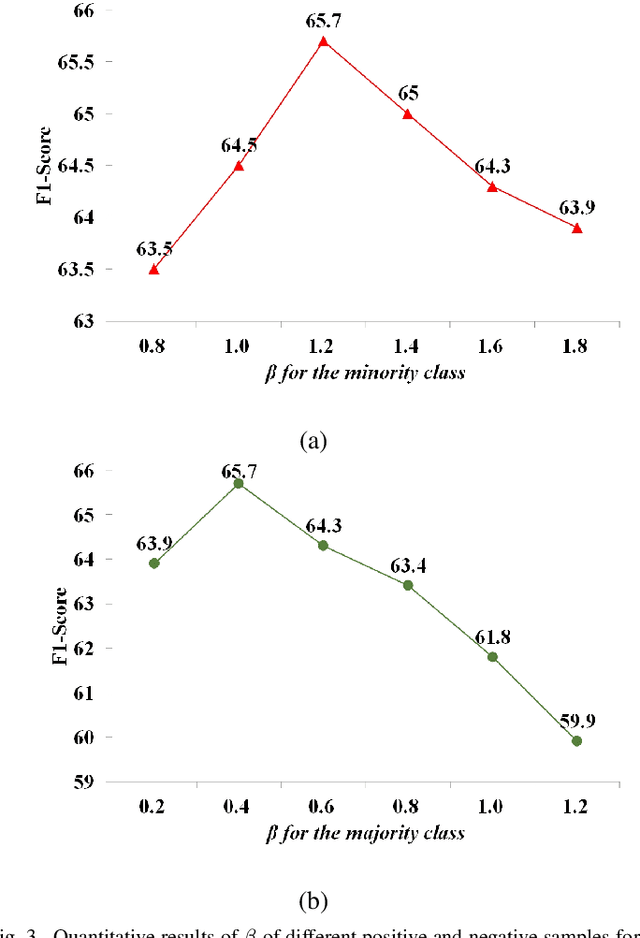
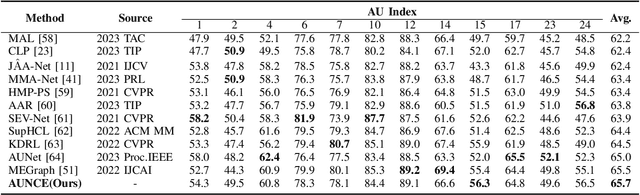
The predominant approach to facial action unit (AU) detection revolves around a supervised multi-label binary classification problem. Existing methodologies often encode pixel-level information of AUs, thereby imposing substantial demands on model complexity and expressiveness. Moreover, this practice elevates the susceptibility to overfitting due to the presence of noisy AU labels. In the present study, we introduce a contrastive learning framework enhanced by both supervised and self-supervised signals. The objective is to acquire discriminative features, deviating from the conventional pixel-level learning paradigm within the domain of AU detection. To address the challenge posed by noisy AU labels, we augment the supervised signal through the introduction of a self-supervised signal. This augmentation is achieved through positive sample sampling, encompassing three distinct types of positive sample pairs. Furthermore, to mitigate the imbalanced distribution of each AU type, we employ an importance re-weighting strategy tailored for minority AUs. The resulting loss, denoted as AUNCE, is proposed to encapsulate this strategy. Our experimental assessments, conducted on two widely-utilized benchmark datasets (BP4D and DISFA), underscore the superior performance of our approach compared to state-of-the-art methods in the realm of AU detection.
Boosting Facial Action Unit Detection Through Jointly Learning Facial Landmark Detection and Domain Separation and Reconstruction
Oct 08, 2023Recently how to introduce large amounts of unlabeled facial images in the wild into supervised Facial Action Unit (AU) detection frameworks has become a challenging problem. In this paper, we propose a new AU detection framework where multi-task learning is introduced to jointly learn AU domain separation and reconstruction and facial landmark detection by sharing the parameters of homostructural facial extraction modules. In addition, we propose a new feature alignment scheme based on contrastive learning by simple projectors and an improved contrastive loss, which adds four additional intermediate supervisors to promote the feature reconstruction process. Experimental results on two benchmarks demonstrate our superiority against the state-of-the-art methods for AU detection in the wild.