 Add to Chrome
 Add to Firefox
 Add to Edge
Self-Evolving Neuro-Symbolic Skills for Tool-Augmented Spatial Reasoning
Aug 08, 2026
Large vision-language models have achieved strong performance in multimodal reasoning, but they remain unreliable on fine-grained spatial tasks that demand both precise spatial perception and fine-grained geometric computation beyond end-to-end generation. Tool augmentation offers a natural solution, while existing methods either plan tool calls from scratch without explicit dependency constraints or rely on fixed pipelines that are redundant and generalize poorly across spatial tasks. An effective spatial reasoning agent should instead accumulate reusable experience and adaptively compose it for new problems. To this end, we propose NeSy-Spatial, a neuro-symbolic framework for self-evolving spatial skills. NeSy-Spatial abstracts tool interactions and geometric operations into typed executable atomic instructions and composes them into two complementary skill types: Tool-Use Skills for organizing tool execution and Geometry Skills for structured geometric reasoning. During inference, NeSy-Spatial retrieves and executes relevant skills in a closed-loop process. During evolution, it analyzes buffered successful and failed trajectories to refine skill structures and prune unreliable or inactive entries. Experiments on three spatial reasoning benchmarks show that NeSy-Spatial consistently improves reasoning accuracy with more precise tool utilization.

On the Learnability of Test-Time Adaptation: A Recovery Complexity Perspective
May 27, 2026Test-time adaptation (TTA) aims to adapt models to maintain reliable performance on non-stationary test streams without requiring labeled data. Despite its empirical success, the learnability of TTA under non-stationary streams remains unexplored. A key challenge is the lack of a principled theoretical framework that simultaneously aligns with the TTA objective and captures both continuously evolving distribution shifts and intrinsic information constraints. To address this gap, we propose the first theoretical framework for studying the learnability of TTA and introduce $(ε,δ)$-Recovery Complexity and $(ε,ρ)$-TTA Learnability. Recovery complexity measures the post-shift time needed to maintain excess risk below a target level with high probability, and is further extended to TTA learnability, which measures the long-term reliability of TTA. Within this framework, we introduce a novel discrete surrogate for non-stationary test streams, enabling a unified and tractable analysis of both gradual and abrupt shifts. We derive order-wise matching lower and upper bounds on recovery complexity, revealing fundamental limits of TTA and an intrinsic adaptivity-information trade-off. These results provide unified learnability guarantees for TTA that complement regret-based analyses.
LAST: Leveraging Tools as Hints to Enhance Spatial Reasoning for Multimodal Large Language Models
Apr 08, 2026Spatial reasoning is a cornerstone capability for intelligent systems to perceive and interact with the physical world. However, multimodal large language models (MLLMs) frequently suffer from hallucinations and imprecision when parsing complex geometric layouts. As data-driven scaling struggles to internalize structured geometric priors and spatial constraints, integrating mature, specialized vision models presents a compelling alternative. Despite its promise, applying this paradigm to spatial reasoning is hindered by two key challenges: The difficulty of invoking heterogeneous, parameter-rich tools, as well as the challenge of understanding and effectively leveraging their diverse low-level outputs (e.g., segmentation masks, depth maps) in high-level reasoning. To address these challenges, we propose LAST, a unified framework for tool-augmented spatial reasoning. LAST features an extensible interactive sandbox, termed LAST-Box, which abstracts heterogeneous tool invocations into atomic instructions and reusable spatial skills, returning multimodal hints (e.g., annotated images and textual descriptions) that can be directly consumed by LLMs. We further design a three-stage progressive training strategy that guides models from understanding tool outputs to proficient and adaptive tool invocation. Experiments on four datasets show that LAST-7B achieves around 20\% performance gains over its backbone and outperforms strong proprietary closed-source LLMs, substantially enhancing reasoning on complex spatial tasks.
Thinking with Tables: Enhancing Multi-Modal Tabular Understanding via Neuro-Symbolic Reasoning
Mar 25, 2026Multimodal Large Language Models (MLLMs) have demonstrated remarkable reasoning capabilities across modalities such as images and text. However, tabular data, despite being a critical real-world modality, remains relatively underexplored in multimodal learning. In this paper, we focus on the task of Tabular-Vision Multi-Modal Understanding (TVMU) and identify three core challenges: (1) high structural variability and data incompleteness in tables, (2) implicit and complex feature dependencies, and (3) significant heterogeneity in problem-solving pipelines across downstream tasks. To address these issues, we propose Thinking with Tables (TWT). TWT employs a program-aided code-based neuro-symbolic reasoning mechanism that facilitates key operations, such as information extraction and element modeling, by interacting with external environments. We evaluate TWT on eight representative datasets. Experimental results demonstrate that TWT consistently outperforms existing baselines by an average of 10\% in accuracy, achieving performance comparable to, or even surpassing, proprietary commercial SOTA LLMs on TVMU tasks. Models and codes are available at https://github.com/kunyang-YU/Thinking-with-Tables
NeSy-Route: A Neuro-Symbolic Benchmark for Constrained Route Planning in Remote Sensing
Mar 17, 2026Remote sensing underpins crucial applications such as disaster relief and ecological field surveys, where systems must understand complex scenes and constraints and make reliable decisions. Current remote-sensing benchmarks mainly focus on evaluating perception and reasoning capabilities of multimodal large language models (MLLMs). They fail to assess planning capability, stemming either from the difficulty of curating and validating planning tasks at scale or from evaluation protocols that are inaccurate and inadequate. To address these limitations, we introduce NeSy-Route, a large-scale neuro-symbolic benchmark for constrained route planning in remote sensing. Within this benchmark, we introduce an automated data-generation framework that integrates high-fidelity semantic masks with heuristic search to produce diverse route-planning tasks with provably optimal solutions. This allows NeSy-Route to comprehensively evaluate planning across 10,821 route-planning samples, nearly 10 times larger than the largest prior benchmark. Furthermore, a three-level hierarchical neuro-symbolic evaluation protocol is developed to enable accurate assessment and support fine-grained analysis on perception, reasoning, and planning simultaneously. Our comprehensive evaluation of various state-of-the-art MLLMs demonstrates that existing MLLMs show significant deficiencies in perception and planning capabilities. We hope NeSy-Route can support further research and development of more powerful MLLMs for remote sensing.
Automated Text-to-Table for Reasoning-Intensive Table QA: Pipeline Design and Benchmarking Insights
May 26, 2025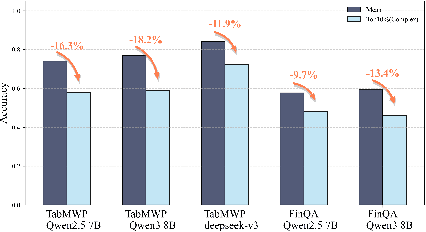
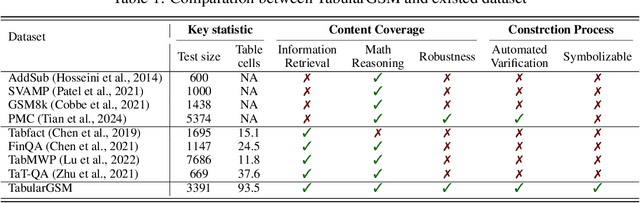
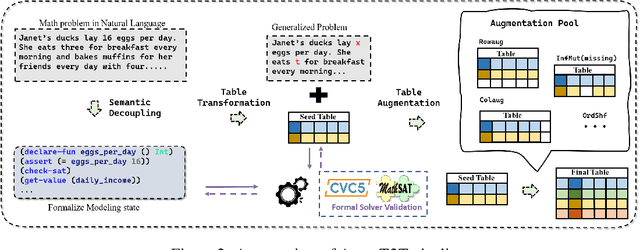
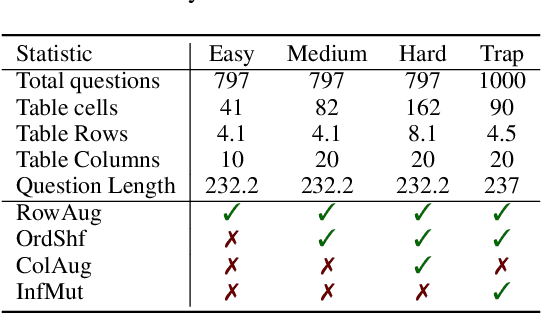
Reasoning with tabular data holds increasing importance in modern applications, yet comprehensive evaluation methodologies for reasoning-intensive Table Question Answering (QA) tasks remain nascent. Existing research is constrained by two primary bottlenecks: 1) Reliance on costly manually annotated real-world data, which is difficult to cover complex reasoning scenarios; 2) The heterogeneity of table structures hinders systematic analysis of the intrinsic mechanisms behind the underperformance of LLMs, especially in reasoning-intensive tasks. To address these issues, we propose an automated generation pipeline AutoT2T that transforms mathematical word problems into table-based reasoning tasks, eliminating the need for manual annotation. The pipeline can generate multiple variants of a table for the same reasoning problem, including noisy versions to support robustness evaluation. Based on this, we construct a new benchmark TabularGSM, which systematically spans a range of table complexities and trap problems. Experimental analyses through AutoT2T and TabularGSM reveal that the tight coupling between reasoning and retrieval or identification processes is a key factor underlying the failure of LLMs in complex Table QA tasks. This highlights the necessity for models to develop synergistic reasoning capabilities in order to perform effectively in complex Table QA tasks.
LawGPT: Knowledge-Guided Data Generation and Its Application to Legal LLM
Feb 10, 2025
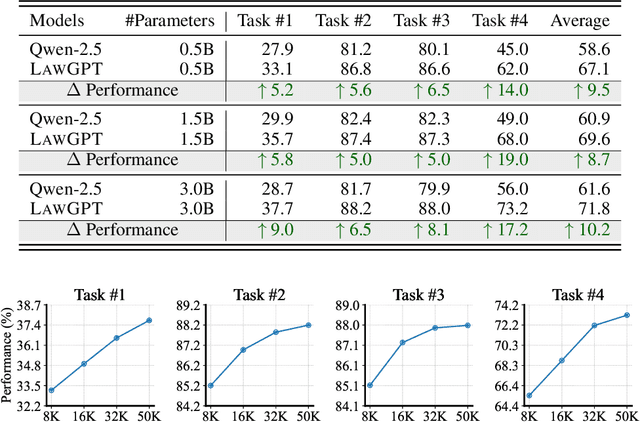
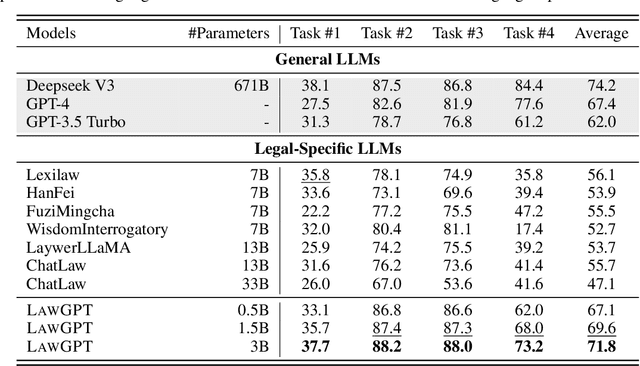
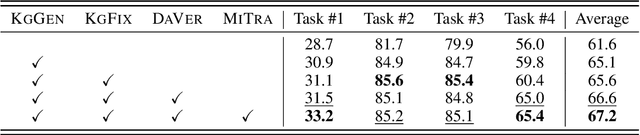
Large language models (LLMs), both proprietary and open-source, have demonstrated remarkable capabilities across various natural language processing tasks. However, they face significant limitations in legal reasoning tasks. Proprietary models introduce data privacy risks and high inference costs, while open-source models underperform due to insufficient legal domain training data. To address these limitations, we study data generation for legal reasoning to improve the legal reasoning performance of open-source LLMs with the help of proprietary LLMs. This is challenging due to the lack of legal knowledge in proprietary LLMs and the difficulty in verifying the generated data. We propose KgDG, a knowledge-guided data generation framework for legal reasoning. Our framework enables leveraging legal knowledge to enhance generation diversity and introduces a refinement and verification process to ensure the quality of generated data. Moreover, we expand the generated dataset to further enhance the LLM reasoning capabilities. Using KgDG, we create a synthetic legal reasoning dataset containing 50K high-quality examples. Our trained model LawGPT outperforms existing legal-specific LLMs and achieves performance comparable to proprietary LLMs, demonstrating the effectiveness of KgDG and LawGPT. Our code and resources is publicly available at https://anonymous.4open.science/r/KgDG-45F5 .
Robustness Assessment of Mathematical Reasoning in the Presence of Missing and Contradictory Conditions
Jun 07, 2024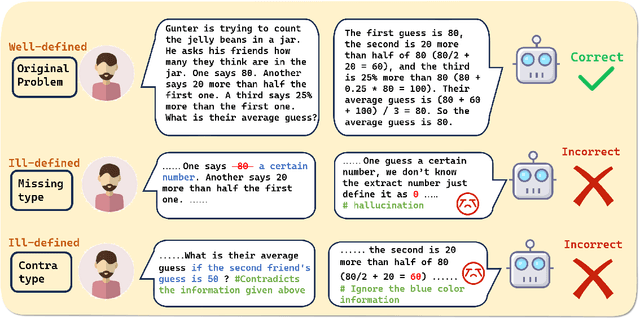

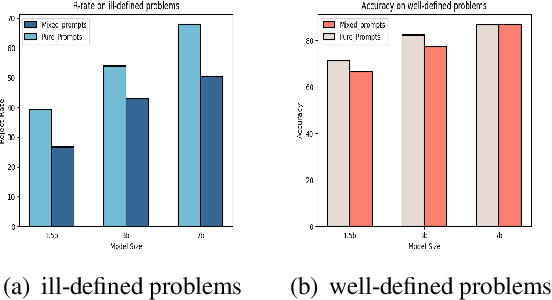
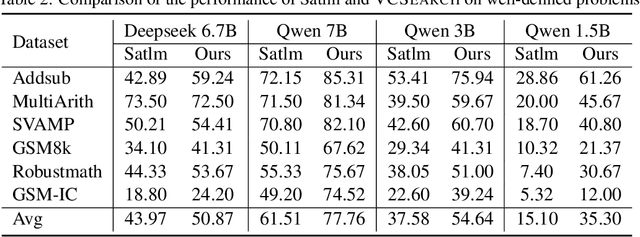
Large language models (LLMs) have demonstrated impressive performance on reasoning tasks, which can be further improved through few-shot prompting techniques. However, the current evaluation primarily focuses on carefully constructed benchmarks and neglects the consideration of real-world reasoning problems that present missing and contradictory conditions, known as ill-defined problems. Our observations suggest that existing few-shot prompting techniques are ineffective in such scenarios, often providing overconfident answers or hallucination. To further study this problem, we develop a benchmark called Problems with Missing and Contradictory conditions (PMC) and introduce two novel metrics to evaluate the performance of few-shot prompting methods in these scenarios. Our analysis using the PMC benchmark reveals a trade-off dilemma between the performance of mathematical reasoning for well-defined problems and the ability to recognize ill-defined problems. To address the challenges posed by PMC, we propose a novel few-shot prompting method called SMT-LIB Prompting (SLP), which utilizes the SMT-LIB language to model the problems instead of solving them directly. Subsequently, a double-check solving strategy checks the satisfiability and uniqueness of the solution and provides final feedback. Extensive experiments demonstrate the superiority of our SLP approach compared to existing few-shot prompting methods when dealing with problems with missing and contradictory conditions. We will open-source our benchmark and code to facilitate future research.