 Add to Chrome
 Add to Firefox
 Add to Edge
Not All Directions Matter: Toward Structured and Task-Aware Low-Rank Adaptation
Mar 15, 2026
Low-Rank Adaptation (LoRA) has become a cornerstone of parameter-efficient fine-tuning (PEFT). Yet, its efficacy is hampered by two fundamental limitations: semantic drift, by treating all update directions with equal importance, and structural incoherence, from adapting layers independently, resulting in suboptimal, uncoordinated updates. To remedy these, we propose StructLoRA, a framework that addresses both limitations through a principled, dual-component design: (1) an Information Bottleneck-guided filter that prunes task-irrelevant directions to mitigate semantic drift, and (2) a lightweight, training-only graph-based coordinator that enforces inter-layer consistency to resolve structural incoherence. Extensive experiments across large language model , vision language model, and vision model (including LLaMA, LLaVA, and ViT) demonstrate that StructLoRA consistently establishes a new state-of-the-art, outperforming not only vanilla LoRA but also advanced dynamic rank allocation and sparsity-based methods. Notably, the benefits are particularly pronounced in challenging low-rank and low-data regimes. Crucially, since our proposed modules operate only during training, StructLoRA enhances performance with zero additional inference cost, advancing the focus of PEFT -- from mere parameter compression to a more holistic optimization of information quality and structural integrity.

Self-Supervised Visual Prompting for Cross-Domain Road Damage Detection
Nov 16, 2025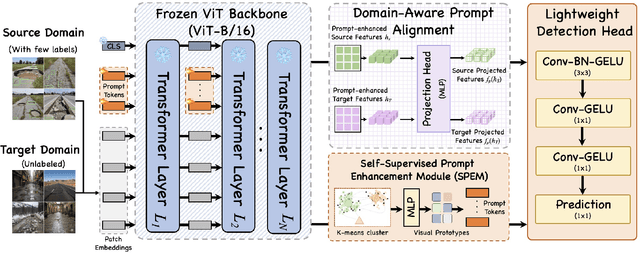
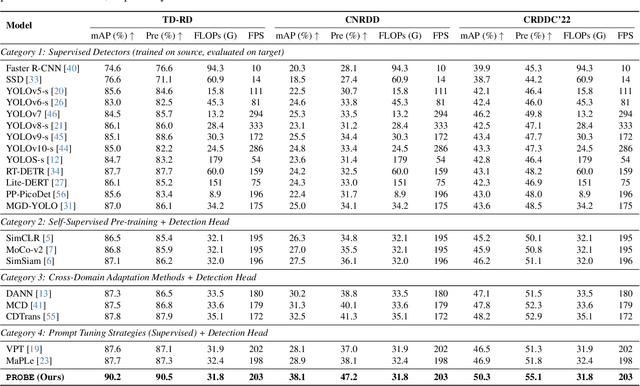
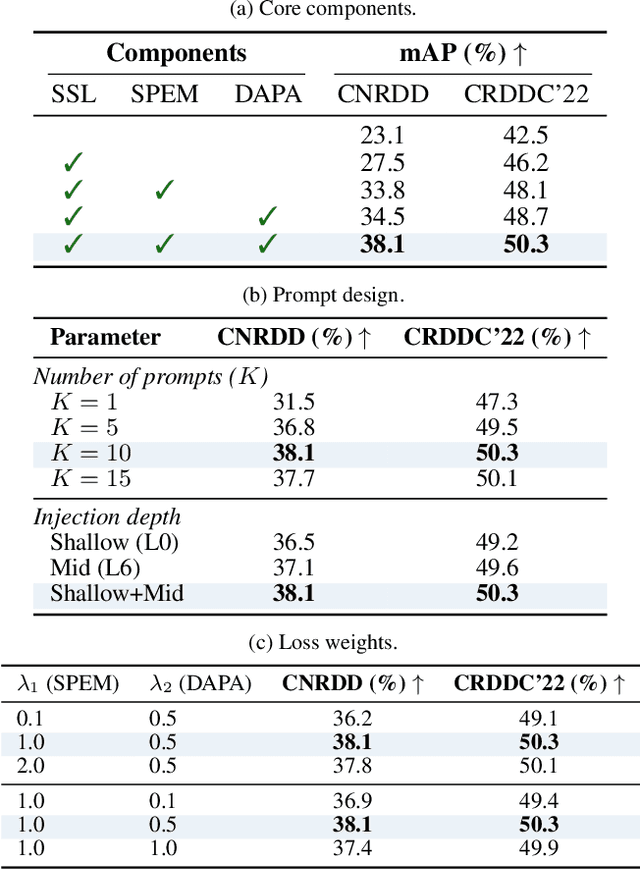

The deployment of automated pavement defect detection is often hindered by poor cross-domain generalization. Supervised detectors achieve strong in-domain accuracy but require costly re-annotation for new environments, while standard self-supervised methods capture generic features and remain vulnerable to domain shift. We propose \ours, a self-supervised framework that \emph{visually probes} target domains without labels. \ours introduces a Self-supervised Prompt Enhancement Module (SPEM), which derives defect-aware prompts from unlabeled target data to guide a frozen ViT backbone, and a Domain-Aware Prompt Alignment (DAPA) objective, which aligns prompt-conditioned source and target representations. Experiments on four challenging benchmarks show that \ours consistently outperforms strong supervised, self-supervised, and adaptation baselines, achieving robust zero-shot transfer, improved resilience to domain variations, and high data efficiency in few-shot adaptation. These results highlight self-supervised prompting as a practical direction for building scalable and adaptive visual inspection systems. Source code is publicly available: https://github.com/xixiaouab/PROBE/tree/main