 Add to Chrome
 Add to Firefox
 Add to Edge
Dependency-Guided Code Generation: Structured Matrix Decomposition and Consistency-Guided Refinement
Jul 18, 2026
The increasing complexity of modern software systems has made automated code generation a fundamental task in software engineering. However, existing approaches often fail to adequately capture the intricate, multi-level dependencies among code entities, leading to generated code that is logically incomplete or difficult to integrate into real-world systems. To address this limitation, we propose a dependency-aware code generation framework that explicitly models interactions among code entities through a graph-based representation. We decompose dependencies into two complementary components: a quantized matrix that captures strong, explicit relations, and a sparse low-rank factorization that models weaker, implicit interactions. The decomposition is efficiently learned via an alternating optimization procedure. During code generation, the learned dependency structure is incorporated as a constraint, ensuring both semantic coherence and structural consistency of the generated code. Furthermore, we introduce a sparse triplet representation for strong dependencies, significantly improving storage efficiency and computational scalability. Extensive experiments demonstrate that our approach consistently produces code with superior semantic alignment and structural fidelity compared to existing methods.

Though Language Models Err While They Strive: Conformal Prediction for Self-Correcting Scientific Generation
Jul 18, 2026Large language models frequently violate fundamental scientific principles when generating technical content, undermining their reliability in scientific applications. We introduce Scientific Feasibility Control SFC, a graph-structured conformal prediction framework that provides statistical guarantees for scientific reasoning validity through progressive absolute-coherent-factuality validation. Our approach decomposes scientific reasoning into atomic absolute-coherent-factuality units requiring both individual correctness against physical laws and logical substantiation from preceding context, addressing the cascade effect where early scientific errors contaminate subsequent reasoning steps. Unlike independence-based methods that treat claims in isolation, SFC models logical dependencies as approximate deducibility graphs and operates through real-time validation with dynamic branching when scientific violations are detected, the system branches to alternative generation paths using verified context as foundation. We demonstrate SFC across established scientific reasoning benchmarks including PhyX multimodal physics, MATH, ScienceQA, and ARC Challenge, achieving 50.1 percent accuracy on PhyX physics reasoning, substantially outperforming recent reasoning models including DeepSeek-R1 49.8 percent and GPT-4 45.8 percent while providing 91.7 percent scientific validity with formal conformal coverage guarantees at alpha equals 0.10 confidence level and reducing scientific law violations by 73 percent across multiple model architectures.
BlockPilot: Instance-Adaptive Policy Learning for Diffusion-based Speculative Decoding
Jun 30, 2026Speculative decoding accelerates inference by using a lightweight draft model to generate candidate tokens in parallel, and are then verified by the target model, enabling lossless acceleration. Recently, diffusion-based speculative decoding further improves parallelism by generating multiple tokens per forward pass via block-level diffusion, achieving state-of-the-art (SOTA) performance. However, existing methods adopt a fixed inference block size and assume a uniform optimal decoding strategy across all inputs. In this paper, we show that this assumption is suboptimal, as the optimal block size varies across samples and plays a critical role in speculative decoding performance. Moreover, these values exhibit a clear local structure, concentrating around the training block size, which reduces the problem to a low-dimensional and structured decision space. Based on these insights, we propose BlockPilot, a sample-adaptive policy that predicts the optimal block size from the prefilling representation. Specifically, we formulate block size selection as a lightweight policy learning problem and propose an instance-adaptive decision mechanism that predicts the optimal block size based on the representation of the prefilling stage. The prediction is performed only once after prefilling, allowing for seamless integration. Extensive experiments demonstrate that our method is plug-and-play, introduces minimal overhead, and consistently improves efficiency, achieving an acceptance length of 5.92 and a 4.20$\times$ speedup on Qwen3-4B under temperature $T=1$.
SafeMind: A Risk-Aware Differentiable Control Framework for Adaptive and Safe Quadruped Locomotion
Apr 10, 2026Learning-based quadruped controllers achieve impressive agility but typically lack formal safety guarantees under model uncertainty, perception noise, and unstructured contact conditions. We introduce SafeMind, a differentiable stochastic safety-control framework that unifies probabilistic Control Barrier Functions with semantic context understanding and meta-adaptive risk calibration. SafeMind explicitly models epistemic and aleatoric uncertainty through a variance-aware barrier constraint embedded in a differentiable quadratic program, thereby preserving gradient flow for end-to-end training. A semantics-to-constraint encoder modulates safety margins using perceptual or language cues, while a meta-adaptive learner continuously adjusts risk sensitivity across environments. We provide theoretical conditions for probabilistic forward invariance, feasibility, and stability under stochastic dynamics. SafeMind is deployed on Unitree A1 and ANYmal C at 200~Hz and validated across 12 terrain types, dynamic obstacles, morphology perturbations, and semantically defined tasks. Experiments show that SafeMind reduces safety violations by 3--10x and energy consumption by 10--15% relative to state-of-the-art CBF, MPC, and hybrid RL baselines, while maintaining real-time control performance.
ShieldedCode: Learning Robust Representations for Virtual Machine Protected Code
Jan 28, 2026Large language models (LLMs) have achieved remarkable progress in code generation, yet their potential for software protection remains largely untapped. Reverse engineering continues to threaten software security, while traditional virtual machine protection (VMP) relies on rigid, rule-based transformations that are costly to design and vulnerable to automated analysis. In this work, we present the first protection-aware framework that learns robust representations of VMP-protected code. Our approach builds large-scale paired datasets of source code and normalized VM implementations, and introduces hierarchical dependency modeling at intra-, preceding-, and inter-instruction levels. We jointly optimize language modeling with functionality-aware and protection-aware contrastive objectives to capture both semantic equivalence and protection strength. To further assess resilience, we propose a protection effectiveness optimization task that quantifies and ranks different VM variants derived from the same source. Coupled with a two-stage continual pre-training and fine-tuning pipeline, our method enables models to generate, compare, and reason over protected code. Extensive experiments show that our framework significantly improves robustness across diverse protection levels, opening a new research direction for learning-based software defense. In this work, we present ShieldedCode, the first protection-aware framework that learns robust representations of VMP-protected code. Our method achieves 26.95% Pass@1 on L0 VM code generation compared to 22.58% for GPT-4o., and improves binary similarity detection Recall@1 by 10% over state of art methods like jTrans.
Self-Supervised Visual Prompting for Cross-Domain Road Damage Detection
Nov 16, 2025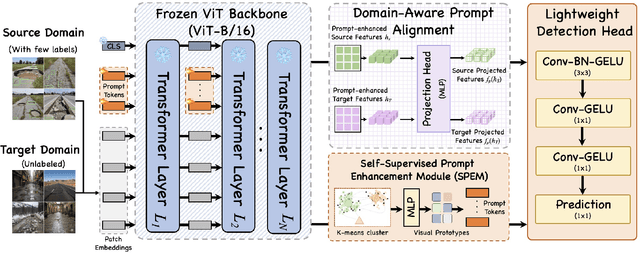
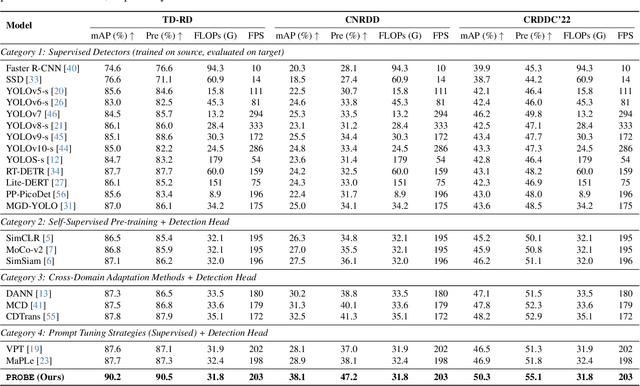
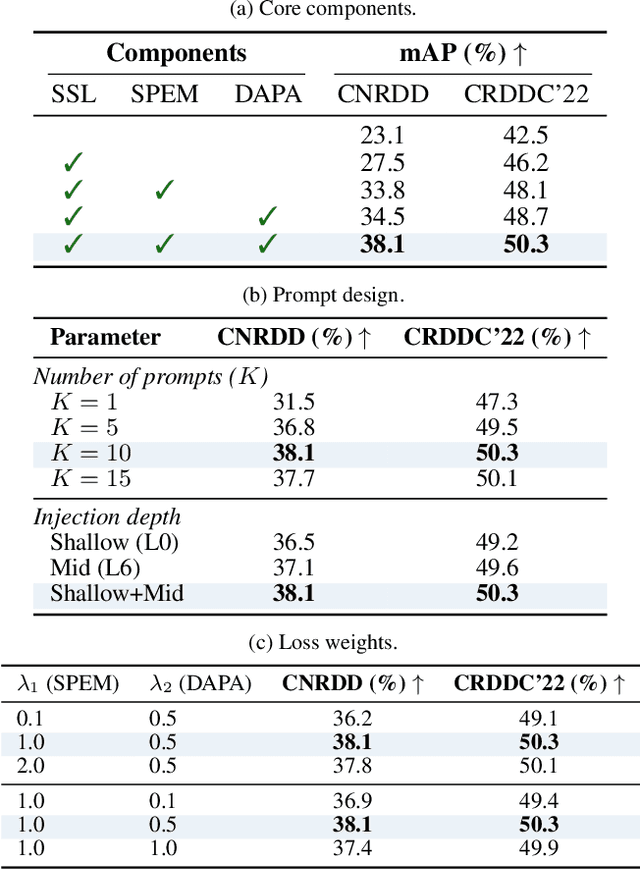

The deployment of automated pavement defect detection is often hindered by poor cross-domain generalization. Supervised detectors achieve strong in-domain accuracy but require costly re-annotation for new environments, while standard self-supervised methods capture generic features and remain vulnerable to domain shift. We propose \ours, a self-supervised framework that \emph{visually probes} target domains without labels. \ours introduces a Self-supervised Prompt Enhancement Module (SPEM), which derives defect-aware prompts from unlabeled target data to guide a frozen ViT backbone, and a Domain-Aware Prompt Alignment (DAPA) objective, which aligns prompt-conditioned source and target representations. Experiments on four challenging benchmarks show that \ours consistently outperforms strong supervised, self-supervised, and adaptation baselines, achieving robust zero-shot transfer, improved resilience to domain variations, and high data efficiency in few-shot adaptation. These results highlight self-supervised prompting as a practical direction for building scalable and adaptive visual inspection systems. Source code is publicly available: https://github.com/xixiaouab/PROBE/tree/main