 Add to Chrome
 Add to Firefox
 Add to Edge
Robust Exploration in Directed Controller Synthesis via Reinforcement Learning with Soft Mixture-of-Experts
Feb 22, 2026
On-the-fly Directed Controller Synthesis (OTF-DCS) mitigates state-space explosion by incrementally exploring the system and relies critically on an exploration policy to guide search efficiently. Recent reinforcement learning (RL) approaches learn such policies and achieve promising zero-shot generalization from small training instances to larger unseen ones. However, a fundamental limitation is anisotropic generalization, where an RL policy exhibits strong performance only in a specific region of the domain-parameter space while remaining fragile elsewhere due to training stochasticity and trajectory-dependent bias. To address this, we propose a Soft Mixture-of-Experts framework that combines multiple RL experts via a prior-confidence gating mechanism and treats these anisotropic behaviors as complementary specializations. The evaluation on the Air Traffic benchmark shows that Soft-MoE substantially expands the solvable parameter space and improves robustness compared to any single expert.

SVFR: A Unified Framework for Generalized Video Face Restoration
Jan 03, 2025
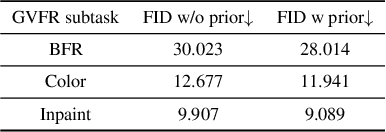
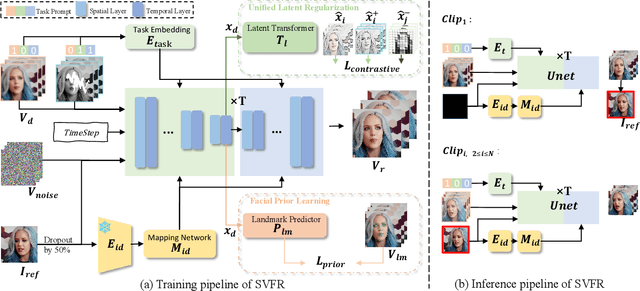

Face Restoration (FR) is a crucial area within image and video processing, focusing on reconstructing high-quality portraits from degraded inputs. Despite advancements in image FR, video FR remains relatively under-explored, primarily due to challenges related to temporal consistency, motion artifacts, and the limited availability of high-quality video data. Moreover, traditional face restoration typically prioritizes enhancing resolution and may not give as much consideration to related tasks such as facial colorization and inpainting. In this paper, we propose a novel approach for the Generalized Video Face Restoration (GVFR) task, which integrates video BFR, inpainting, and colorization tasks that we empirically show to benefit each other. We present a unified framework, termed as stable video face restoration (SVFR), which leverages the generative and motion priors of Stable Video Diffusion (SVD) and incorporates task-specific information through a unified face restoration framework. A learnable task embedding is introduced to enhance task identification. Meanwhile, a novel Unified Latent Regularization (ULR) is employed to encourage the shared feature representation learning among different subtasks. To further enhance the restoration quality and temporal stability, we introduce the facial prior learning and the self-referred refinement as auxiliary strategies used for both training and inference. The proposed framework effectively combines the complementary strengths of these tasks, enhancing temporal coherence and achieving superior restoration quality. This work advances the state-of-the-art in video FR and establishes a new paradigm for generalized video face restoration. Code and video demo are available at https://github.com/wangzhiyaoo/SVFR.git.