 Add to Chrome
 Add to Firefox
 Add to Edge
SLAI T-Rex: Full-Parameter Post-training of the DeepSeek-V4 Family on Ascend SuperPOD
Jul 22, 2026
Full-parameter post-training of trillion-parameter-scale MoE models introduces substantial system-level challenges for large-scale distributed training, including severe memory pressure, non-overlapped communication overhead, and inefficient kernel execution. While most large-scale LLM training systems are built around GPU-based clusters, this report presents an end-to-end optimization practice on the Ascend NPU SuperPOD. Using the DeepSeek-V4 model family as the target workload, we develop a hierarchical optimization framework spanning model-level parallelism, computation-communication orchestration, and low-level kernel execution. The resulting system achieves 34.22% Model FLOPs Utilization (MFU) with a 2.93x improvement over the open-source baseline recipe while maintaining training stability. Building on this optimized infrastructure, we further establish a CPT and SFT workflow for complex Operations Research (OR) tasks. We refer to the integrated framework as SLAI T-Rex. Using DeepSeek-V4-Flash, we develop OR-oriented CPT and SFT data pipelines that combine collected domain resources with solver-verified synthetic optimization documents. The resulting dataset contains 10K high-quality SFT samples spanning four task categories and three problem representations. The specialized model achieves the highest average zero-shot Pass@1 score among the evaluated models, reaching 71.81% and outperforming GPT-5.4-Mini and the base DeepSeek-V4-Flash model by 3.98 and 11.27 percentage points, respectively. Overall, this work demonstrates a full-stack pathway from efficient trillion-parameter model post-training on Ascend infra to domain-specialized Flash models for solver-grounded mathematical modeling, advancing frontier-model systems for complex reasoning.

High-Throughput LLM inference on Heterogeneous Clusters
Apr 18, 2025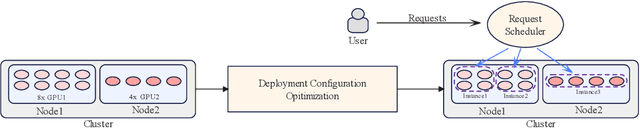


Nowadays, many companies possess various types of AI accelerators, forming heterogeneous clusters. Efficiently leveraging these clusters for high-throughput large language model (LLM) inference services can significantly reduce costs and expedite task processing. However, LLM inference on heterogeneous clusters presents two main challenges. Firstly, different deployment configurations can result in vastly different performance. The number of possible configurations is large, and evaluating the effectiveness of a specific setup is complex. Thus, finding an optimal configuration is not an easy task. Secondly, LLM inference instances within a heterogeneous cluster possess varying processing capacities, leading to different processing speeds for handling inference requests. Evaluating these capacities and designing a request scheduling algorithm that fully maximizes the potential of each instance is challenging. In this paper, we propose a high-throughput inference service system on heterogeneous clusters. First, the deployment configuration is optimized by modeling the resource amount and expected throughput and using the exhaustive search method. Second, a novel mechanism is proposed to schedule requests among instances, which fully considers the different processing capabilities of various instances. Extensive experiments show that the proposed scheduler improves throughput by 122.5% and 33.6% on two heterogeneous clusters, respectively.