 Add to Chrome
 Add to Firefox
 Add to Edge
SR-OPSD: Self-Referenced On-Policy Self-Distillation
Aug 10, 2026
On-policy self-distillation (OPSD) converts feedback into dense token-level supervision on trajectories generated by the policy to be optimized, providing a useful complement to reinforcement learning with sparse outcome rewards. However, the self-teacher policy used in OPSD is typically a stop-gradient or exponential-moving-average copy of the policy conditioned on additional context information, and thus co-evolves with both the student policy and its on-policy context distribution. Directly matching such a moving target with a fixed projection objective can lead to unstable optimization or excessive distributional concentration. This nature of OPSD motivates the proposed \emph{Self-Referenced On-Policy Self-Distillation (SR-OPSD)}. At fixed student-generated contexts, a token-level variational characterization identifies the effective distillation target as a geometric interpolation between the self-teacher policy and a reference policy. Meanwhile, we use the Rényi divergence family to generalize the projection geometry. This formulation separates \emph{where} the adaptive target is placed from \emph{how} the student is projected toward it: the interpolation coefficient controls underlying target, while the Rényi order controls the projection geometry and its sensitivity to token-level density ratios. Extensive experiments across scientific evaluation, mathematical reasoning, and coding generation tasks with multiple large language models show that SR-OPSD achieves the state-of-the-art or competitive performance across various settings.

High-Throughput LLM inference on Heterogeneous Clusters
Apr 18, 2025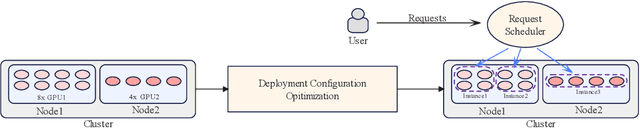


Nowadays, many companies possess various types of AI accelerators, forming heterogeneous clusters. Efficiently leveraging these clusters for high-throughput large language model (LLM) inference services can significantly reduce costs and expedite task processing. However, LLM inference on heterogeneous clusters presents two main challenges. Firstly, different deployment configurations can result in vastly different performance. The number of possible configurations is large, and evaluating the effectiveness of a specific setup is complex. Thus, finding an optimal configuration is not an easy task. Secondly, LLM inference instances within a heterogeneous cluster possess varying processing capacities, leading to different processing speeds for handling inference requests. Evaluating these capacities and designing a request scheduling algorithm that fully maximizes the potential of each instance is challenging. In this paper, we propose a high-throughput inference service system on heterogeneous clusters. First, the deployment configuration is optimized by modeling the resource amount and expected throughput and using the exhaustive search method. Second, a novel mechanism is proposed to schedule requests among instances, which fully considers the different processing capabilities of various instances. Extensive experiments show that the proposed scheduler improves throughput by 122.5% and 33.6% on two heterogeneous clusters, respectively.
LocMoE: A Low-overhead MoE for Large Language Model Training
Jan 25, 2024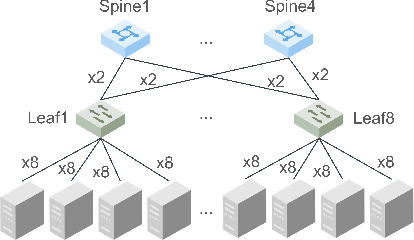
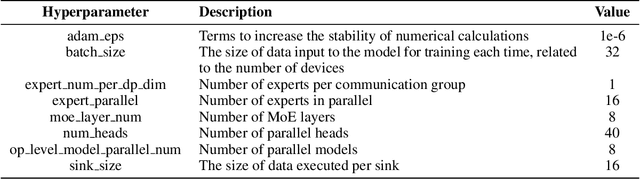
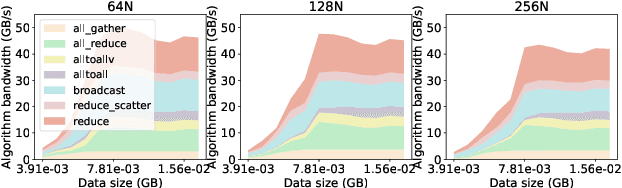
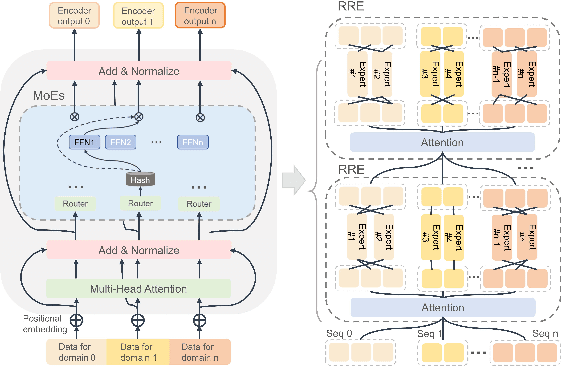
The Mixtures-of-Experts (MoE) model is a widespread distributed and integrated learning method for large language models (LLM), which is favored due to its ability to sparsify and expand models efficiently. However, the performance of MoE is limited by load imbalance and high latency of All-To-All communication, along with relatively redundant computation owing to large expert capacity. Load imbalance may result from existing routing policies that consistently tend to select certain experts. The frequent inter-node communication in the All-To-All procedure also significantly prolongs the training time. To alleviate the above performance problems, we propose a novel routing strategy that combines load balance and locality by converting partial inter-node communication to that of intra-node. Notably, we elucidate that there is a minimum threshold for expert capacity, calculated through the maximal angular deviation between the gating weights of the experts and the assigned tokens. We port these modifications on the PanGu-Sigma model based on the MindSpore framework with multi-level routing and conduct experiments on Ascend clusters. The experiment results demonstrate that the proposed LocMoE reduces training time per epoch by 12.68% to 22.24% compared to classical routers, such as hash router and switch router, without impacting the model accuracy.