 Add to Chrome
 Add to Firefox
 Add to Edge
Boundary-Aligned Contribution Routing for Robust Optical--SAR Object Detection
Aug 15, 2026
Optical imagery provides rich appearance cues, whereas synthetic aperture radar (SAR) offers observations that are less sensitive to illumination and weather, making optical--SAR fusion attractive for remote-sensing object detection. However, the presence of multiple modalities does not guarantee beneficial fusion: imperfect spatial, temporal, and semantic correspondence can make an otherwise intact stream conditionally harmful and induce negative cross-modal transfer. We handle this issue through a model-specific task-utility perspective and learn task-conditioned contribution routing using detection supervision alone. The proposed fusion-boundary-aligned routing regulates each modality's contribution before the first learned cross-modal feature-value mixing operation. For architectures with frequent shallow interaction, a Feature Router performs cross-conditioned, group-addressable modulation near the input; for dual-backbone architectures, a Dual-Statistic Semantic Router predicts stream-level contribution weights from modality-specific average and maximum statistics before late semantic fusion. The routers require no explicit utility supervision, quality labels, reconstruction, or distillation. Experiments on M4-SAR and SpaceNet6-OTD cover nominal full inputs, controlled correspondence shifts, missing modalities, and four nonzero modality-corruption scenarios. Across the reported clean-training controls, routing improves full-input $\text{mAP}_{50}$ by 0.5--5.9 points. Relative to the corresponding modality-dropout baselines, it raises missing-modality $\text{mAP}_{50}$ by 7.6--41.6 points and reduces the negative-transfer rate by up to 12.7 percentage points. Spearman correlations between the learned routing weights and model-specific leave-one-modality-out utility range from 0.45 to 0.66, supporting the task-utility interpretation of the routing coefficients.

DeGuNet: Depth-Guided Ultra-Compact Backbones for Efficient LiDAR-Camera 3D Detection
Jul 14, 2026In autonomous driving perception, the fusion of LiDAR and camera modalities has become the dominant paradigm for 3D object detection. However, current multi-modal frameworks heavily rely on massive visual backbones pretrained on 2D semantic tasks. This reliance introduces substantial parameter redundancy and a structural misalignment, as 2D priors are ill-equipped to handle the extreme sparsity of LiDAR projections required for Bird's-Eye-View geometry. To address this, we present DeGuNet, an ultra-compact and plug-and-play image backbone explicitly designed for depth-guided representation learning. By incorporating sparsity-aware feature extraction mechanisms, DeGuNet effectively aligns multi-view images with unstructured LiDAR depth while strictly preventing invalid-region contamination. Extensive experiments on the nuScenes dataset demonstrate DeGuNet's broad plug-and-play applicability and superior efficiency. When integrated into established baselines, it fundamentally eliminates architectural redundancy, reducing GPU memory consumption by up to 66.5% and achieving a 1.16x inference speedup. Concurrently, DeGuNet delivers up to a 6.20 absolute mAP gain, establishing a new paradigm for parameter-efficient multi-modal 3D perception.
Can BEV Perception Gracefully Degrade under Sensor Failures?
May 29, 2026Despite the remarkable success of multi-modal bird's-eye view (BEV) perception in autonomous driving, current systems exhibit a critical vulnerability: existing fusion mechanisms are highly brittle to sensor corruptions, often causing catastrophic performance degradation. This vulnerability largely stems from the fact that standard fusion frameworks typically integrate multi-modal representations in a static manner, leading to a precipitous performance collapse under missing or corrupted modalities. In contrast, we show that graceful degradation is achievable through active modality reliability assessment. To this end, we present Grace-BEV, a lightweight and plug-and-play framework that enforces active reliability awareness during multi-modal fusion. Instead of relying on computationally expensive cross-modal interactions, Grace-BEV leverages the aligned BEV space to explicitly assess modality trustworthiness via a TrustGate Router and dynamically recalibrate feature integration using the FailSafe Fusion Block. Furthermore, we devise a Three-Phase Training strategy with Modality Dropout to prevent modality dominance and encourage balanced cross-modal learning under unreliable inputs. Extensive experiments on nuScenes-R and nuScenes-C show that Grace-BEV maintains robust performance across diverse corruption settings. Notably, under catastrophic LiDAR failures where standard baselines collapse to 0.0% mean Average Precision (mAP), Grace-BEV restores performance to as high as 34.7% mAP. Moreover, it improves clean accuracy by up to 1.4%, achieving a strong trade-off between robustness and efficiency.
Dual-Interaction-Aware Cooperative Control Strategy for Alleviating Mixed Traffic Congestion
Mar 04, 2026As Intelligent Transportation System (ITS) develops, Connected and Automated Vehicles (CAVs) are expected to significantly reduce traffic congestion through cooperative strategies, such as in bottleneck areas. However, the uncertainty and diversity in the behaviors of Human-Driven Vehicles (HDVs) in mixed traffic environments present major challenges for CAV cooperation. This paper proposes a Dual-Interaction-Aware Cooperative Control (DIACC) strategy that enhances both local and global interaction perception within the Multi-Agent Reinforcement Learning (MARL) framework for Connected and Automated Vehicles (CAVs) in mixed traffic bottleneck scenarios. The DIACC strategy consists of three key innovations: 1) A Decentralized Interaction-Adaptive Decision-Making (D-IADM) module that enhances actor's local interaction perception by distinguishing CAV-CAV cooperative interactions from CAV-HDV observational interactions. 2) A Centralized Interaction-Enhanced Critic (C-IEC) that improves critic's global traffic understanding through interaction-aware value estimation, providing more accurate guidance for policy updates. 3) A reward design that employs softmin aggregation with temperature annealing to prioritize interaction-intensive scenarios in mixed traffic. Additionally, a lightweight Proactive Safety-based Action Refinement (PSAR) module applies rule-based corrections to accelerate training convergence. Experimental results demonstrate that DIACC significantly improves traffic efficiency and adaptability compared to rule-based and benchmark MARL models.
Boosting Maximum Entropy Reinforcement Learning via One-Step Flow Matching
Feb 02, 2026Diffusion policies are expressive yet incur high inference latency. Flow Matching (FM) enables one-step generation, but integrating it into Maximum Entropy Reinforcement Learning (MaxEnt RL) is challenging: the optimal policy is an intractable energy-based distribution, and the efficient log-likelihood estimation required to balance exploration and exploitation suffers from severe discretization bias. We propose \textbf{F}low-based \textbf{L}og-likelihood-\textbf{A}ware \textbf{M}aximum \textbf{E}ntropy RL (\textbf{FLAME}), a principled framework that addresses these challenges. First, we derive a Q-Reweighted FM objective that bypasses partition function estimation via importance reweighting. Second, we design a decoupled entropy estimator that rigorously corrects bias, which enables efficient exploration and brings the policy closer to the optimal MaxEnt policy. Third, we integrate the MeanFlow formulation to achieve expressive and efficient one-step control. Empirical results on MuJoCo show that FLAME outperforms Gaussian baselines and matches multi-step diffusion policies with significantly lower inference cost. Code is available at https://github.com/lzqw/FLAME.
RAPO: An Adaptive Ranking Paradigm for Bilingual Lexicon Induction
Oct 18, 2022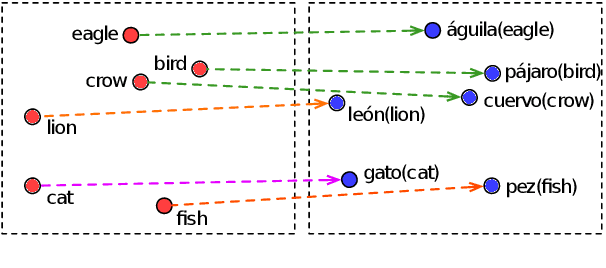
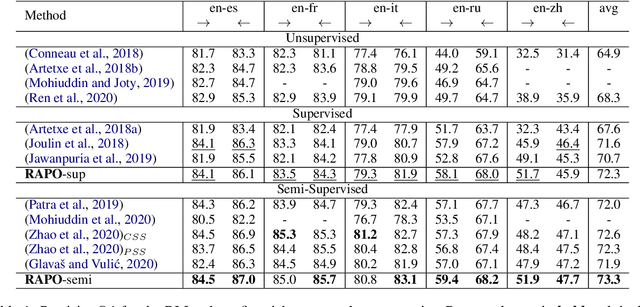
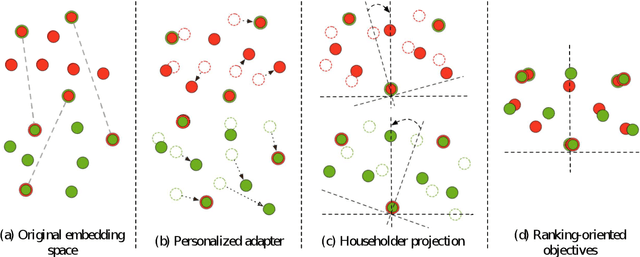
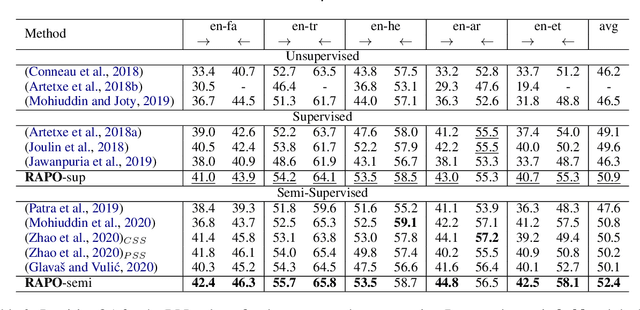
Bilingual lexicon induction induces the word translations by aligning independently trained word embeddings in two languages. Existing approaches generally focus on minimizing the distances between words in the aligned pairs, while suffering from low discriminative capability to distinguish the relative orders between positive and negative candidates. In addition, the mapping function is globally shared by all words, whose performance might be hindered by the deviations in the distributions of different languages. In this work, we propose a novel ranking-oriented induction model RAPO to learn personalized mapping function for each word. RAPO is capable of enjoying the merits from the unique characteristics of a single word and the cross-language isomorphism simultaneously. Extensive experimental results on public datasets including both rich-resource and low-resource languages demonstrate the superiority of our proposal. Our code is publicly available in \url{https://github.com/Jlfj345wf/RAPO}.