 Add to Chrome
 Add to Firefox
 Add to Edge
Beyond Retrieval: Analytic Memory for Multimodal Agents
Jul 31, 2026
Long-term multimodal memory must support not only retrieving relevant information but also computing over observations accumulated across interactions. Existing systems largely emphasize \emph{retrieval memory}, organizing interaction histories through summaries and indexes to return query-relevant information at multiple granularities, from high-level abstractions to underlying records. In this paper, we formulate \emph{analytic memory} as a complementary abstraction that organizes recurring multimodal observations into queryable structures supporting filtering, aggregation, ranking, and temporal comparison. We present AdaMM, a framework that jointly supports retrieval and analytic memory. Rather than relying on application-defined schemas, AdaMM extracts provenance-linked attribute-value observations from dialogue, images, and contextual metadata, discovers recurring field structures, and materializes them for analytical access. At inference time, a memory-aware planner decomposes queries into retrieval and analytic operations and routes each operation to the appropriate tools. Experiments on two long-term multimodal memory benchmarks, MemEye and MemGallery, show that AdaMM improves performance by up to 11.3\% and 7.3\%, respectively.

Trip+: Benchmarking Agents in Personalized Interactive Travel Planning
Jun 19, 2026Interactive travel planning has become a popular use case for language models. Agents are deployed to manage evolving preferences and unexpected disruptions over multiple turns. Such settings require models to make complex, profile-conditioned planning decisions. However, existing benchmarks often evaluate feasibility, personalization, or interaction in relatively isolated settings. We therefore introduce Trip+ to measure the ability of agents to plan travel holistically. In Trip+, given traveler profiles and dynamic interactions, agents must generate and revise minute-level itineraries. End-to-end traveler experiences are evaluated via an LLM-based simulator, enabling the assessment of subjective metrics like fatigue. Our scenarios range from simple request resolutions to complex environment-driven replanning. We evaluate 18 LMs and find a consistent gap in experiential quality. Models favor technically feasible but exhausting itineraries that diverge sharply from profiled traveler preferences.
M$^3$Exam: Benchmarking Multimodal Memory for Realistic User-Agent Interactions
Jun 05, 2026Language agents are increasingly deployed over accumulating multimodal information, yet existing benchmarks assume a human-human form with sparse visuals and straightforward content, evaluating neither reasoning over authentic multimodal file interaction nor the interpretation of concealed user information. We therefore introduce M$^3$Exam, a query-centric multimodal conversational memory benchmark built on realistic user-agent interaction, with multi-dimensional evaluation spanning cross-modal grounding and implicit information inference. Benchmarking MLLMs and memory systems reveals persistent gaps in cross-modal grounding, cross session reasoning, and the efficiency cost of accumulating multimodal context. We further propose M$^3$Proctor, a multimodal memory method that detects query modality bias and consumes raw visual sources only on demand, improving accuracy by 13% while cutting index-construction time and retrieved tokens by over 70%.
GEM: A Native Graph-based Index for Multi-Vector Retrieval
Mar 20, 2026In multi-vector retrieval, both queries and data are represented as sets of high-dimensional vectors, enabling finer-grained semantic matching and improving retrieval quality over single-vector approaches. However, its practical adoption is held back by the lack of effective indexing algorithms. Existing work, attempting to reuse standard single-vector indexes, often fails to preserve multi-vector semantics or remains slow. In this work, we present GEM, a native indexing framework for multi-vector representations. The core idea is to construct a proximity graph directly over vector sets, preserving their fine-grained semantics while enabling efficient navigation. First, GEM designs a set-level clustering scheme. It associates each vector set with only its most informative clusters, effectively reducing redundancy without hurting semantic coverage. Then, it builds local proximity graphs within clusters and bridges them into a globally navigable structure. To handle the non-metric nature of multi-vector similarity, GEM decouples the graph construction metric from the final relevance score and injects semantic shortcuts to guide efficient navigation toward relevant regions. At query time, GEM launches beam search from multiple entry points and prunes paths early using cluster cues. To further enhance efficiency, a quantized distance estimation technique is used for both indexing and search. Across in-domain, out-of-domain, and multi-modal benchmarks, GEM achieves up to 16x speedup over state-of-the-art methods while matching or improving accuracy.
RAPO: An Adaptive Ranking Paradigm for Bilingual Lexicon Induction
Oct 18, 2022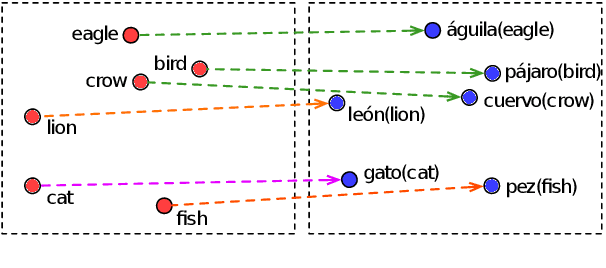
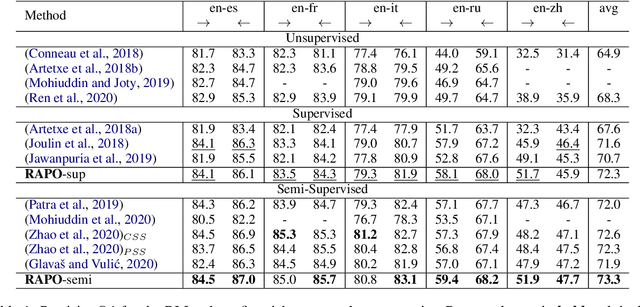
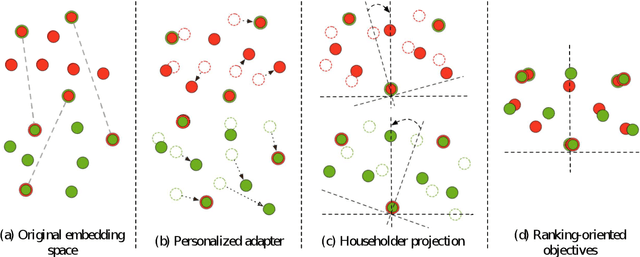
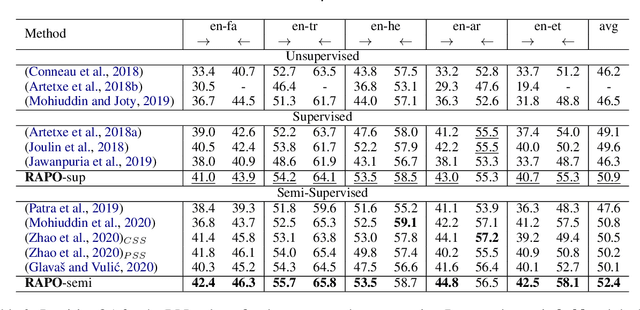
Bilingual lexicon induction induces the word translations by aligning independently trained word embeddings in two languages. Existing approaches generally focus on minimizing the distances between words in the aligned pairs, while suffering from low discriminative capability to distinguish the relative orders between positive and negative candidates. In addition, the mapping function is globally shared by all words, whose performance might be hindered by the deviations in the distributions of different languages. In this work, we propose a novel ranking-oriented induction model RAPO to learn personalized mapping function for each word. RAPO is capable of enjoying the merits from the unique characteristics of a single word and the cross-language isomorphism simultaneously. Extensive experimental results on public datasets including both rich-resource and low-resource languages demonstrate the superiority of our proposal. Our code is publicly available in \url{https://github.com/Jlfj345wf/RAPO}.
TANet: Thread-Aware Pretraining for Abstractive Conversational Summarization
Apr 09, 2022
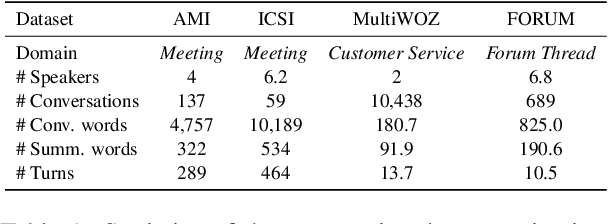
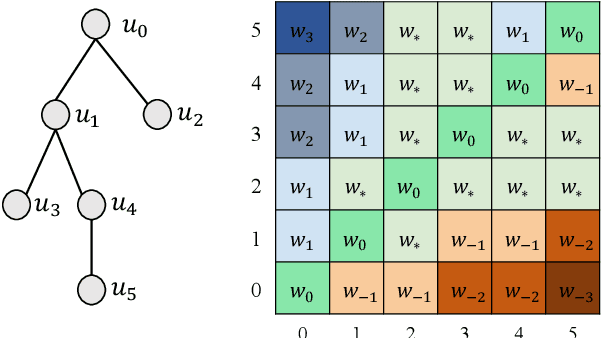
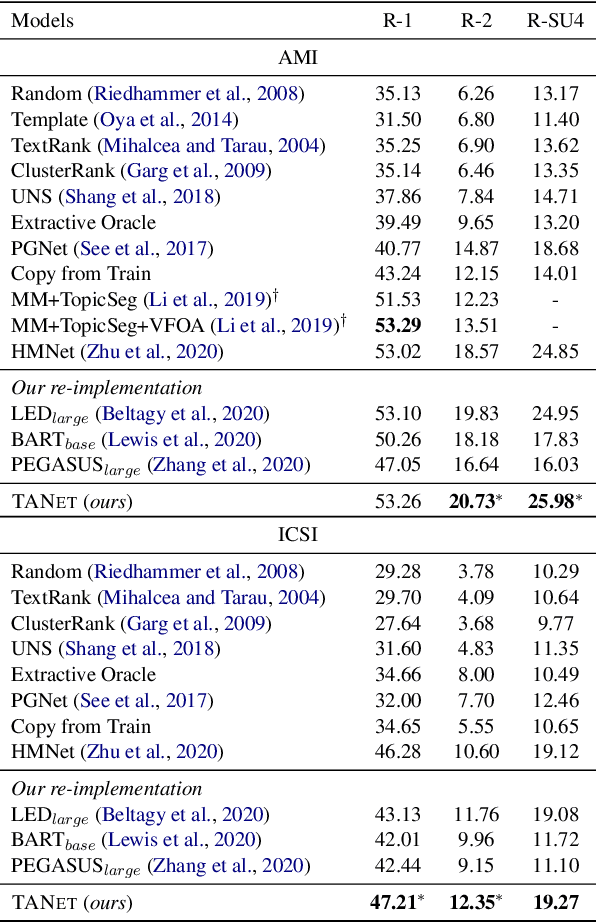
Although pre-trained language models (PLMs) have achieved great success and become a milestone in NLP, abstractive conversational summarization remains a challenging but less studied task. The difficulty lies in two aspects. One is the lack of large-scale conversational summary data. Another is that applying the existing pre-trained models to this task is tricky because of the structural dependence within the conversation and its informal expression, etc. In this work, we first build a large-scale (11M) pretraining dataset called RCS, based on the multi-person discussions in the Reddit community. We then present TANet, a thread-aware Transformer-based network. Unlike the existing pre-trained models that treat a conversation as a sequence of sentences, we argue that the inherent contextual dependency among the utterances plays an essential role in understanding the entire conversation and thus propose two new techniques to incorporate the structural information into our model. The first is thread-aware attention which is computed by taking into account the contextual dependency within utterances. Second, we apply thread prediction loss to predict the relations between utterances. We evaluate our model on four datasets of real conversations, covering types of meeting transcripts, customer-service records, and forum threads. Experimental results demonstrate that TANET achieves a new state-of-the-art in terms of both automatic evaluation and human judgment.