 Add to Chrome
 Add to Firefox
 Add to Edge
VTC-Bench: Evaluating Agentic Multimodal Models via Compositional Visual Tool Chaining
Mar 16, 2026
Recent advancements extend Multimodal Large Language Models (MLLMs) beyond standard visual question answering to utilizing external tools for advanced visual tasks. Despite this progress, precisely executing and effectively composing diverse tools for complex tasks remain persistent bottleneck. Constrained by sparse tool-sets and simple tool-use trajectories, existing benchmarks fail to capture complex and diverse tool interactions, falling short in evaluating model performance under practical, real-world conditions. To bridge this gap, we introduce VisualToolChain-Bench~(VTC-Bench), a comprehensive benchmark designed to evaluate tool-use proficiency in MLLMs. To align with realistic computer vision pipelines, our framework features 32 diverse OpenCV-based visual operations. This rich tool-set enables extensive combinations, allowing VTC-Bench to rigorously assess multi-tool composition and long-horizon, multi-step plan execution. For precise evaluation, we provide 680 curated problems structured across a nine-category cognitive hierarchy, each with ground-truth execution trajectories. Extensive experiments on 19 leading MLLMs reveal critical limitations in current models' visual agentic capabilities. Specifically, models struggle to adapt to diverse tool-sets and generalize to unseen operations, with the leading model Gemini-3.0-Pro only achieving 51\% on our benchmark. Furthermore, multi-tool composition remains a persistent challenge. When facing complex tasks, models struggle to formulate efficient execution plans, relying heavily on a narrow, suboptimal subset of familiar functions rather than selecting the optimal tools. By identifying these fundamental challenges, VTC-Bench establishes a rigorous baseline to guide the development of more generalized visual agentic models.

Looking at Outfit to Parse Clothing
Mar 04, 2017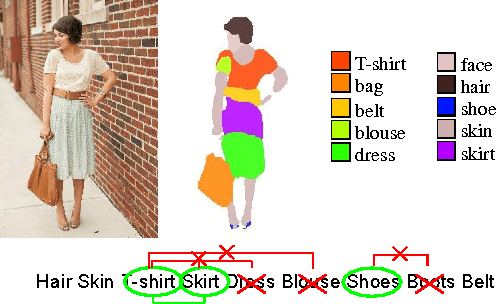
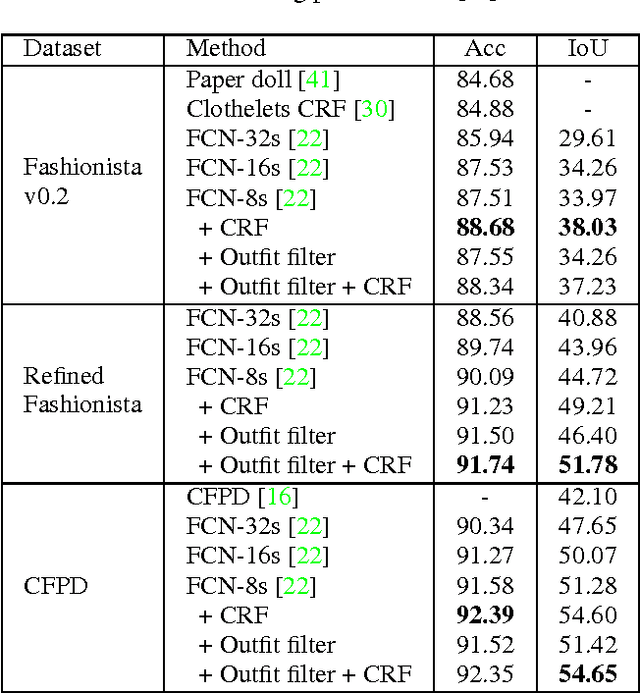
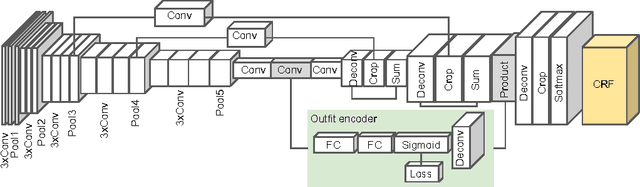
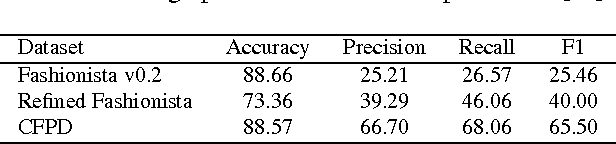
This paper extends fully-convolutional neural networks (FCN) for the clothing parsing problem. Clothing parsing requires higher-level knowledge on clothing semantics and contextual cues to disambiguate fine-grained categories. We extend FCN architecture with a side-branch network which we refer outfit encoder to predict a consistent set of clothing labels to encourage combinatorial preference, and with conditional random field (CRF) to explicitly consider coherent label assignment to the given image. The empirical results using Fashionista and CFPD datasets show that our model achieves state-of-the-art performance in clothing parsing, without additional supervision during training. We also study the qualitative influence of annotation on the current clothing parsing benchmarks, with our Web-based tool for multi-scale pixel-wise annotation and manual refinement effort to the Fashionista dataset. Finally, we show that the image representation of the outfit encoder is useful for dress-up image retrieval application.