 Add to Chrome
 Add to Firefox
 Add to Edge
GigaSpeechBench: A Real-World Multilingual Speech-to-Text Benchmark
Jun 27, 2026
While modern ASR systems achieve low error rates on high-resource benchmarks, such performance often overestimates real-world robustness. Existing evaluations address challenges in isolation, lacking a unified benchmark for domain terminology, age variation, dialects, accents, and low-resource languages, particularly across the Middle East and Southeast Asia, representing over one billion under-evaluated speakers. To address this gap, we introduce GigaSpeechBench, a comprehensive multilingual and multidimensional in-the-wild ASR & AST benchmark comprising 680 hours of human-annotated speech. It features five modules: (1) 12 low-resource Middle Eastern and Southeast Asian languages, plus challenging Japanese and Korean; (2) 6 Chinese dialects; (3) 6 English accents; (4) dense terminology across 12 vertical domains for Chinese and English; and (5) older adult and child speech. We further provide human-annotated Chinese and English translations for 11 languages to support AST evaluation. Extensive evaluations of leading foundation models and commercial APIs reveal significant performance degradation in these challenging settings, exposing critical evaluation blind spots.

The HCCL Speaker Verification System for Far-Field Speaker Verification Challenge
Jul 03, 2021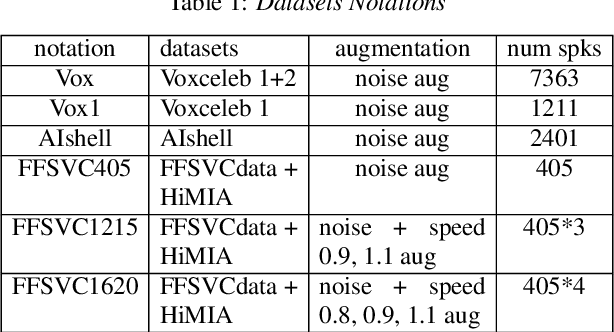
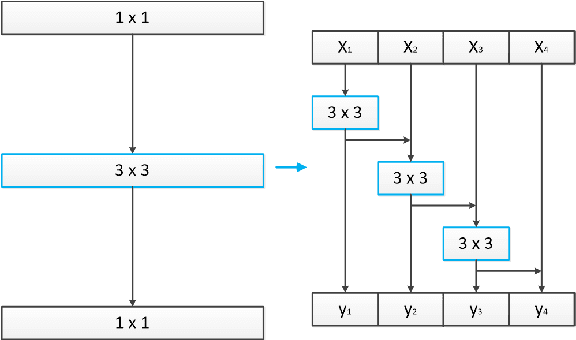
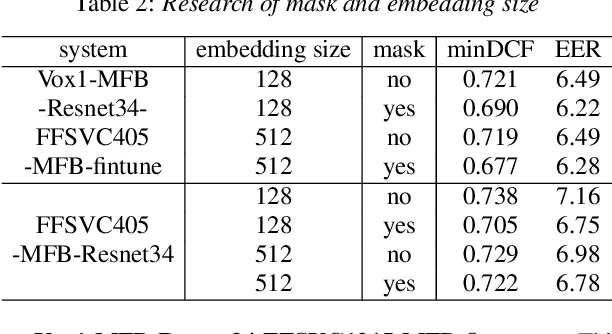
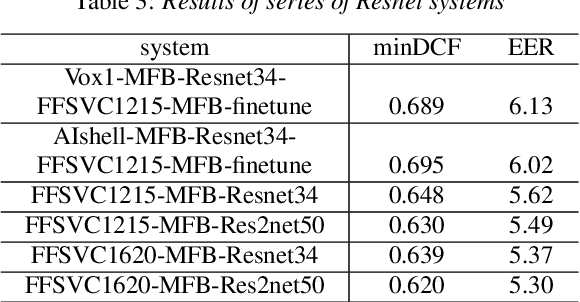
This paper describes the systems submitted by team HCCL to the Far-Field Speaker Verification Challenge. Our previous work in the AIshell Speaker Verification Challenge 2019 shows that the powerful modeling abilities of Neural Network architectures can provide exceptional performance for this kind of task. Therefore, in this challenge, we focus on constructing deep Neural Network architectures based on TDNN, Resnet and Res2net blocks. Most of the developed systems consist of Neural Network embeddings are applied with PLDA backend. Firstly, the speed perturbation method is applied to augment data and significant performance improvements are achieved. Then, we explore the use of AMsoftmax loss function and propose to join a CE-loss branch when we train model using AMsoftmax loss. In addition, the impact of score normalization on performance is also investigated. The final system, a fusion of four systems, achieves minDCF 0.5342, EER 5.05\% on task1 eval set, and achieves minDCF 0.5193, EER 5.47\% on task3 eval set.