 Add to Chrome
 Add to Firefox
 Add to Edge
A geometry-based deep equilibrium model for image restoration under multiplicative Gamma noise
Aug 05, 2026
We propose a deep learning framework for image restoration from images degraded by both multiplicative Gamma noise and blur. Unlike conventional deep equilibrium (DEQ) models that rely on implicit neural regularization, the proposed method learns an explicit and interpretable regularizer parameterized by geometric priors associated with surface area and mean curvature. To minimize the resulting variational model, we develop a mirror descent algorithm tailored to the commonly used Gamma-noise fidelity terms. Leveraging the Kurdyka-Lojasiewicz property for functions defined in $o$-minimal structures, we establish the global convergence of the generated iterates to a critical point. Experimental results on both grayscale and color image restoration demonstrate that the proposed method consistently outperforms representative model-based approaches while achieving performance comparable to state-of-the-art DEQ models based on implicit regularization, despite requiring substantially fewer trainable parameters.

From level set evolution to threshold optimization: A grayscale level set framework for image segmentation
Jul 24, 2026The segmentation of multiple degradations has been a challenging problem in the field of image segmentation. Existing level set approaches commonly adopt a length regularization term to constrain the geometric shape of the segmentation contour. However, the introduction of the length term often results in numerical instability and high computational cost. In this paper, we show that the length term is not essential under certain smoothness constraints, and theoretically prove that the presence of the length term affects the property of $|\nabla φ|=1$. Based on the finding, we define a class of smooth images, construct the grayscale level set, and propose a fast segmentation framework for degraded images, such as heavily noisy images and intensity inhomogeneous images. The framework transforms PDE evolution into one-dimensional threshold search, which has significant advantages in computational speed, especially on large-scale images. Experiments validate the segmentation performance of the proposed framework on various degraded images.
A Smooth Phase-Separation Model for Weak-Boundary Segmentation of Homogeneous Structures
Jul 24, 2026Segmentation of adjacent structures with similar intensity distributions remains a challenging problem in image analysis, particularly when object boundaries are weak or ambiguous. Under such conditions, classical variational models may suffer from degenerated image-driven forces, leading to boundary leakage or undesired merging of neighboring regions. To address these limitations, we propose a smooth phase-separation variational model based on the Cahn--Hilliard equation for weak-boundary segmentation of homogeneous-appearance structures. The proposed framework integrates softmax-based region fitting with Cahn--Hilliard phase-field regularization to maintain interface discrimination under weak image-driven forces. We further introduce a mixed $L^2-H^{-1}$ gradient flow, which preserves higher-order interfacial regularization while allowing adaptive changes of phase masses, establish the continuous energy dissipation law, and prove the existence and uniqueness of weak solutions in the natural solution class. For numerical computation, we develop a stabilized scalar auxiliary variable (SAV) scheme that is linear, FFT-based, and satisfies a modified discrete energy dissipation law. Numerical experiments on synthetic and medical images demonstrate that the proposed method effectively separates adjacent homogeneous structures across weak boundaries and achieves competitive segmentation accuracy and improved boundary localization compared with representative variational, phase-field, and deep learning methods.
Latent Geometric Chords for Query-Efficient Decision-Based Adversarial Attacks
May 29, 2026While decision-based black-box adversarial attacks present a severe security threat, current methodologies suffer from fundamental limitations. Pixel-wise attacks frequently introduce unnatural, high-frequency visual artifacts, while latent-space frameworks are confined by the limited search space of low-dimensional manifolds and inherent reconstruction flaws. To resolve these limitations, we propose Latent Geometric Chords (LGC) for Query-Efficient Decision-Based Adversarial Attacks alongside a variant, LGC-H. At its core, LGC navigates decision boundaries by executing a curvature-aware geometric search within a compressed semantic manifold. To guarantee high visual fidelity and circumvent dimensionality bottlenecks, we introduce a Residual-based Adversarial Generation (RAG) mechanism. RAG isolates semantic perturbations as geometric chords and superimposes them directly onto the original source image. RAG substantially resolves baseline reconstruction flaws and effectively doubles the permissible search space dimensions. Experimental results demonstrate that LGC achieves robust cross-dataset transferability and substantially outperforms state-of-the-art baselines. Notably, our method, LGC, minimizes perturbation magnitudes while achieving state-of-the-art visual fidelity--with a Structural Similarity Index Measure (SSIM) exceeding 0.99 and a Learned Perceptual Image Patch Similarity (LPIPS) below 0.01 at 5000 queries--and sustaining high attack success rates under stringent perceptual constraints, successfully compromising adversarially trained robust models. The source code is available at: https://github.com/eihmuekhine/Latent-Geometric-Chords.
SILSM: A Sustainable Interactive Level Set Method for Progressive Refinement
May 23, 2026Interactive segmentation aims to precisely isolate target objects using sparse user guidance. However, traditional methods often suffer from heavy interaction burdens and parameter sensitivity, while deep learning approaches struggle with data dependency and iterative instability. Motivated by these limitations, we propose the Sustainable Interactive Level Set Method (SILSM). The proposed level set evolution equation incorporates interaction, regularization, and segmentation terms. Specifically, high-order regularization is employed to maintain numerical stability, and unlike traditional methods, we decouple user guidance into an independent interaction term to enable direct manual control over the zero-level set evolution. Furthermore, we develop a numerical algorithm tailored for multiple interactions, which facilitates dynamic refinement by effectively updating the segmentation results based on sequential user inputs. We theoretically demonstrate that the high-order term provides stronger regularization constraints than the conventional length term, while the interaction term ensures segmentation strictly within the user-selected region. Experimental results further demonstrate that the proposed method is robust to interactive inputs, achieves competitive performance at the first interaction, and supports stable multi-round interactions with progressively improved segmentation quality.
PDAC: Efficient Coreset Selection for Continual Learning via Probability Density Awareness
Nov 12, 2025Rehearsal-based Continual Learning (CL) maintains a limited memory buffer to store replay samples for knowledge retention, making these approaches heavily reliant on the quality of the stored samples. Current Rehearsal-based CL methods typically construct the memory buffer by selecting a representative subset (referred to as coresets), aiming to approximate the training efficacy of the full dataset with minimal storage overhead. However, mainstream Coreset Selection (CS) methods generally formulate the CS problem as a bi-level optimization problem that relies on numerous inner and outer iterations to solve, leading to substantial computational cost thus limiting their practical efficiency. In this paper, we aim to provide a more efficient selection logic and scheme for coreset construction. To this end, we first analyze the Mean Squared Error (MSE) between the buffer-trained model and the Bayes-optimal model through the perspective of localized error decomposition to investigate the contribution of samples from different regions to MSE suppression. Further theoretical and experimental analyses demonstrate that samples with high probability density play a dominant role in error suppression. Inspired by this, we propose the Probability Density-Aware Coreset (PDAC) method. PDAC leverages the Projected Gaussian Mixture (PGM) model to estimate each sample's joint density, enabling efficient density-prioritized buffer selection. Finally, we introduce the streaming Expectation Maximization (EM) algorithm to enhance the adaptability of PGM parameters to streaming data, yielding Streaming PDAC (SPDAC) for streaming scenarios. Extensive comparative experiments show that our methods outperforms other baselines across various CL settings while ensuring favorable efficiency.
An ICTM-RMSAV Framework for Bias-Field Aware Image Segmentation under Poisson and Multiplicative Noise
Nov 12, 2025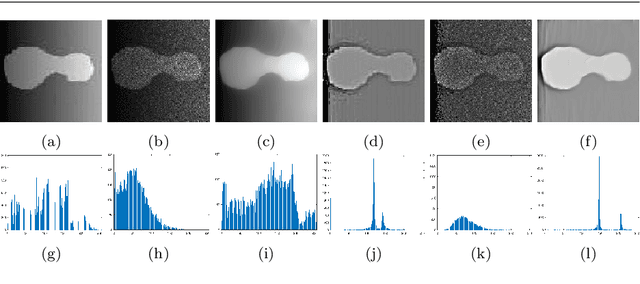
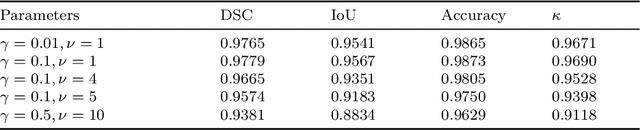
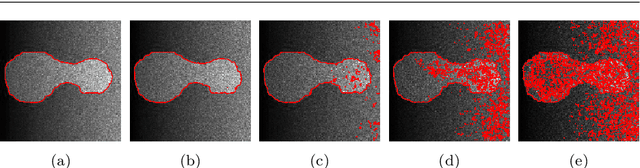
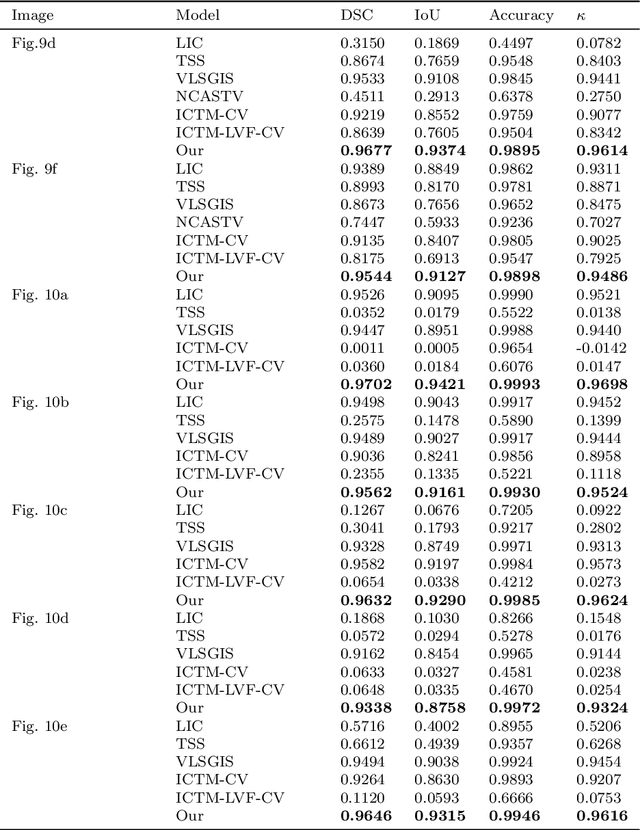
Image segmentation is a core task in image processing, yet many methods degrade when images are heavily corrupted by noise and exhibit intensity inhomogeneity. Within the iterative-convolution thresholding method (ICTM) framework, we propose a variational segmentation model that integrates denoising terms. Specifically, the denoising component consists of an I-divergence term and an adaptive total-variation (TV) regularizer, making the model well suited to images contaminated by Gamma--distributed multiplicative noise and Poisson noise. A spatially adaptive weight derived from a gray-level indicator guides diffusion differently across regions of varying intensity. To further address intensity inhomogeneity, we estimate a smoothly varying bias field, which improves segmentation accuracy. Regions are represented by characteristic functions, with contour length encoded accordingly. For efficient optimization, we couple ICTM with a relaxed modified scalar auxiliary variable (RMSAV) scheme. Extensive experiments on synthetic and real-world images with intensity inhomogeneity and diverse noise types show that the proposed model achieves superior accuracy and robustness compared with competing approaches.
Towards Frequency-Adaptive Learning for SAR Despeckling
Nov 08, 2025Synthetic Aperture Radar (SAR) images are inherently corrupted by speckle noise, limiting their utility in high-precision applications. While deep learning methods have shown promise in SAR despeckling, most methods employ a single unified network to process the entire image, failing to account for the distinct speckle statistics associated with different spatial physical characteristics. It often leads to artifacts, blurred edges, and texture distortion. To address these issues, we propose SAR-FAH, a frequency-adaptive heterogeneous despeckling model based on a divide-and-conquer architecture. First, wavelet decomposition is used to separate the image into frequency sub-bands carrying different intrinsic characteristics. Inspired by their differing noise characteristics, we design specialized sub-networks for different frequency components. The tailored approach leverages statistical variations across frequencies, improving edge and texture preservation while suppressing noise. Specifically, for the low-frequency part, denoising is formulated as a continuous dynamic system via neural ordinary differential equations, ensuring structural fidelity and sufficient smoothness that prevents artifacts. For high-frequency sub-bands rich in edges and textures, we introduce an enhanced U-Net with deformable convolutions for noise suppression and enhanced features. Extensive experiments on synthetic and real SAR images validate the superior performance of the proposed model in noise removal and structural preservation.
Mixed geometry information regularization for image multiplicative denoising
Dec 21, 2024This paper focuses on solving the multiplicative gamma denoising problem via a variation model. Variation-based regularization models have been extensively employed in a variety of inverse problem tasks in image processing. However, sufficient geometric priors and efficient algorithms are still very difficult problems in the model design process. To overcome these issues, in this paper we propose a mixed geometry information model, incorporating area term and curvature term as prior knowledge. In addition to its ability to effectively remove multiplicative noise, our model is able to preserve edges and prevent staircasing effects. Meanwhile, to address the challenges stemming from the nonlinearity and non-convexity inherent in higher-order regularization, we propose the efficient additive operator splitting algorithm (AOS) and scalar auxiliary variable algorithm (SAV). The unconditional stability possessed by these algorithms enables us to use large time step. And the SAV method shows higher computational accuracy in our model. We employ the second order SAV algorithm to further speed up the calculation while maintaining accuracy. We demonstrate the effectiveness and efficiency of the model and algorithms by a lot of numerical experiments, where the model we proposed has better features texturepreserving properties without generating any false information.
Adversarial Transferability in Deep Denoising Models: Theoretical Insights and Robustness Enhancement via Out-of-Distribution Typical Set Sampling
Dec 08, 2024Deep learning-based image denoising models demonstrate remarkable performance, but their lack of robustness analysis remains a significant concern. A major issue is that these models are susceptible to adversarial attacks, where small, carefully crafted perturbations to input data can cause them to fail. Surprisingly, perturbations specifically crafted for one model can easily transfer across various models, including CNNs, Transformers, unfolding models, and plug-and-play models, leading to failures in those models as well. Such high adversarial transferability is not observed in classification models. We analyze the possible underlying reasons behind the high adversarial transferability through a series of hypotheses and validation experiments. By characterizing the manifolds of Gaussian noise and adversarial perturbations using the concept of typical set and the asymptotic equipartition property, we prove that adversarial samples deviate slightly from the typical set of the original input distribution, causing the models to fail. Based on these insights, we propose a novel adversarial defense method: the Out-of-Distribution Typical Set Sampling Training strategy (TS). TS not only significantly enhances the model's robustness but also marginally improves denoising performance compared to the original model.