 Add to Chrome
 Add to Firefox
 Add to Edge
From level set evolution to threshold optimization: A grayscale level set framework for image segmentation
Jul 24, 2026
The segmentation of multiple degradations has been a challenging problem in the field of image segmentation. Existing level set approaches commonly adopt a length regularization term to constrain the geometric shape of the segmentation contour. However, the introduction of the length term often results in numerical instability and high computational cost. In this paper, we show that the length term is not essential under certain smoothness constraints, and theoretically prove that the presence of the length term affects the property of $|\nabla φ|=1$. Based on the finding, we define a class of smooth images, construct the grayscale level set, and propose a fast segmentation framework for degraded images, such as heavily noisy images and intensity inhomogeneous images. The framework transforms PDE evolution into one-dimensional threshold search, which has significant advantages in computational speed, especially on large-scale images. Experiments validate the segmentation performance of the proposed framework on various degraded images.

A Smooth Phase-Separation Model for Weak-Boundary Segmentation of Homogeneous Structures
Jul 24, 2026Segmentation of adjacent structures with similar intensity distributions remains a challenging problem in image analysis, particularly when object boundaries are weak or ambiguous. Under such conditions, classical variational models may suffer from degenerated image-driven forces, leading to boundary leakage or undesired merging of neighboring regions. To address these limitations, we propose a smooth phase-separation variational model based on the Cahn--Hilliard equation for weak-boundary segmentation of homogeneous-appearance structures. The proposed framework integrates softmax-based region fitting with Cahn--Hilliard phase-field regularization to maintain interface discrimination under weak image-driven forces. We further introduce a mixed $L^2-H^{-1}$ gradient flow, which preserves higher-order interfacial regularization while allowing adaptive changes of phase masses, establish the continuous energy dissipation law, and prove the existence and uniqueness of weak solutions in the natural solution class. For numerical computation, we develop a stabilized scalar auxiliary variable (SAV) scheme that is linear, FFT-based, and satisfies a modified discrete energy dissipation law. Numerical experiments on synthetic and medical images demonstrate that the proposed method effectively separates adjacent homogeneous structures across weak boundaries and achieves competitive segmentation accuracy and improved boundary localization compared with representative variational, phase-field, and deep learning methods.
Grounding LLM Reasoning under Incomplete Graph Evidence
Jun 29, 2026Knowledge graphs can guide large language models (LLMs) reasoning, but the graph seen by a system is usually a retrieved, linked, temporally scoped, and incomplete evidence state rather than a complete account of truth. We develop a theoretical perspective on grounding observable LLM trajectories under such incomplete graph evidence.The evidence state induces entity anchors, typed relation residuals, path energies, and support regions, while the language model supplies a prior over candidate trajectories. We show that, under open-world incompleteness, no hard rule based only on the observed state can both reject every false unsupported trajectory and retain every true-but-unobserved one.We then characterize soft grounding as a KL-regularized deformation of the LLM prior: finite slack preserves support for unsupported but non-contradicted trajectories, whereas hard conditioning appears as an infinite-penalty limit.The framework also yields stability bounds under evidence perturbations and clarifies the constraint regimes appropriate for GraphRAG, KGQA, graph agents, constrained decoding, and faithful generation. The claims are evidence-relative: KG compatibility is treated as declared support, not factual truth.
SILSM: A Sustainable Interactive Level Set Method for Progressive Refinement
May 23, 2026Interactive segmentation aims to precisely isolate target objects using sparse user guidance. However, traditional methods often suffer from heavy interaction burdens and parameter sensitivity, while deep learning approaches struggle with data dependency and iterative instability. Motivated by these limitations, we propose the Sustainable Interactive Level Set Method (SILSM). The proposed level set evolution equation incorporates interaction, regularization, and segmentation terms. Specifically, high-order regularization is employed to maintain numerical stability, and unlike traditional methods, we decouple user guidance into an independent interaction term to enable direct manual control over the zero-level set evolution. Furthermore, we develop a numerical algorithm tailored for multiple interactions, which facilitates dynamic refinement by effectively updating the segmentation results based on sequential user inputs. We theoretically demonstrate that the high-order term provides stronger regularization constraints than the conventional length term, while the interaction term ensures segmentation strictly within the user-selected region. Experimental results further demonstrate that the proposed method is robust to interactive inputs, achieves competitive performance at the first interaction, and supports stable multi-round interactions with progressively improved segmentation quality.
An ICTM-RMSAV Framework for Bias-Field Aware Image Segmentation under Poisson and Multiplicative Noise
Nov 12, 2025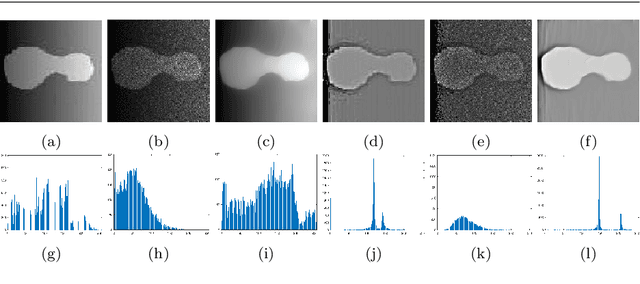
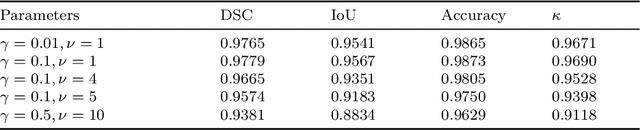
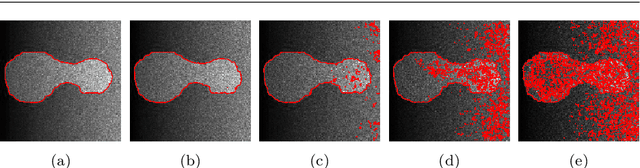
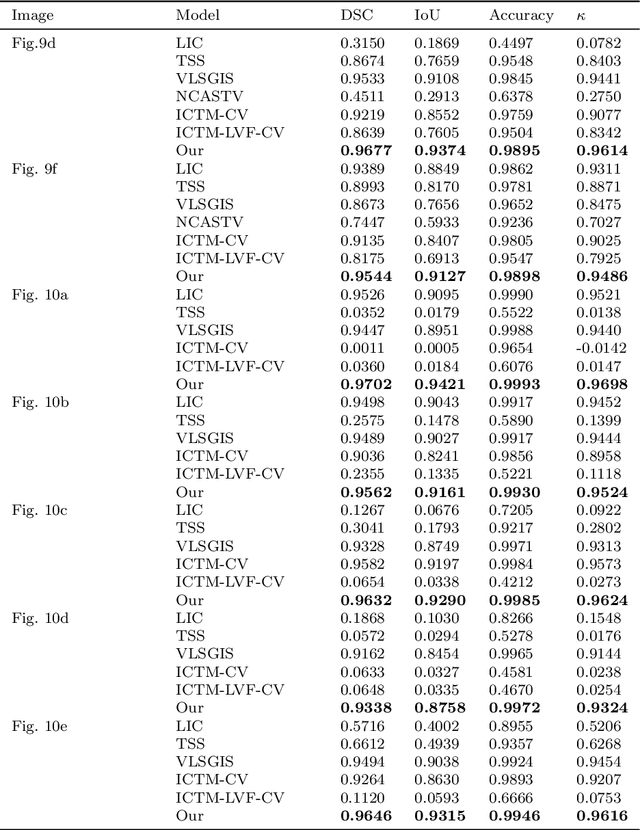
Image segmentation is a core task in image processing, yet many methods degrade when images are heavily corrupted by noise and exhibit intensity inhomogeneity. Within the iterative-convolution thresholding method (ICTM) framework, we propose a variational segmentation model that integrates denoising terms. Specifically, the denoising component consists of an I-divergence term and an adaptive total-variation (TV) regularizer, making the model well suited to images contaminated by Gamma--distributed multiplicative noise and Poisson noise. A spatially adaptive weight derived from a gray-level indicator guides diffusion differently across regions of varying intensity. To further address intensity inhomogeneity, we estimate a smoothly varying bias field, which improves segmentation accuracy. Regions are represented by characteristic functions, with contour length encoded accordingly. For efficient optimization, we couple ICTM with a relaxed modified scalar auxiliary variable (RMSAV) scheme. Extensive experiments on synthetic and real-world images with intensity inhomogeneity and diverse noise types show that the proposed model achieves superior accuracy and robustness compared with competing approaches.
Physics-Informed Design of Input Convex Neural Networks for Consistency Optimal Transport Flow Matching
Nov 08, 2025We propose a consistency model based on the optimal-transport flow. A physics-informed design of partially input-convex neural networks (PICNN) plays a central role in constructing the flow field that emulates the displacement interpolation. During the training stage, we couple the Hamilton-Jacobi (HJ) residual in the OT formulation with the original flow matching loss function. Our approach avoids inner optimization subproblems that are present in previous one-step OFM approaches. During the prediction stage, our approach supports both one-step (Brenier-map) and multi-step ODE sampling from the same learned potential, leveraging the straightness of the OT flow. We validate scalability and performance on standard OT benchmarks.
Mixed geometry information regularization for image multiplicative denoising
Dec 21, 2024This paper focuses on solving the multiplicative gamma denoising problem via a variation model. Variation-based regularization models have been extensively employed in a variety of inverse problem tasks in image processing. However, sufficient geometric priors and efficient algorithms are still very difficult problems in the model design process. To overcome these issues, in this paper we propose a mixed geometry information model, incorporating area term and curvature term as prior knowledge. In addition to its ability to effectively remove multiplicative noise, our model is able to preserve edges and prevent staircasing effects. Meanwhile, to address the challenges stemming from the nonlinearity and non-convexity inherent in higher-order regularization, we propose the efficient additive operator splitting algorithm (AOS) and scalar auxiliary variable algorithm (SAV). The unconditional stability possessed by these algorithms enables us to use large time step. And the SAV method shows higher computational accuracy in our model. We employ the second order SAV algorithm to further speed up the calculation while maintaining accuracy. We demonstrate the effectiveness and efficiency of the model and algorithms by a lot of numerical experiments, where the model we proposed has better features texturepreserving properties without generating any false information.
Re-initialization-free Level Set Method via Molecular Beam Epitaxy Equation Regularization for Image Segmentation
Oct 13, 2023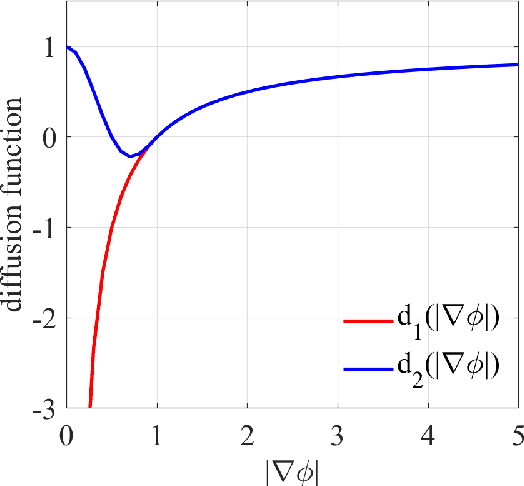
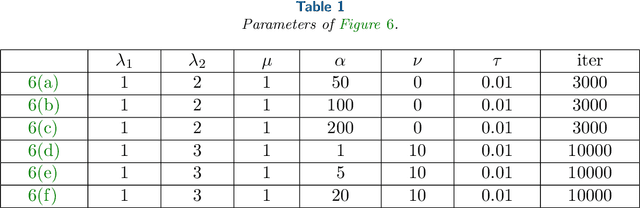
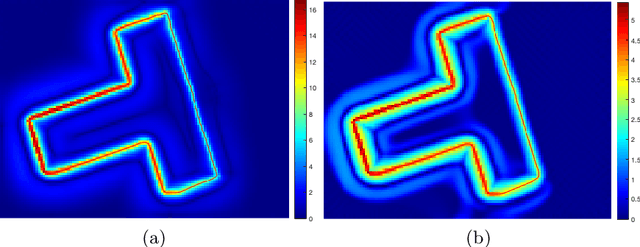
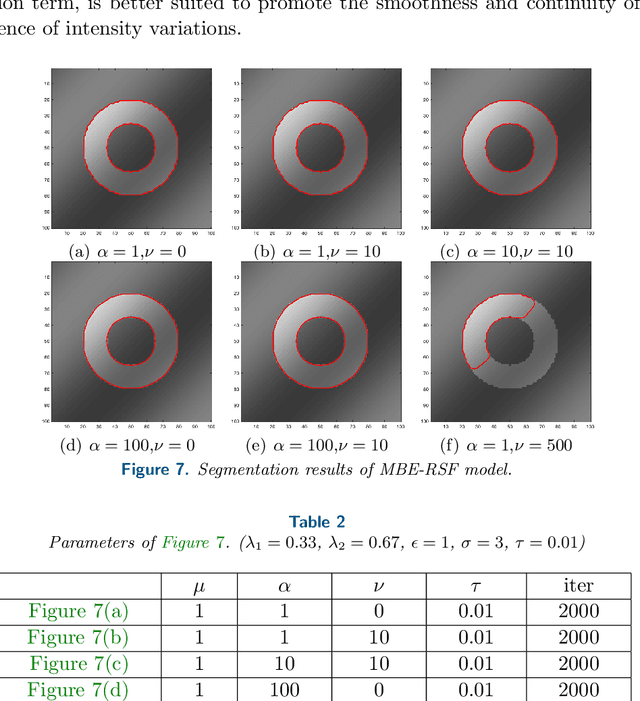
Variational level set method has become a powerful tool in image segmentation due to its ability to handle complex topological changes and maintain continuity and smoothness in the process of evolution. However its evolution process can be unstable, which results in over flatted or over sharpened contours and segmentation failure. To improve the accuracy and stability of evolution, we propose a high-order level set variational segmentation method integrated with molecular beam epitaxy (MBE) equation regularization. This method uses the crystal growth in the MBE process to limit the evolution of the level set function, and thus can avoid the re-initialization in the evolution process and regulate the smoothness of the segmented curve. It also works for noisy images with intensity inhomogeneity, which is a challenge in image segmentation. To solve the variational model, we derive the gradient flow and design scalar auxiliary variable (SAV) scheme coupled with fast Fourier transform (FFT), which can significantly improve the computational efficiency compared with the traditional semi-implicit and semi-explicit scheme. Numerical experiments show that the proposed method can generate smooth segmentation curves, retain fine segmentation targets and obtain robust segmentation results of small objects. Compared to existing level set methods, this model is state-of-the-art in both accuracy and efficiency.