 Add to Chrome
 Add to Firefox
 Add to Edge
PDAC: Efficient Coreset Selection for Continual Learning via Probability Density Awareness
Nov 12, 2025
Rehearsal-based Continual Learning (CL) maintains a limited memory buffer to store replay samples for knowledge retention, making these approaches heavily reliant on the quality of the stored samples. Current Rehearsal-based CL methods typically construct the memory buffer by selecting a representative subset (referred to as coresets), aiming to approximate the training efficacy of the full dataset with minimal storage overhead. However, mainstream Coreset Selection (CS) methods generally formulate the CS problem as a bi-level optimization problem that relies on numerous inner and outer iterations to solve, leading to substantial computational cost thus limiting their practical efficiency. In this paper, we aim to provide a more efficient selection logic and scheme for coreset construction. To this end, we first analyze the Mean Squared Error (MSE) between the buffer-trained model and the Bayes-optimal model through the perspective of localized error decomposition to investigate the contribution of samples from different regions to MSE suppression. Further theoretical and experimental analyses demonstrate that samples with high probability density play a dominant role in error suppression. Inspired by this, we propose the Probability Density-Aware Coreset (PDAC) method. PDAC leverages the Projected Gaussian Mixture (PGM) model to estimate each sample's joint density, enabling efficient density-prioritized buffer selection. Finally, we introduce the streaming Expectation Maximization (EM) algorithm to enhance the adaptability of PGM parameters to streaming data, yielding Streaming PDAC (SPDAC) for streaming scenarios. Extensive comparative experiments show that our methods outperforms other baselines across various CL settings while ensuring favorable efficiency.

A Tunable Despeckling Neural Network Stabilized via Diffusion Equation
Nov 24, 2024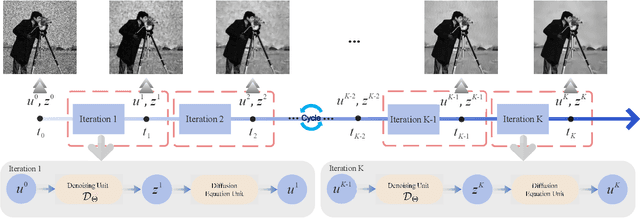
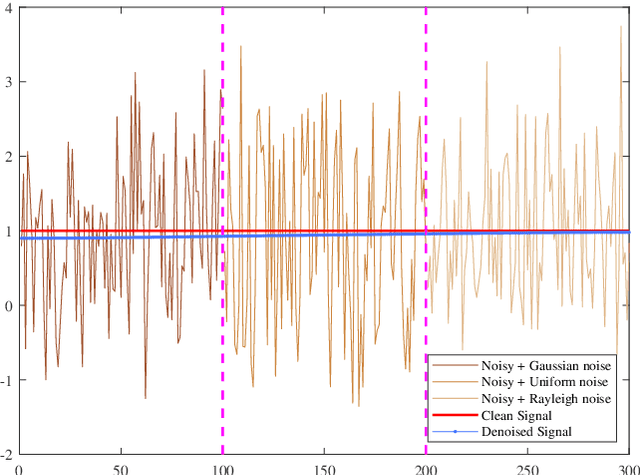
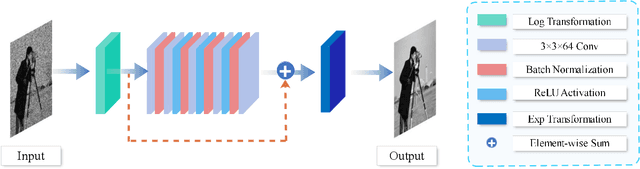
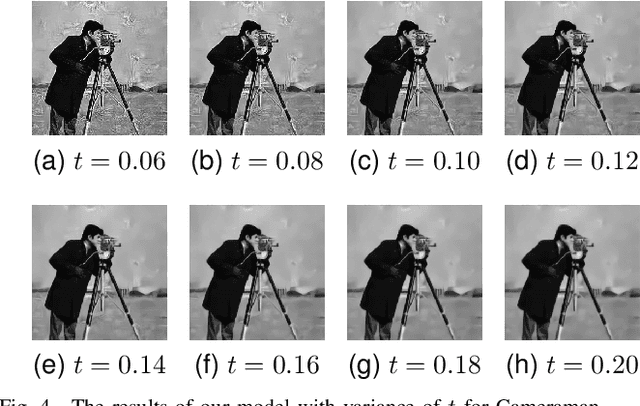
Multiplicative Gamma noise remove is a critical research area in the application of synthetic aperture radar (SAR) imaging, where neural networks serve as a potent tool. However, real-world data often diverges from theoretical models, exhibiting various disturbances, which makes the neural network less effective. Adversarial attacks work by finding perturbations that significantly disrupt functionality of neural networks, as the inherent instability of neural networks makes them highly susceptible. A network designed to withstand such extreme cases can more effectively mitigate general disturbances in real SAR data. In this work, the dissipative nature of diffusion equations is employed to underpin a novel approach for countering adversarial attacks and improve the resistance of real noise disturbance. We propose a tunable, regularized neural network that unrolls a denoising unit and a regularization unit into a single network for end-to-end training. In the network, the denoising unit and the regularization unit are composed of the denoising network and the simplest linear diffusion equation respectively. The regularization unit enhances network stability, allowing post-training time step adjustments to effectively mitigate the adverse impacts of adversarial attacks. The stability and convergence of our model are theoretically proven, and in the experiments, we compare our model with several state-of-the-art denoising methods on simulated images, adversarial samples, and real SAR images, yielding superior results in both quantitative and visual evaluations.