 Add to Chrome
 Add to Firefox
 Add to Edge
LLM-Based User Personas for Recommendations at Scale
Jun 10, 2026
Large Language Models (LLMs) offer unprecedented potential for enhancing recommendation systems through their world knowledge and reasoning capabilities. However, existing approaches often rely on structured IDs or offline processing, limiting semantic richness, real-time adaptability, and user-facing interpretability. In this paper, we introduce a novel framework that enables real-time generation of LLM-based user interest personas for a large-scale commercial video recommendation platform. Our method generates natural-language user interest personas that address the exploitation-exploration trade-off by combining the summarization of existing interests with novel topics, directly during serving. To overcome the computational challenges of online LLM inference at a billion-user scale, we design a cost-efficient architecture leveraging knowledge distillation, asynchronous inference, and input optimization via semantically clustered video representations. Extensive offline evaluations, user studies, and live A/B tests demonstrate significant improvements in viewer value. This work bridges the gap between high-level semantic understanding and industrial-scale recommendation, paving the way for more dynamic, explainable, and satisfying personalized experiences.

Garbage In, Garbage Out? Do Machine Learning Application Papers in Social Computing Report Where Human-Labeled Training Data Comes From?
Dec 17, 2019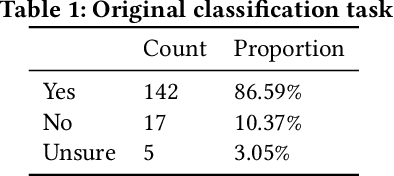
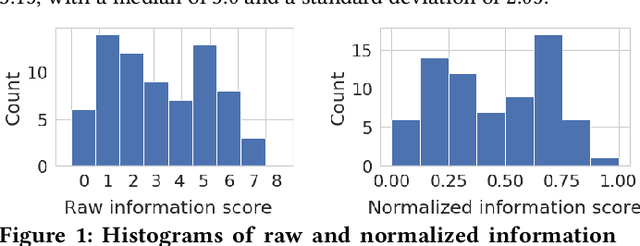
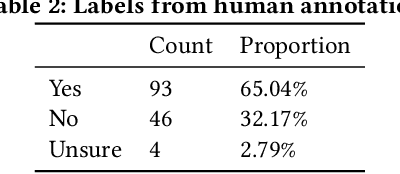
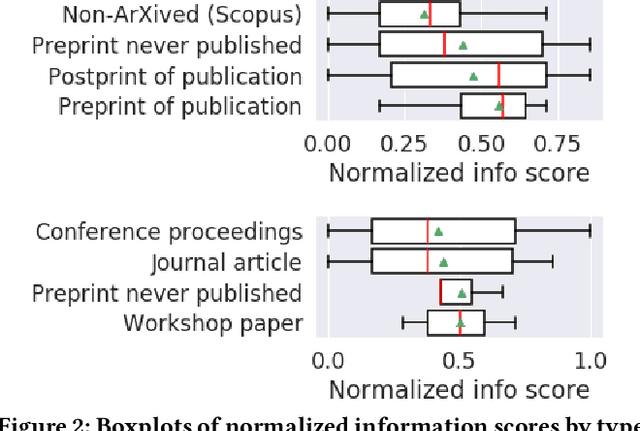
Many machine learning projects for new application areas involve teams of humans who label data for a particular purpose, from hiring crowdworkers to the paper's authors labeling the data themselves. Such a task is quite similar to (or a form of) structured content analysis, which is a longstanding methodology in the social sciences and humanities, with many established best practices. In this paper, we investigate to what extent a sample of machine learning application papers in social computing --- specifically papers from ArXiv and traditional publications performing an ML classification task on Twitter data --- give specific details about whether such best practices were followed. Our team conducted multiple rounds of structured content analysis of each paper, making determinations such as: Does the paper report who the labelers were, what their qualifications were, whether they independently labeled the same items, whether inter-rater reliability metrics were disclosed, what level of training and/or instructions were given to labelers, whether compensation for crowdworkers is disclosed, and if the training data is publicly available. We find a wide divergence in whether such practices were followed and documented. Much of machine learning research and education focuses on what is done once a "gold standard" of training data is available, but we discuss issues around the equally-important aspect of whether such data is reliable in the first place.
* 18 pages, includes appendix