 Add to Chrome
 Add to Firefox
 Add to Edge
AXIS: A Growable Community-Driven Data Engine for Scalable Robot Manipulation
Jul 23, 2026
Learning effective robot manipulation policies requires diverse, high-quality demonstrations, yet existing data pipelines are often difficult to scale because they rely on specialized hardware, centralized operators, or fixed task suites. We present AXIS, a growable community-driven data engine and benchmark for scalable robot learning, which enables browser-based teleoperation for large-scale demonstration collection, automatically generates and validates new manipulation tasks, and transforms community-collected demonstrations into training-ready data through automated success checking, quality filtering, trajectory smoothing, and visual and physics-based augmentation. The AXIS dataset currently contains 207 diverse tasks and 50K+ trajectories. Meanwhile, AXIS organizes data into task snapshots and evaluates policies with a systematic held-out protocol. We compare vision-language-action (VLA) policies under a unified AXIS evaluation suite and analyze scaling behavior across different data volumes. Continual pretraining on AXIS substantially improves the overall success rate of $π_{0.5}$ by 5.8%, outperforms the model pretrained on RoboCasa365 by 37.3%, and exhibits consistent scaling with increasing data volume, with the largest gains observed under layout, sensor-noise, and camera perturbations.

Humanoid Whole-Body Manipulation via Active Spatial Brain and Generalizable Action Cerebellum
May 20, 2026In this paper, we explore spatial-aware humanoid whole-body manipulation task. Compared with tabletop settings, this task poses two key challenges: 1) Spatial understanding is challenging in complex 3D environments with diverse spatial relations. 2) Action generation is difficult to generalize, as limited and costly real-robot data restricts data-driven models generalization. To address these challenges, we propose a generalizable humanoid loco-manipulation framework that leverages the spatial perception and action generation capabilities of multi-agent large models. Specifically, our framework includes two components: Active Spatial Brain for active spatial perception and decision-making, and Generalizable Action Cerebellum for executable robot action generation. The first component actively perceives the spatial scene and makes decisions on task planning and subtask decomposition. The second component generate executable robot actions based on the decisions made by the first module without needs of task-specific real robot data. To benchmark our framework, we design a set of spatial manipulation tasks from two perspectives: evaluating spatial perception and understanding, and assessing real-robot task performance. The results demonstrate strong performance on both aspects across diverse tasks and environments.
OmniDexGrasp: Generalizable Dexterous Grasping via Foundation Model and Force Feedback
Oct 27, 2025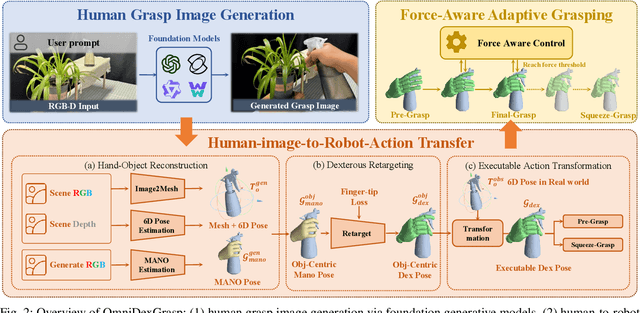
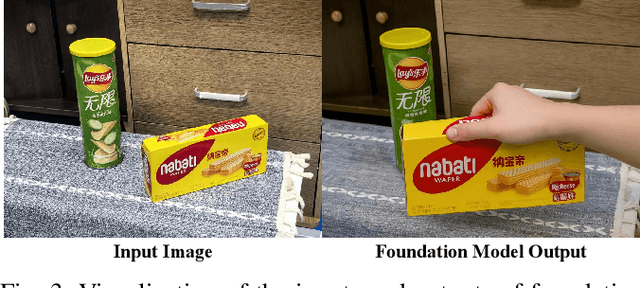
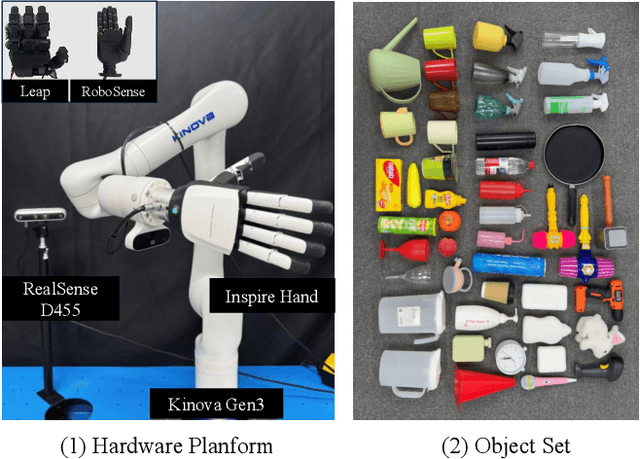
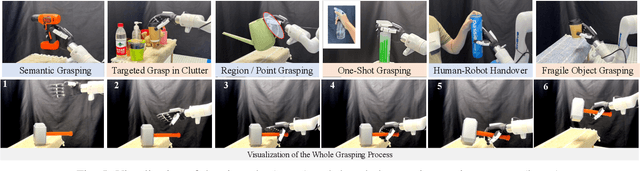
Enabling robots to dexterously grasp and manipulate objects based on human commands is a promising direction in robotics. However, existing approaches are challenging to generalize across diverse objects or tasks due to the limited scale of semantic dexterous grasp datasets. Foundation models offer a new way to enhance generalization, yet directly leveraging them to generate feasible robotic actions remains challenging due to the gap between abstract model knowledge and physical robot execution. To address these challenges, we propose OmniDexGrasp, a generalizable framework that achieves omni-capabilities in user prompting, dexterous embodiment, and grasping tasks by combining foundation models with the transfer and control strategies. OmniDexGrasp integrates three key modules: (i) foundation models are used to enhance generalization by generating human grasp images supporting omni-capability of user prompt and task; (ii) a human-image-to-robot-action transfer strategy converts human demonstrations into executable robot actions, enabling omni dexterous embodiment; (iii) force-aware adaptive grasp strategy ensures robust and stable grasp execution. Experiments in simulation and on real robots validate the effectiveness of OmniDexGrasp on diverse user prompts, grasp task and dexterous hands, and further results show its extensibility to dexterous manipulation tasks.