 Add to Chrome
 Add to Firefox
 Add to Edge
Simple yet Effective: Low-Rank Spatial Attention for Neural Operators
Apr 04, 2026
Neural operators have emerged as data-driven surrogates for solving partial differential equations (PDEs), and their success hinges on efficiently modeling the long-range, global coupling among spatial points induced by the underlying physics. In many PDE regimes, the induced global interaction kernels are empirically compressible, exhibiting rapid spectral decay that admits low-rank approximations. We leverage this observation to unify representative global mixing modules in neural operators under a shared low-rank template: compressing high-dimensional pointwise features into a compact latent space, processing global interactions within it, and reconstructing the global context back to spatial points. Guided by this view, we introduce Low-Rank Spatial Attention (LRSA) as a clean and direct instantiation of this template. Crucially, unlike prior approaches that often rely on non-standard aggregation or normalization modules, LRSA is built purely from standard Transformer primitives, i.e., attention, normalization, and feed-forward networks, yielding a concise block that is straightforward to implement and directly compatible with hardware-optimized kernels. In our experiments, such a simple construction is sufficient to achieve high accuracy, yielding an average error reduction of over 17\% relative to second-best methods, while remaining stable and efficient in mixed-precision training.

Accelerating Data Generation for Nonlinear temporal PDEs via homologous perturbation in solution space
Oct 24, 2025
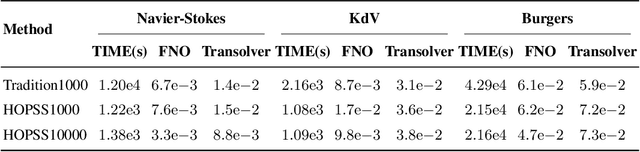
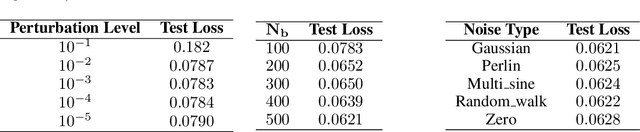
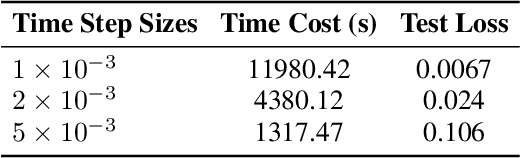
Data-driven deep learning methods like neural operators have advanced in solving nonlinear temporal partial differential equations (PDEs). However, these methods require large quantities of solution pairs\u2014the solution functions and right-hand sides (RHS) of the equations. These pairs are typically generated via traditional numerical methods, which need thousands of time steps iterations far more than the dozens required for training, creating heavy computational and temporal overheads. To address these challenges, we propose a novel data generation algorithm, called HOmologous Perturbation in Solution Space (HOPSS), which directly generates training datasets with fewer time steps rather than following the traditional approach of generating large time steps datasets. This algorithm simultaneously accelerates dataset generation and preserves the approximate precision required for model training. Specifically, we first obtain a set of base solution functions from a reliable solver, usually with thousands of time steps, and then align them in time steps with training datasets by downsampling. Subsequently, we propose a "homologous perturbation" approach: by combining two solution functions (one as the primary function, the other as a homologous perturbation term scaled by a small scalar) with random noise, we efficiently generate comparable-precision PDE data points. Finally, using these data points, we compute the variation in the original equation's RHS to form new solution pairs. Theoretical and experimental results show HOPSS lowers time complexity. For example, on the Navier-Stokes equation, it generates 10,000 samples in approximately 10% of traditional methods' time, with comparable model training performance.