 Add to Chrome
 Add to Firefox
 Add to Edge
Ling and Ring 2.6 Technical Report: Efficient and Instant Agentic Intelligence at Trillion-Parameter Scale
Jun 13, 2026
Efficient and scalable agentic intelligence requires models that can deliver both low-latency responses and strong reasoning capabilities while remaining practical to train, serve, and deploy. In this report, we present Ling-2.6 and Ring-2.6, a family of models designed to address this challenge at scale. Ling-2.6 is optimized for instant response generation and high capability per output token, whereas Ring-2.6 is tailored for deeper reasoning and more advanced agentic workflows. Instead of training from scratch, we upgrade the Ling-2.0 base model through architectural migration pre-training and large-scale post-training. This upgrade is guided by a unified co-design of model architecture, optimization objectives, serving systems, and agent training environments, enabling improvements in both model capability and deployment efficiency. At the architectural level, we introduce a hybrid linear attention design that integrates Lightning Attention with MLA, improving the efficiency of long-context training and decoding. To further enhance token efficiency, we optimize capability per output token through Evolutionary Chain-of-Thought, Linguistic Unit Policy Optimization, bidirectional preference alignment, and shortest-correct-response distillation. For agentic capabilities, we propose KPop, a reinforcement learning framework designed to support stable training of Ring-2.6-1T on large-scale environment-grounded data. KPop improves training efficiency through asynchronous scheduling across coding, search, tool use, and workflow execution, enabling scalable learning from complex agent-environment interactions. Together, Ling-2.6 and Ring-2.6 provide a practical pathway toward efficient, scalable, and open agentic systems. We open-source all checkpoints in the 2.6 family to support further research and development in practical agentic intelligence.

LightThinker++: From Reasoning Compression to Memory Management
Apr 04, 2026Large language models (LLMs) excel at complex reasoning, yet their efficiency is limited by the surging cognitive overhead of long thought traces. In this paper, we propose LightThinker, a method that enables LLMs to dynamically compress intermediate thoughts into compact semantic representations. However, static compression often struggles with complex reasoning where the irreversible loss of intermediate details can lead to logical bottlenecks. To address this, we evolve the framework into LightThinker++, introducing Explicit Adaptive Memory Management. This paradigm shifts to behavioral-level management by incorporating explicit memory primitives, supported by a specialized trajectory synthesis pipeline to train purposeful memory scheduling. Extensive experiments demonstrate the framework's versatility across three dimensions. (1) LightThinker reduces peak token usage by 70% and inference time by 26% with minimal accuracy loss. (2) In standard reasoning, LightThinker++ slashes peak token usage by 69.9% while yielding a +2.42% accuracy gain under the same context budget for maximum performance. (3) Most notably, in long-horizon agentic tasks, it maintains a stable footprint beyond 80 rounds (a 60%-70% reduction), achieving an average performance gain of 14.8% across different complex scenarios. Overall, our work provides a scalable direction for sustaining deep LLM reasoning over extended horizons with minimal overhead.
Thinker: Training LLMs in Hierarchical Thinking for Deep Search via Multi-Turn Interaction
Nov 14, 2025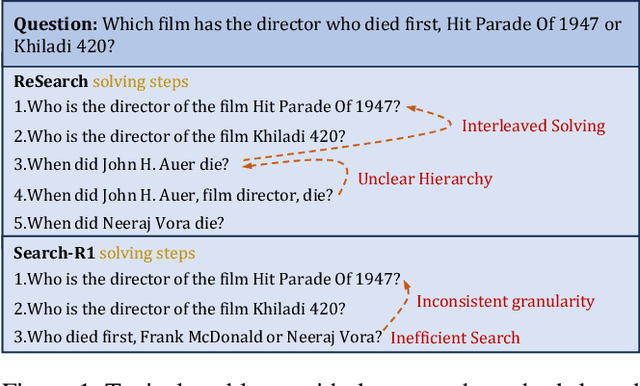
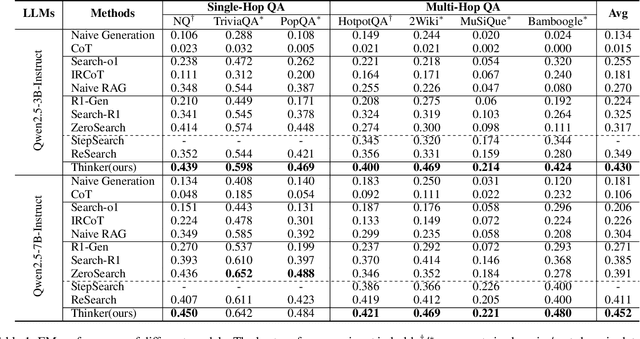
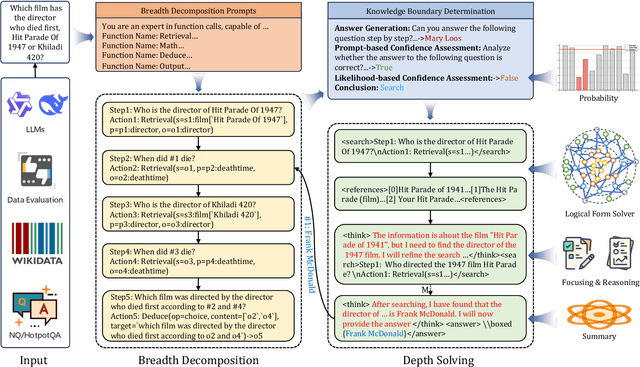
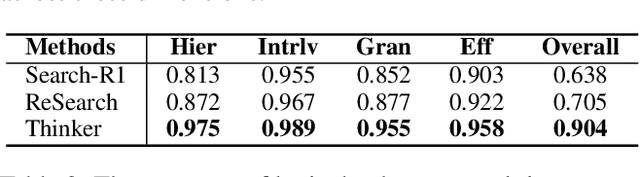
Efficient retrieval of external knowledge bases and web pages is crucial for enhancing the reasoning abilities of LLMs. Previous works on training LLMs to leverage external retrievers for solving complex problems have predominantly employed end-to-end reinforcement learning. However, these approaches neglect supervision over the reasoning process, making it difficult to guarantee logical coherence and rigor. To address these limitations, we propose Thinker, a hierarchical thinking model for deep search through multi-turn interaction, making the reasoning process supervisable and verifiable. It decomposes complex problems into independently solvable sub-problems, each dually represented in both natural language and an equivalent logical function to support knowledge base and web searches. Concurrently, dependencies between sub-problems are passed as parameters via these logical functions, enhancing the logical coherence of the problem-solving process. To avoid unnecessary external searches, we perform knowledge boundary determination to check if a sub-problem is within the LLM's intrinsic knowledge, allowing it to answer directly. Experimental results indicate that with as few as several hundred training samples, the performance of Thinker is competitive with established baselines. Furthermore, when scaled to the full training set, Thinker significantly outperforms these methods across various datasets and model sizes. The source code is available at https://github.com/OpenSPG/KAG-Thinker.
Last Layer Logits to Logic: Empowering LLMs with Logic-Consistent Structured Knowledge Reasoning
Nov 11, 2025Large Language Models (LLMs) achieve excellent performance in natural language reasoning tasks through pre-training on vast unstructured text, enabling them to understand the logic in natural language and generate logic-consistent responses. However, the representational differences between unstructured and structured knowledge make LLMs inherently struggle to maintain logic consistency, leading to \textit{Logic Drift} challenges in structured knowledge reasoning tasks such as Knowledge Graph Question Answering (KGQA). Existing methods address this limitation by designing complex workflows embedded in prompts to guide LLM reasoning. Nevertheless, these approaches only provide input-level guidance and fail to fundamentally address the \textit{Logic Drift} in LLM outputs. Additionally, their inflexible reasoning workflows cannot adapt to different tasks and knowledge graphs. To enhance LLMs' logic consistency in structured knowledge reasoning, we specifically target the logits output from the autoregressive generation process. We propose the \textit{Logits-to-Logic} framework, which incorporates logits strengthening and logits filtering as core modules to correct logical defects in LLM outputs. Extensive experiments show that our approach significantly improves LLMs' logic consistency in structured knowledge reasoning and achieves state-of-the-art performance on multiple KGQA benchmarks.
Every Step Evolves: Scaling Reinforcement Learning for Trillion-Scale Thinking Model
Oct 21, 2025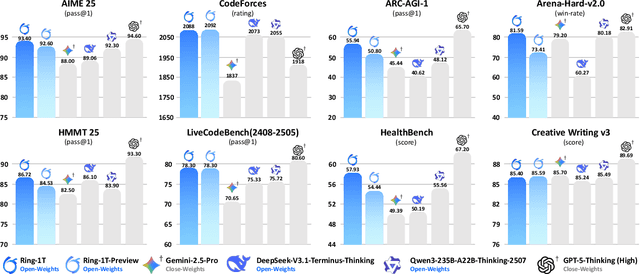
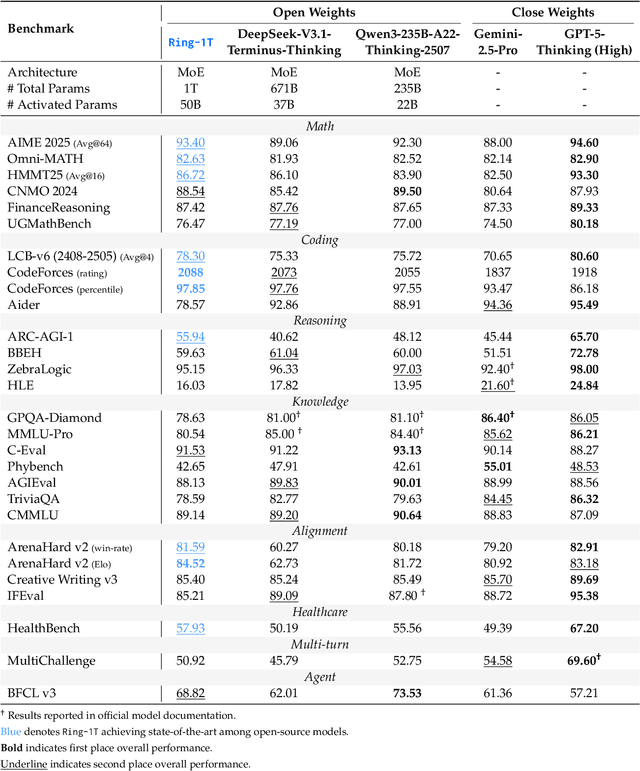
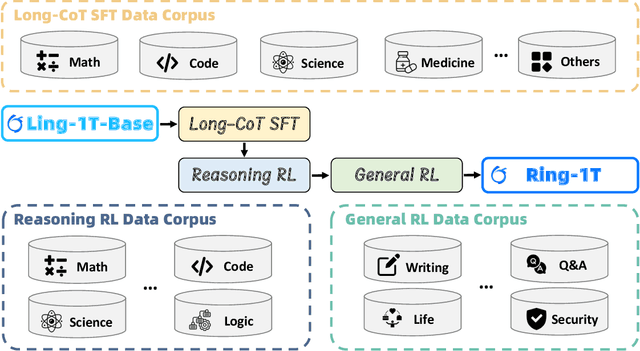
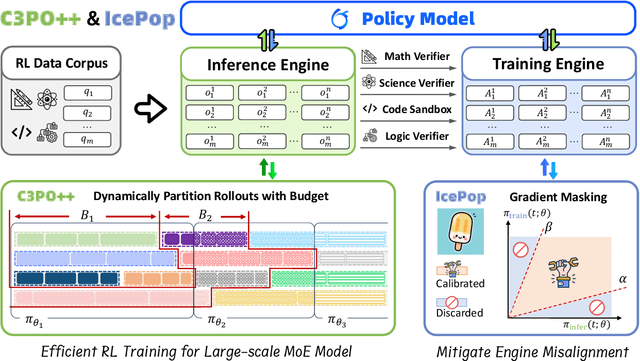
We present Ring-1T, the first open-source, state-of-the-art thinking model with a trillion-scale parameter. It features 1 trillion total parameters and activates approximately 50 billion per token. Training such models at a trillion-parameter scale introduces unprecedented challenges, including train-inference misalignment, inefficiencies in rollout processing, and bottlenecks in the RL system. To address these, we pioneer three interconnected innovations: (1) IcePop stabilizes RL training via token-level discrepancy masking and clipping, resolving instability from training-inference mismatches; (2) C3PO++ improves resource utilization for long rollouts under a token budget by dynamically partitioning them, thereby obtaining high time efficiency; and (3) ASystem, a high-performance RL framework designed to overcome the systemic bottlenecks that impede trillion-parameter model training. Ring-1T delivers breakthrough results across critical benchmarks: 93.4 on AIME-2025, 86.72 on HMMT-2025, 2088 on CodeForces, and 55.94 on ARC-AGI-v1. Notably, it attains a silver medal-level result on the IMO-2025, underscoring its exceptional reasoning capabilities. By releasing the complete 1T parameter MoE model to the community, we provide the research community with direct access to cutting-edge reasoning capabilities. This contribution marks a significant milestone in democratizing large-scale reasoning intelligence and establishes a new baseline for open-source model performance.