 Add to Chrome
 Add to Firefox
 Add to Edge
BenchBench: Benchmarking Automated Benchmark Generation
Mar 21, 2026
Benchmarks are the de facto standard for tracking progress in large language models (LLMs), yet static test sets can rapidly saturate, become vulnerable to contamination, and are costly to refresh. Scalable evaluation of open-ended items often relies on LLM judges, introducing additional sources of bias and prompt sensitivity. We argue that evaluation must extend beyond how well models answer benchmarks to how well models design them. We introduce BenchBench, a three-stage pipeline and dataset for benchmarking automated benchmark generation: (i) extract structured domain cards from seed benchmarks, (ii) prompt multiple designer LLMs to generate quota-controlled suites, and (iii) validate items with a multi-model answerer panel using exact/numeric/symbolic verifiers when possible and rubric-guided judging otherwise, yielding designer--answerer matrices with item-level quality flags and psychometric diagnostics. Across nine variants spanning computer science, mathematics, medicine, and theory-of-mind reasoning (including multilingual and multimodal settings), we generate 16.7K items, retain ~15K core items post-filtering, and produce ~152K graded model--item responses. BenchBench shows that benchmark-design ability is only moderately correlated with answer-time strength (Spearman rho ~0.37), invalidity is negatively associated with discrimination (Pearson r~0.62), and the resulting designer--answerer matrices enable scalable audits of format/modality/language fidelity and suite-dependent self/family interactions. The project is available at: https://github.com/koanatakiyo/BenchBench.

Advancing ESG Intelligence: An Expert-level Agent and Comprehensive Benchmark for Sustainable Finance
Jan 13, 2026Environmental, social, and governance (ESG) criteria are essential for evaluating corporate sustainability and ethical performance. However, professional ESG analysis is hindered by data fragmentation across unstructured sources, and existing large language models (LLMs) often struggle with the complex, multi-step workflows required for rigorous auditing. To address these limitations, we introduce ESGAgent, a hierarchical multi-agent system empowered by a specialized toolset, including retrieval augmentation, web search and domain-specific functions, to generate in-depth ESG analysis. Complementing this agentic system, we present a comprehensive three-level benchmark derived from 310 corporate sustainability reports, designed to evaluate capabilities ranging from atomic common-sense questions to the generation of integrated, in-depth analysis. Empirical evaluations demonstrate that ESGAgent outperforms state-of-the-art closed-source LLMs with an average accuracy of 84.15% on atomic question-answering tasks, and excels in professional report generation by integrating rich charts and verifiable references. These findings confirm the diagnostic value of our benchmark, establishing it as a vital testbed for assessing general and advanced agentic capabilities in high-stakes vertical domains.
HyperGraphRAG: Retrieval-Augmented Generation with Hypergraph-Structured Knowledge Representation
Mar 27, 2025While standard Retrieval-Augmented Generation (RAG) based on chunks, GraphRAG structures knowledge as graphs to leverage the relations among entities. However, previous GraphRAG methods are limited by binary relations: one edge in the graph only connects two entities, which cannot well model the n-ary relations among more than two entities that widely exist in reality. To address this limitation, we propose HyperGraphRAG, a novel hypergraph-based RAG method that represents n-ary relational facts via hyperedges, modeling the complicated n-ary relations in the real world. To retrieve and generate over hypergraphs, we introduce a complete pipeline with a hypergraph construction method, a hypergraph retrieval strategy, and a hypergraph-guided generation mechanism. Experiments across medicine, agriculture, computer science, and law demonstrate that HyperGraphRAG outperforms standard RAG and GraphRAG in accuracy and generation quality.
Jointprop: Joint Semi-supervised Learning for Entity and Relation Extraction with Heterogeneous Graph-based Propagation
May 25, 2023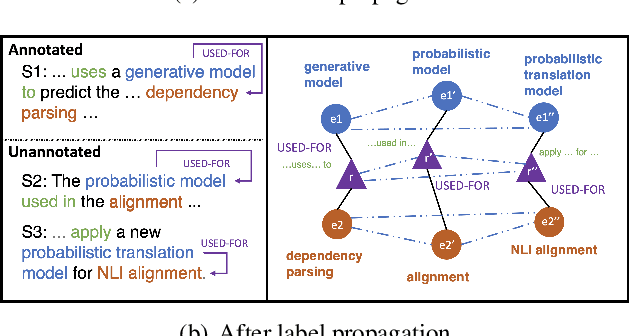

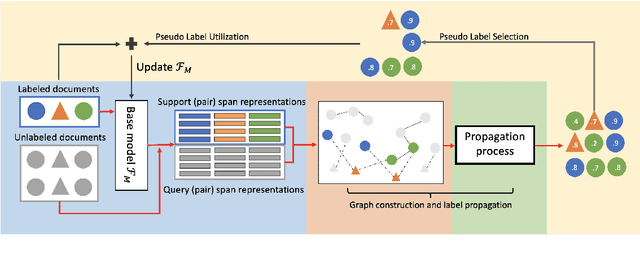
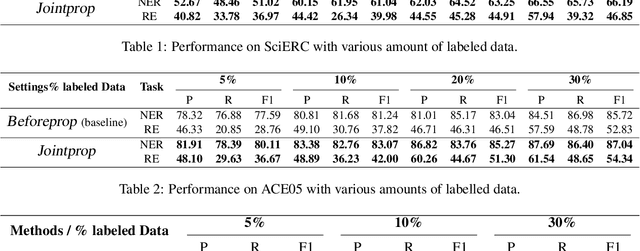
Semi-supervised learning has been an important approach to address challenges in extracting entities and relations from limited data. However, current semi-supervised works handle the two tasks (i.e., Named Entity Recognition and Relation Extraction) separately and ignore the cross-correlation of entity and relation instances as well as the existence of similar instances across unlabeled data. To alleviate the issues, we propose Jointprop, a Heterogeneous Graph-based Propagation framework for joint semi-supervised entity and relation extraction, which captures the global structure information between individual tasks and exploits interactions within unlabeled data. Specifically, we construct a unified span-based heterogeneous graph from entity and relation candidates and propagate class labels based on confidence scores. We then employ a propagation learning scheme to leverage the affinities between labelled and unlabeled samples. Experiments on benchmark datasets show that our framework outperforms the state-of-the-art semi-supervised approaches on NER and RE tasks. We show that the joint semi-supervised learning of the two tasks benefits from their codependency and validates the importance of utilizing the shared information between unlabeled data.