 Add to Chrome
 Add to Firefox
 Add to Edge
Trustworthy Protein-Ligand Binding Affinity Prediction via Reliability-Aware Multi-Engine Fusion
Jul 20, 2026
Accurate protein-ligand binding affinity prediction is central to computational drug discovery, yet modern docking engines frequently disagree without indicating which prediction to trust. Consensus scoring and ensemble methods improve mean accuracy but treat all predictions identically without interpretable confidence measures or uncertainty decomposition, ignoring the chemical context of each protein-ligand pair. To address this limitation, we introduce RELIABLE-BA (RELIABiLity-aware Evidential fusion for Binding Affinity), an evidential framework for multi-engine binding affinity prediction. Our model comprises three steps: (1) modeling each engine as an evidential expert via Normal-Inverse-Gamma distributions, (2) scaling epistemic uncertainty through learned reliability from molecular context while preserving each expert's predictive mean, and (3) fusing experts through closed-form aggregation that captures both individual uncertainty and inter-engine disagreement. Experiments on the PDBBind and BDB2020+ benchmarks demonstrate competitive point prediction with substantially improved uncertainty calibration, and additional validation on the SARS-CoV-2 Mpro dataset and 5HT2A receptor demonstrates applicability to clinically relevant drug targets. Crucially, these uncertainty estimates enable reliable filtering of protein-ligand pairs, reducing prediction error by up to 25% when retaining only high-confidence pairs. To our knowledge, RELIABLE-BA is the first multi-engine binding affinity prediction framework to combine evidential fusion with context-dependent reliability, offering a principled path toward trustworthy AI-guided drug discovery. Our code is publicly available at https://github.com/yongchand/RELIABLE-BA.

SkillFlow: Flow-Driven Recursive Skill Evolution for Agentic Orchestration
May 13, 2026In recent years, a variety of powerful LLM-based agentic systems have been applied to automate complex tasks through task orchestration. However, existing orchestration methods still face key challenges, including strategy collapse under reward maximization, high gradient variance with opaque credit assignment, and unguided skill evolution whose decisions are typically made by directly prompting an LLM to judge rather than derived from principled training signals. To address these challenges, we propose SkillFlow, a flow-based framework that takes a trainable Supervisor as the agent and a structured environment with dynamic skill library and frozen executor, automating task orchestration through multi-turn interaction. SkillFlow employs Tempered Trajectory Balance (TTB), a regression-based flow-matching loss that samples trajectories proportional to reward, preserving diverse orchestration strategies rather than collapsing to a single mode. The same flow objective yields a jointly learned backward policy that provides transparent per-step credit assignment at zero additional inference cost. Building on these flow diagnostics, a recursive skill evolution mechanism determines when to evolve, what skills to create or prune, and where decision gaps lie -- closing the loop from training signal to autonomous capability growth. Experimental results on 14 datasets show that SkillFlow significantly outperforms baselines across question answering, mathematical reasoning, code generation, and real-world interactive decision making tasks. Our code is available at https://anonymous.4open.science/r/SkillFlow-E850.
BenchBench: Benchmarking Automated Benchmark Generation
Mar 21, 2026Benchmarks are the de facto standard for tracking progress in large language models (LLMs), yet static test sets can rapidly saturate, become vulnerable to contamination, and are costly to refresh. Scalable evaluation of open-ended items often relies on LLM judges, introducing additional sources of bias and prompt sensitivity. We argue that evaluation must extend beyond how well models answer benchmarks to how well models design them. We introduce BenchBench, a three-stage pipeline and dataset for benchmarking automated benchmark generation: (i) extract structured domain cards from seed benchmarks, (ii) prompt multiple designer LLMs to generate quota-controlled suites, and (iii) validate items with a multi-model answerer panel using exact/numeric/symbolic verifiers when possible and rubric-guided judging otherwise, yielding designer--answerer matrices with item-level quality flags and psychometric diagnostics. Across nine variants spanning computer science, mathematics, medicine, and theory-of-mind reasoning (including multilingual and multimodal settings), we generate 16.7K items, retain ~15K core items post-filtering, and produce ~152K graded model--item responses. BenchBench shows that benchmark-design ability is only moderately correlated with answer-time strength (Spearman rho ~0.37), invalidity is negatively associated with discrimination (Pearson r~0.62), and the resulting designer--answerer matrices enable scalable audits of format/modality/language fidelity and suite-dependent self/family interactions. The project is available at: https://github.com/koanatakiyo/BenchBench.
A Heterogeneous Graph Based Framework for Multimodal Neuroimaging Fusion Learning
Oct 16, 2021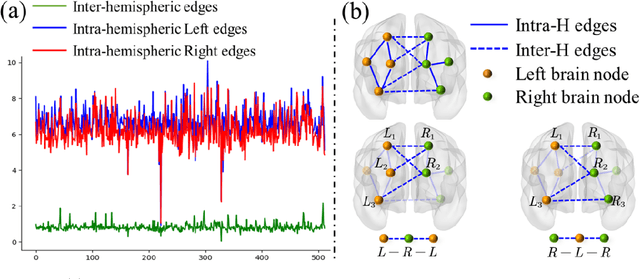
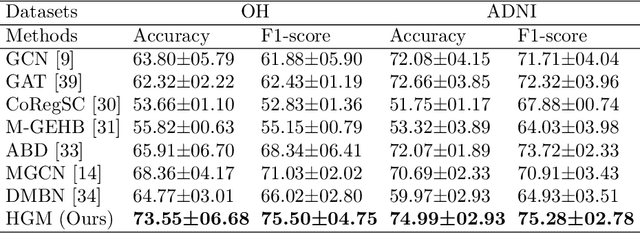
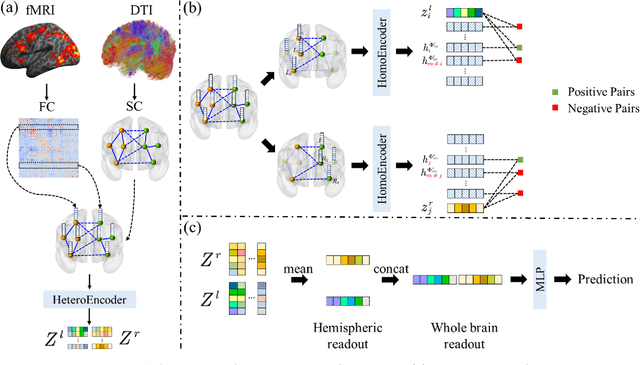
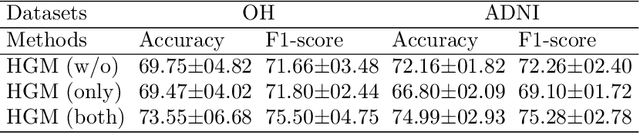
Here, we present a Heterogeneous Graph neural network for Multimodal neuroimaging fusion learning (HGM). Traditional GNN-based models usually assume the brain network is a homogeneous graph with single type of nodes and edges. However, vast literatures have shown the heterogeneity of the human brain especially between the two hemispheres. Homogeneous brain network is insufficient to model the complicated brain state. Therefore, in this work we firstly model the brain network as heterogeneous graph with multi-type nodes (i.e., left and right hemispheric nodes) and multi-type edges (i.e., intra- and inter-hemispheric edges). Besides, we also propose a self-supervised pre-training strategy based on heterogeneou brain network to address the overfitting problem due to the complex model and small sample size. Our results on two datasets show the superiority of proposed model over other multimodal methods for disease prediction task. Besides, ablation experiments show that our model with pre-training strategy can alleviate the problem of limited training sample size.
Deep Open Snake Tracker for Vessel Tracing
Jul 19, 2021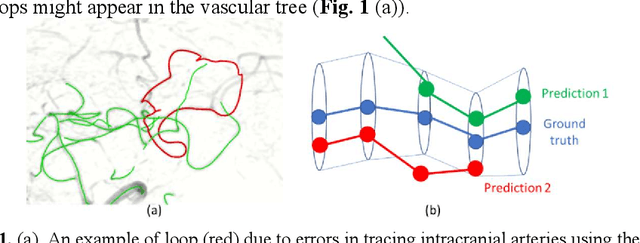
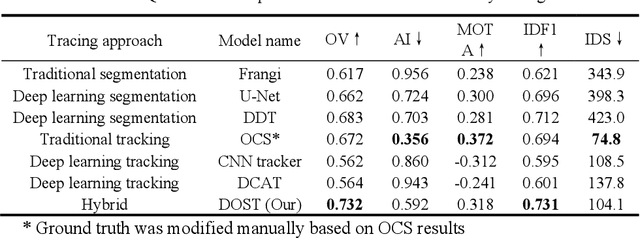
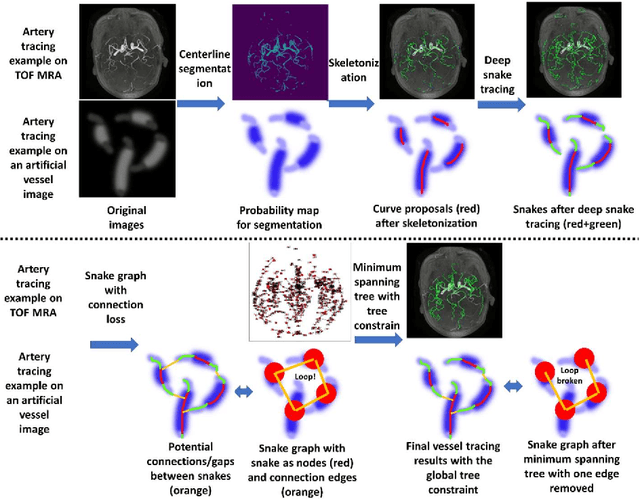
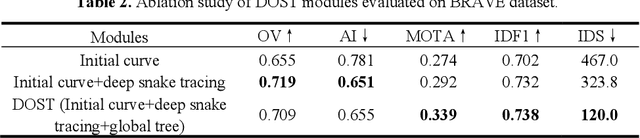
Vessel tracing by modeling vascular structures in 3D medical images with centerlines and radii can provide useful information for vascular health. Existing algorithms have been developed but there are certain persistent problems such as incomplete or inaccurate vessel tracing, especially in complicated vascular beds like the intracranial arteries. We propose here a deep learning based open curve active contour model (DOST) to trace vessels in 3D images. Initial curves were proposed from a centerline segmentation neural network. Then data-driven machine knowledge was used to predict the stretching direction and vessel radius of the initial curve, while the active contour model (as human knowledge) maintained smoothness and intensity fitness of curves. Finally, considering the nonloop topology of most vasculatures, individually traced vessels were connected into a tree topology by applying a minimum spanning tree algorithm on a global connection graph. We evaluated DOST on a Time-of-Flight (TOF) MRA intracranial artery dataset and demonstrated its superior performance over existing segmentation-based and tracking-based vessel tracing methods. In addition, DOST showed strong adaptability on different imaging modalities (CTA, MR T1 SPACE) and vascular beds (coronary arteries).