 Add to Chrome
 Add to Firefox
 Add to Edge
Spatiotemporal-Untrammelled Mixture of Experts for Multi-Person Motion Prediction
Dec 25, 2025
Comprehensively and flexibly capturing the complex spatio-temporal dependencies of human motion is critical for multi-person motion prediction. Existing methods grapple with two primary limitations: i) Inflexible spatiotemporal representation due to reliance on positional encodings for capturing spatiotemporal information. ii) High computational costs stemming from the quadratic time complexity of conventional attention mechanisms. To overcome these limitations, we propose the Spatiotemporal-Untrammelled Mixture of Experts (ST-MoE), which flexibly explores complex spatio-temporal dependencies in human motion and significantly reduces computational cost. To adaptively mine complex spatio-temporal patterns from human motion, our model incorporates four distinct types of spatiotemporal experts, each specializing in capturing different spatial or temporal dependencies. To reduce the potential computational overhead while integrating multiple experts, we introduce bidirectional spatiotemporal Mamba as experts, each sharing bidirectional temporal and spatial Mamba in distinct combinations to achieve model efficiency and parameter economy. Extensive experiments on four multi-person benchmark datasets demonstrate that our approach not only outperforms state-of-art in accuracy but also reduces model parameter by 41.38% and achieves a 3.6x speedup in training. The code is available at https://github.com/alanyz106/ST-MoE.

MIRAM: Masked Image Reconstruction Across Multiple Scales for Breast Lesion Risk Prediction
Mar 10, 2025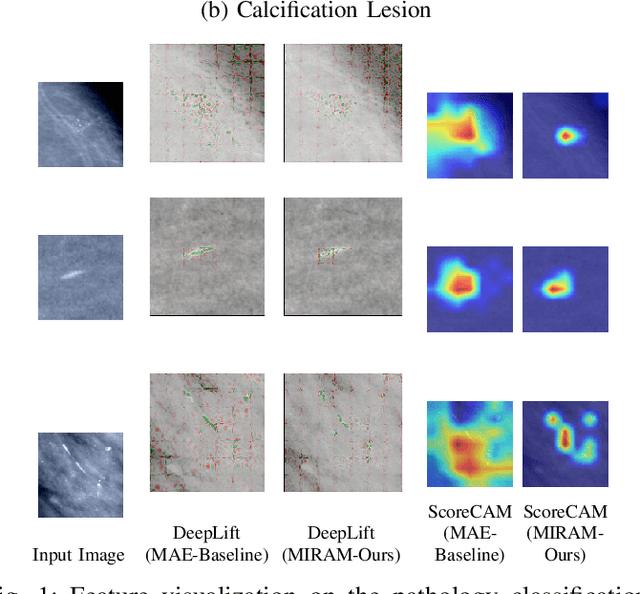
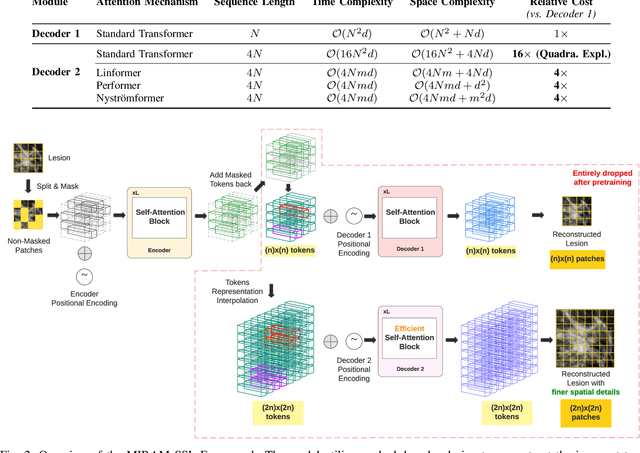
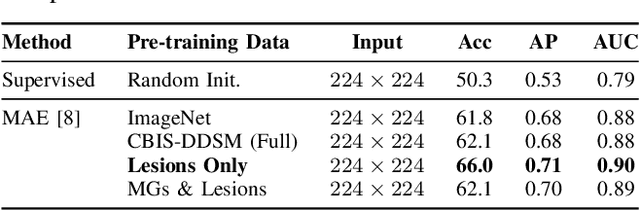
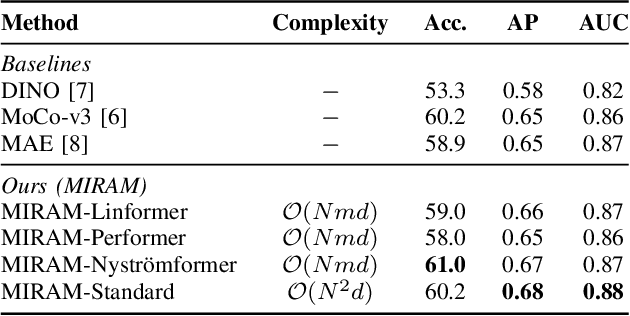
Self-supervised learning (SSL) has garnered substantial interest within the machine learning and computer vision communities. Two prominent approaches in SSL include contrastive-based learning and self-distillation utilizing cropping augmentation. Lately, masked image modeling (MIM) has emerged as a more potent SSL technique, employing image inpainting as a pretext task. MIM creates a strong inductive bias toward meaningful spatial and semantic understanding. This has opened up new opportunities for SSL to contribute not only to classification tasks but also to more complex applications like object detection and image segmentation. Building upon this progress, our research paper introduces a scalable and practical SSL approach centered around more challenging pretext tasks that facilitate the acquisition of robust features. Specifically, we leverage multi-scale image reconstruction from randomly masked input images as the foundation for feature learning. Our hypothesis posits that reconstructing high-resolution images enables the model to attend to finer spatial details, particularly beneficial for discerning subtle intricacies within medical images. The proposed SSL features help improve classification performance on the Curated Breast Imaging Subset of Digital Database for Screening Mammography (CBIS-DDSM) dataset. In pathology classification, our method demonstrates a 3\% increase in average precision (AP) and a 1\% increase in the area under the receiver operating characteristic curve (AUC) when compared to state-of-the-art (SOTA) algorithms. Moreover, in mass margins classification, our approach achieves a 4\% increase in AP and a 2\% increase in AUC.
Multi-hop Commonsense Knowledge Injection Framework for Zero-Shot Commonsense Question Answering
May 10, 2023Commonsense question answering (QA) research requires machines to answer questions based on commonsense knowledge. However, this research requires expensive labor costs to annotate data as the basis of research, and models that rely on fine-tuning paradigms only apply to specific tasks, rather than learn a general commonsense reasoning ability. As a more robust method, zero-shot commonsense question answering shows a good prospect. The current zero-shot framework tries to convert triples in commonsense knowledge graphs (KGs) into QA-form samples as the pre-trained data source to incorporate commonsense knowledge into the model. However, this method ignores the multi-hop relationship in the KG, which is also an important central problem in commonsense reasoning. In this paper, we propose a novel multi-hop commonsense knowledge injection framework. Specifically, it explores multi-hop reasoning paradigm in KGs that conform to linguistic logic, and we further propose two multi-hop QA generation methods based on KGs. Then, we utilize contrastive learning to pre-train the model with the synthetic QA dataset to inject multi-hop commonsense knowledge. Extensive experiments on five commonsense question answering benchmarks demonstrate that our framework achieves state-of-art performance.